Clear Sky Science · en
Echo-coexisting reference channel processing for target detection in passive bistatic radar
Why hidden echoes matter
Modern air-defense and surveillance systems increasingly rely on “passive” radar, which listens to existing radio and TV broadcasts instead of sending out its own powerful pulses. This makes the radar cheaper and harder to detect. But using someone else’s signals comes with a catch: the radar’s own reference channel, which is supposed to contain a clean copy of the broadcast, can secretly include weak reflections from aircraft and other targets. This paper explores how those hidden echoes can mislead the radar, and presents a way to clean them up so that real aircraft stand out while “ghost” detections disappear.
Listening instead of shouting
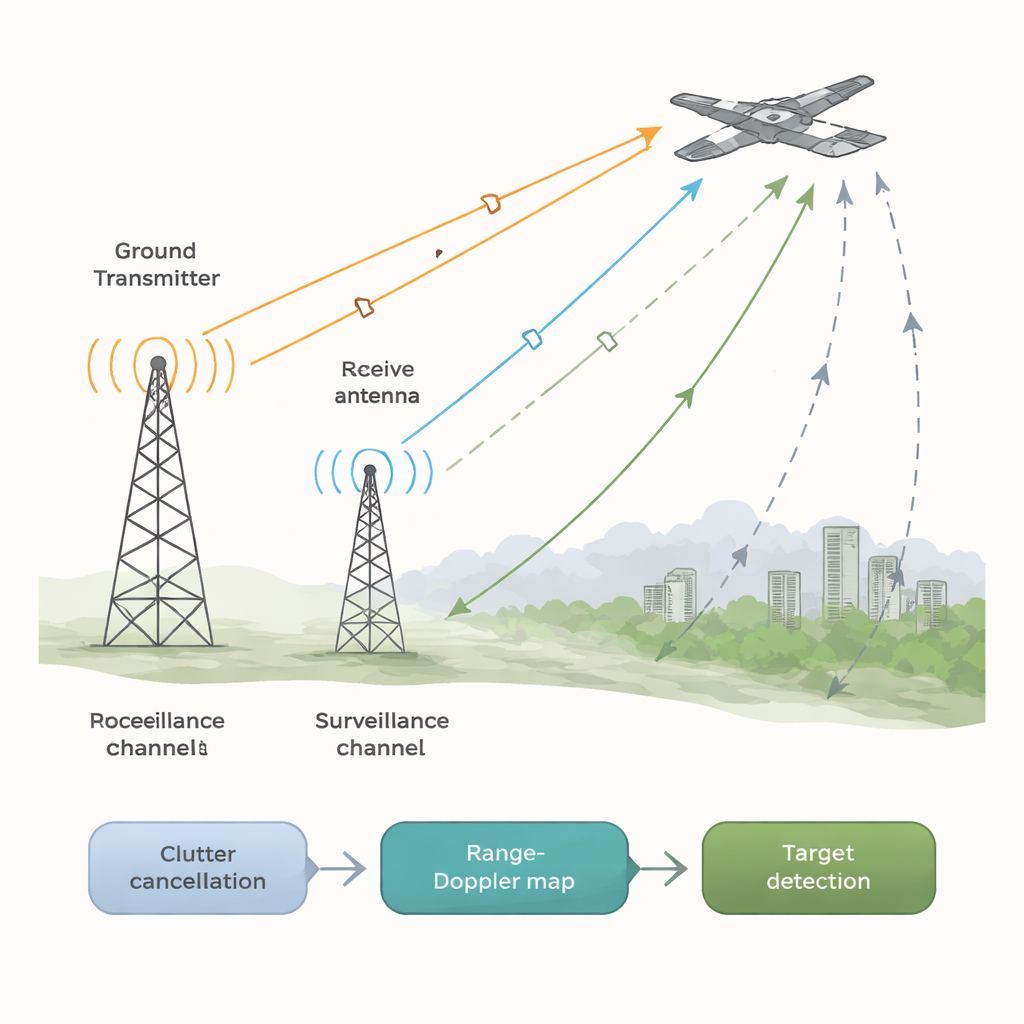
Passive bistatic radar works with at least two listening channels. One, the reference channel, is pointed mainly at the transmitter, such as a digital TV tower or FM radio station, to capture a strong version of the broadcast signal. The other, the surveillance channel, is directed toward the sky to collect echoes from aircraft together with strong unwanted signals, such as the direct broadcast and reflections from buildings, hills and the ground, all grouped under the name “clutter.” Standard processing first tries to subtract this clutter and then forms a range–Doppler map, a two-dimensional picture that shows how far away objects are (range) and how fast they are moving (Doppler shift).
When the clean channel is not clean
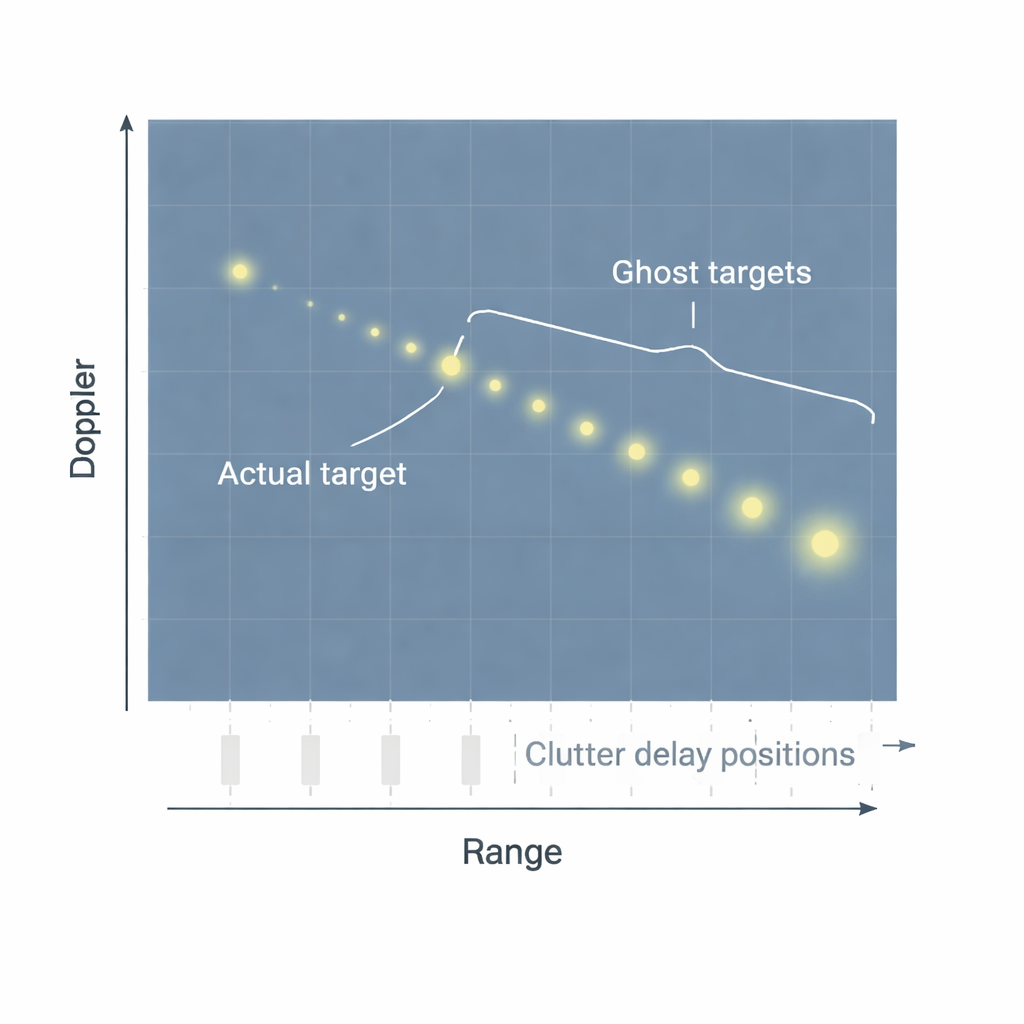
Most earlier methods quietly assume that the reference channel is free of target echoes, or that any target energy there is so tiny it can be ignored. The authors show this is not realistic. Because the reference beam is wide and has significant side lobes, it also picks up aircraft echoes. When these contaminated reference signals are used to cancel clutter and build the range–Doppler map, two bad things happen. First, some of the real target’s strength is accidentally removed, making it harder to detect. Second, a row of extra bright spots appears at the same speed but at different ranges. These are ghost targets: mathematical artefacts created when the unwanted target echo in the reference channel interacts with the multiple reflection paths in the surveillance channel.
Separating real aircraft from their ghosts
The researchers analyze how the usual clutter-cancellation algorithm reshapes the signal when the reference channel carries both the direct broadcast and a target echo. They find that the positions of the ghost targets are not random. In the range–Doppler map, the real target appears first along a Doppler line, and each ghost lies farther away by exactly the same delay as one of the strong multipath reflections. This regular spacing yields a practical rule: when two bright points share nearly the same Doppler but their ranges differ by one of the known clutter delays, the nearer one is the actual target and the farther one is its ghost. Even when the clutter delays are not known in advance, the pattern of weights inside the clutter-cancellation filter reveals which delay gaps to watch for.
Cleaning the reference signal at its source
Instead of trying to erase every ghost spot one by one on the range–Doppler map, the authors propose going back to the source: the extra target echo in the reference channel. Their method uses the already processed residual signal and the learned clutter-cancellation weights to reconstruct what that target echo must look like inside the reference channel. Once this estimated echo is shifted and scaled correctly, it is subtracted from the reference signal, producing a new, “cleaned” reference that no longer carries that target. The system then reruns the clutter cancellation and range–Doppler processing with this cleaned reference. In simulations, the ghost chains vanish, the main peaks for true targets grow noticeably stronger, and targets that were previously buried below the detection threshold become visible.
What this means in practice
For operators of passive radar systems, the study delivers a clear message: treating the reference channel as perfectly clean can lead to missed detections and false alarms caused by ghost tracks. By learning how to spot the geometric pattern of ghosts and then removing the underlying echo from the reference channel, the proposed method restores lost signal power and simplifies the target picture. In everyday terms, it teaches the radar to distinguish a real aircraft from its misleading echoes in a hall of mirrors, making passive radar more reliable for tasks such as air-traffic monitoring and defense surveillance.
Citation: Luo, Z., Che, J. & Ji, F. Echo-coexisting reference channel processing for target detection in passive bistatic radar. Sci Rep 16, 7629 (2026). https://doi.org/10.1038/s41598-026-39039-9
Keywords: passive radar, bistatic radar, ghost targets, clutter cancellation, target detection