Clear Sky Science · en
Experimental study of radiation shielding performance of PbO2-BaO-CaO-B2O3-Y2O3 glass systems
Why safer radiation shields matter
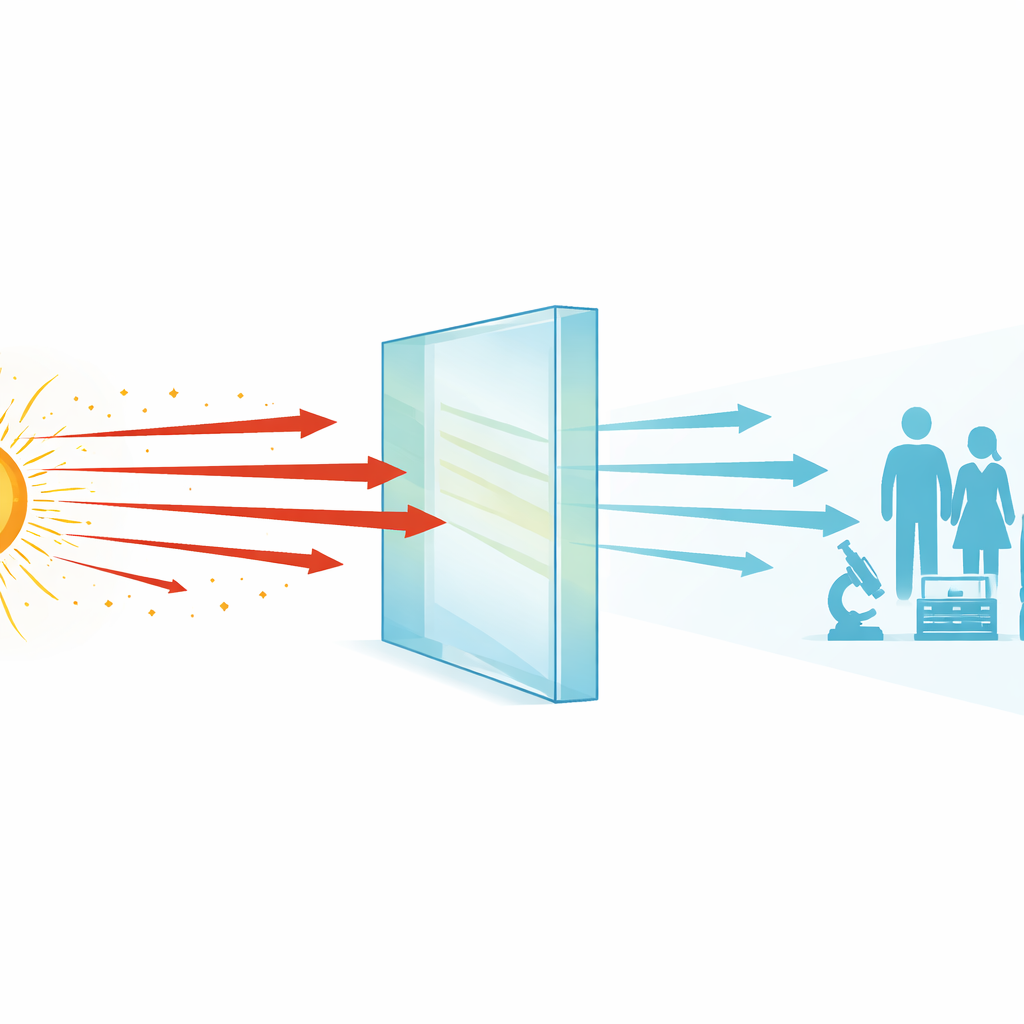
From cancer treatment rooms to airport scanners and nuclear plants, we rely on barriers that quietly soak up harmful radiation while letting people work nearby in safety. Traditional shields made of thick concrete or solid lead can be heavy, opaque, and sometimes toxic. This study explores a different approach: clear, durable glass that can stop powerful gamma rays while still allowing doctors, technicians, and engineers to see what they are doing on the other side.
Building a better protective glass
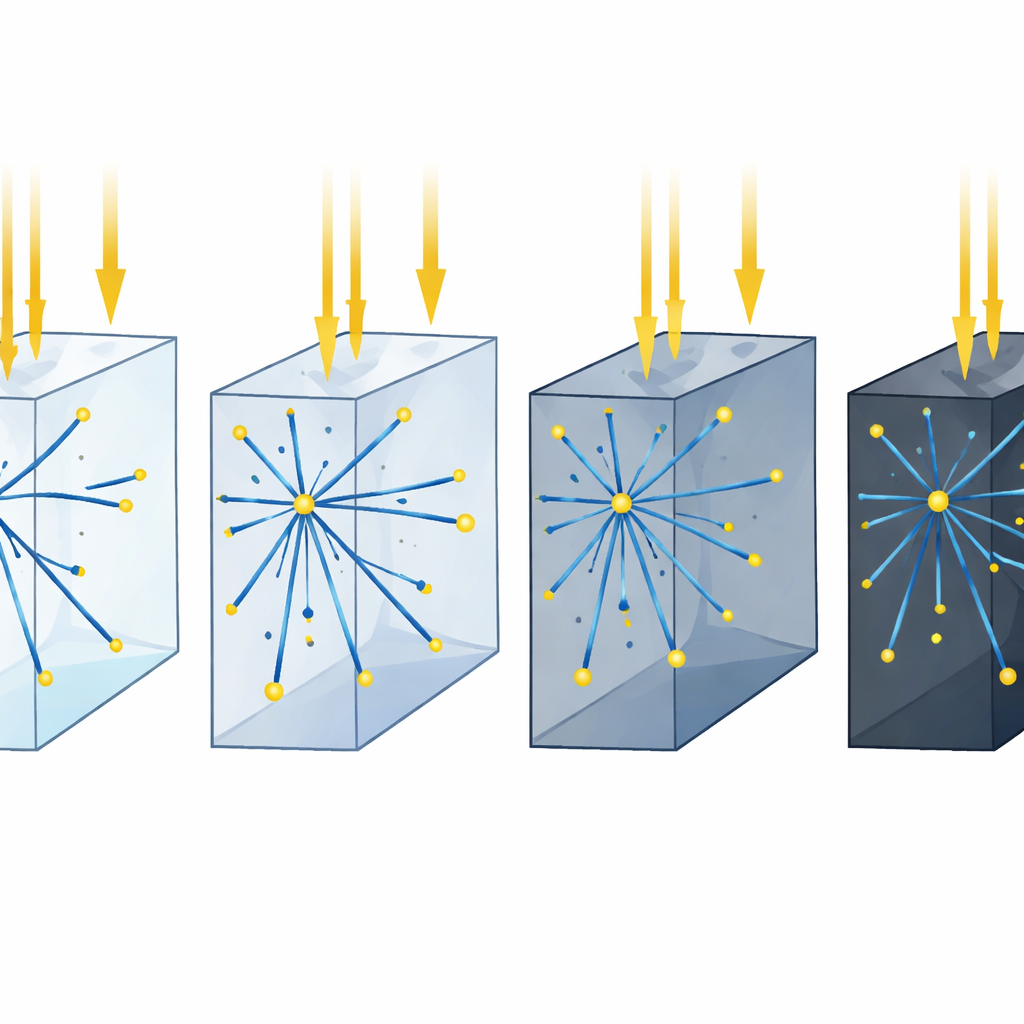
The researchers designed a family of special glasses built from a mix of common glass-forming ingredients and heavier metallic oxides. By carefully adjusting how much lead oxide they added, along with barium, calcium, boron, and a small amount of yttrium oxide, they created four slightly different glass recipes. These were melted in a furnace, stirred for uniformity, then cooled in a controlled way so the final pieces were clear, bubble-free, and mechanically stable. X-ray tests confirmed that all samples remained truly glassy rather than turning partly crystalline, which is important for consistent shielding and optical properties.
Putting the glass between us and the beam
To see how well each glass blocked radiation, the team placed samples between sealed radioactive sources and a highly sensitive detector. These sources emit gamma rays at several distinct energies, ranging from relatively low to very energetic. By measuring how many gamma rays reached the detector with and without glass in place, they could work out how strongly each sample weakened the beam. They also calculated familiar shielding measures such as the “half-value layer” (how much glass is needed to cut the radiation in half) and the “mean free path” (how far a gamma ray travels, on average, before being stopped or deflected).
Comparing real glass with virtual models
To check their measurements, the scientists turned to two independent tools: a widely used online calculator that predicts shielding from the glass recipe, and a detailed computer simulation (Geant4) that tracks countless individual particles as they interact with matter. For each glass type and each gamma-ray energy, they compared the measured blocking power with the predicted values. The agreement was strikingly close—differences were only a few percent or less. This strong match gives confidence that both the experimental setup and the digital models can be used reliably to design and evaluate new shielding materials.
How added lead changes thickness and safety
A clear pattern emerged: as the lead oxide content in the glass increased, the material became better at stopping gamma rays, especially at lower energies where the radiation interacts more strongly with heavy atoms. In practical terms, this means that a thinner piece of the most lead-rich glass is needed to achieve the same protection as a thicker piece of the leaner glass—or of many common concretes, polymers, and even other specialty glasses reported in earlier studies. The most effective composition, called PBCBY-4 in the study, consistently had the smallest half-value layer, the shortest average travel distance for gamma rays, and the lowest fraction of radiation passing through at a given thickness.
What this means for everyday protection
For non-specialists, the bottom line is straightforward: the authors have shown that a carefully engineered, transparent glass can rival or outperform many traditional shielding materials while remaining clear, durable, and relatively compact. Their measurements, backed up by simulations, indicate that the lead- and barium-rich PBCBY-4 glass can stop gamma rays efficiently over a wide range of energies using less thickness than many existing options. In future medical, industrial, and research facilities, such glass could help build viewing windows, protective walls, or instrument housings that provide strong radiation protection without sacrificing visibility or adding unnecessary bulk.
Citation: Elsafi, M., Sayyed, M.I. & Issa, S.A.M. Experimental study of radiation shielding performance of PbO2-BaO-CaO-B2O3-Y2O3 glass systems. Sci Rep 16, 8617 (2026). https://doi.org/10.1038/s41598-026-39038-w
Keywords: radiation shielding glass, gamma ray protection, lead oxide glass, medical radiation safety, Monte Carlo simulation