Clear Sky Science · en
Techno economic and environmental evaluation of second life battery PV hybrid charging stations for sustainable e-mobility in tropical regions
Why cleaner charging matters
Electric cars promise quieter streets and cleaner air, but the way we charge them still often depends on fossil-fueled power plants. This paper explores how sunny, tropical countries can turn old electric-car batteries and rooftop solar panels into low-cost, low-carbon charging stations. Focusing on Malaysia as a real-world example, the researchers show that reusing worn car batteries to store daytime solar power can cut costs, ease pressure on the grid, and shrink climate pollution, all while giving those batteries a useful second life.
Turning old car batteries into a new resource
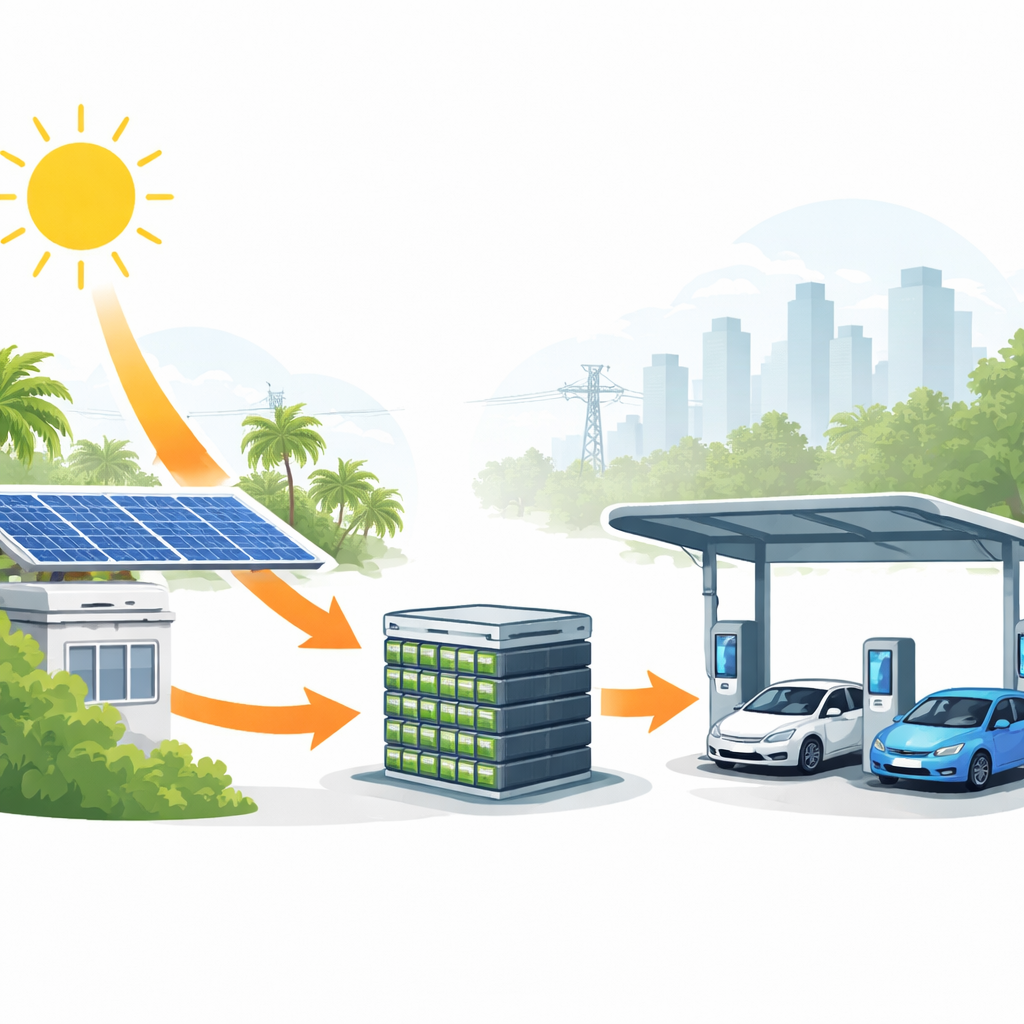
When an electric car battery can no longer deliver the punch needed for driving, it still usually holds around three-quarters of its original capacity. Instead of sending these packs straight to recycling, the team proposes repurposing them for stationary use, where weight and size matter less. In their design, roughly 290 second-life lithium-ion modules are combined into a 50 kilowatt-hour storage unit. This bank sits beside a 15 kilowatt solar array and two AC chargers, creating a compact neighborhood station that can charge about 15 to 20 cars per day using mostly sunshine.
Testing performance under tropical heat
Tropical regions offer abundant sunlight but also high heat and humidity, both of which can accelerate battery wear. To see how repurposed batteries might cope, the researchers tested real modules from a commercial supplier in the lab. Using controlled charge–discharge cycles, they measured capacity and health for 100 cycles. The batteries lost only about 3–4% of their capacity and showed very similar behavior from pack to pack, suggesting predictable, steady aging. These experimentally measured characteristics were then fed into computer models to simulate daily operation in a Malaysian city, capturing both electrical and thermal behavior.
How the solar–battery station actually runs
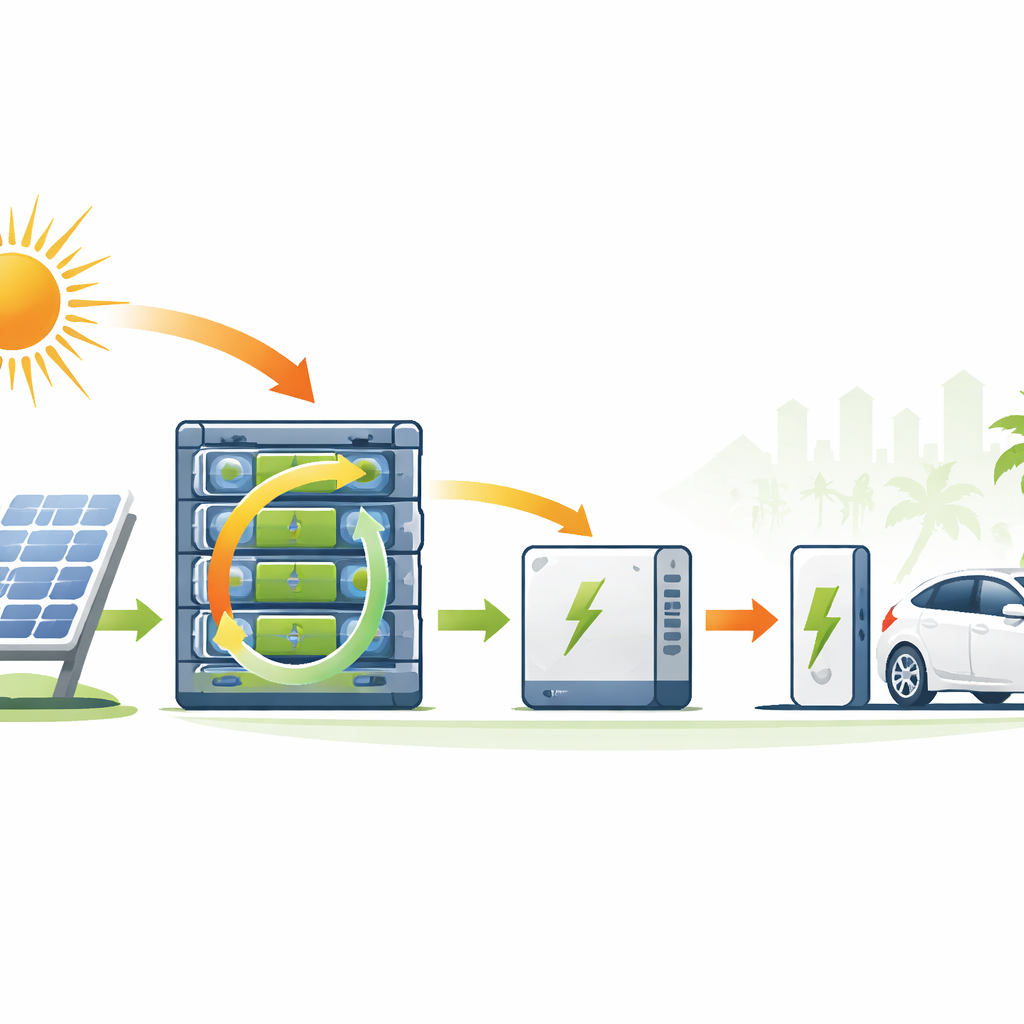
Computer simulations using industry tools traced energy flows hour by hour over many years. The solar panels generate the most electricity around midday, while most drivers plug in during the late afternoon and evening. The second-life battery bank soaks up the excess midday energy and releases it later, smoothing out this mismatch. On average, the system supplies about 90–120 kilowatt-hours of solar-based electricity per day, with around 78% of all charging needs met by local renewable energy rather than the national grid. The models also show that the battery is used regularly but not harshly, helping extend its useful life in this gentler role.
Costs, carbon savings, and key risks
Because the second-life batteries are much cheaper than brand-new packs, the overall investment for the solar-plus-storage station is markedly lower. The study finds that the cost of storing energy drops by about 40% compared with using new batteries, bringing the storage cost down to roughly eight cents per kilowatt-hour. Each station can avoid around 1.2 tons of carbon dioxide emissions per year by replacing grid electricity, even after accounting for uncertain weather and battery aging through thousands of simulated scenarios. At the same time, the authors flag important challenges: keeping battery health above about 70% to maintain reliability, handling heat safely with mostly passive cooling, and creating clear rules and safety standards for reused packs.
What this means for clean travel
For a non-specialist, the takeaway is straightforward: in sunny, growing cities, yesterday’s car batteries can become tomorrow’s clean fuel pumps. By pairing solar panels with repurposed battery packs, the proposed stations provide reliable charging at lower cost, ease strain on the power grid, and cut climate pollution, all while squeezing extra value out of materials that would otherwise be discarded. If supported by smart controls, better cooling, and sensible regulations, this approach could help tropical countries scale up electric vehicles without waiting for massive new power plants—bringing cleaner air and more sustainable mobility within closer reach.
Citation: Sarker, M.T., Hossen, M.S., Ramasamy, G. et al. Techno economic and environmental evaluation of second life battery PV hybrid charging stations for sustainable e-mobility in tropical regions. Sci Rep 16, 8195 (2026). https://doi.org/10.1038/s41598-026-39034-0
Keywords: electric vehicle charging, solar energy, second-life batteries, energy storage, tropical cities