Clear Sky Science · en
Distribution and conservation status of the jungle cat (Felis chaus) across India
Why a little-known wild cat matters
The jungle cat may not be as famous as tigers or leopards, but it quietly shares fields, village edges, and wetlands with millions of people across India. This study asks a deceptively simple question: where, exactly, do these small wild cats live today, and what do they need to survive in a rapidly changing countryside? The answers matter not only for the cats themselves, but also for farmers who benefit from their rodent-hunting habits and for anyone concerned with how wildlife can persist in human-dominated landscapes.
Taking a countrywide wildlife census
To map jungle cats across India, the researchers pulled together an unusually large and varied dataset. They analyzed more than 34 million photographs from over 26,000 camera-trap locations originally set up to count tigers and other large animals. From this “bycatch” they extracted over 26,000 independent jungle cat images. They then added radio-tracking locations from collared cats, carefully verified sightings from scientific papers and reports, and personal field observations. After removing duplicate and clustered records to avoid over‑counting the same individuals, they ended up with 6,151 unique jungle cat locations spanning much of the country. 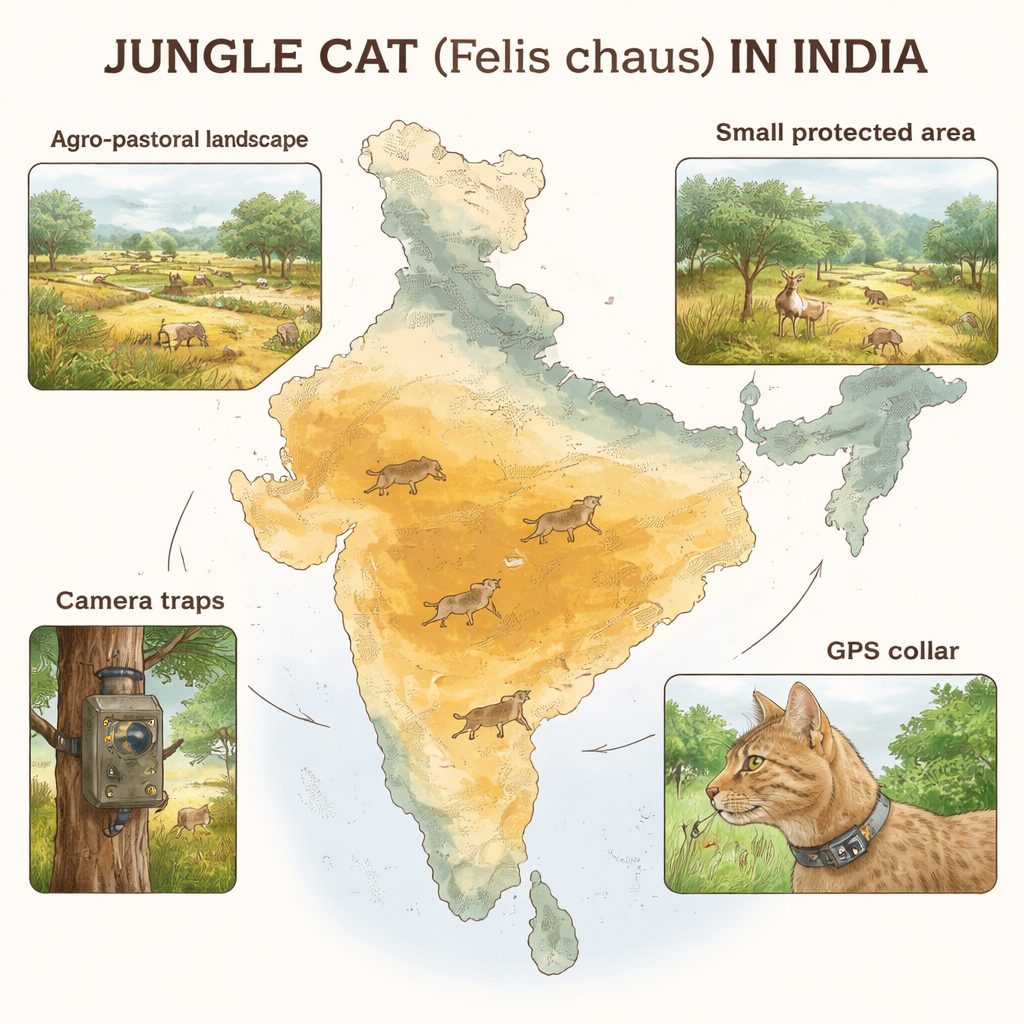
Finding the best places for jungle cats
With this map of locations in hand, the team used two modern computer modeling approaches to ask which environments jungle cats prefer. Both methods—called MaxEnt and Random Forest—compare where animals are found with a suite of environmental factors such as temperature, rainfall, vegetation, livestock numbers, and how heavily people have modified the land. Despite using different mathematical tricks, the two models agreed on the broad picture. Jungle cats are most likely to occur in warm, semi‑arid regions with moderate vegetation cover and low to moderate levels of human activity. They tend to avoid very wet, densely forested landscapes as well as highly built‑up, intensely farmed, or industrialized areas.
Life in the working countryside
The study reveals that jungle cats are specialists of “in‑between” places—grasslands, open scrub, dry deciduous forests, and patchy agro‑pastoral landscapes that sit between wilderness and city. They often use buffer zones and degraded forest edges, and they are recorded both inside protected areas and far beyond park boundaries. Moderate levels of livestock and human presence can even be associated with suitable habitat, likely because grazing and small-scale farming create open, mosaic landscapes rich in rodents and other small prey. However, the same village edges and back roads also bring problems: vehicle collisions, disease and competition from free‑ranging dogs, and the risk of interbreeding with domestic cats, which could dilute jungle cats’ unique genetic identity. 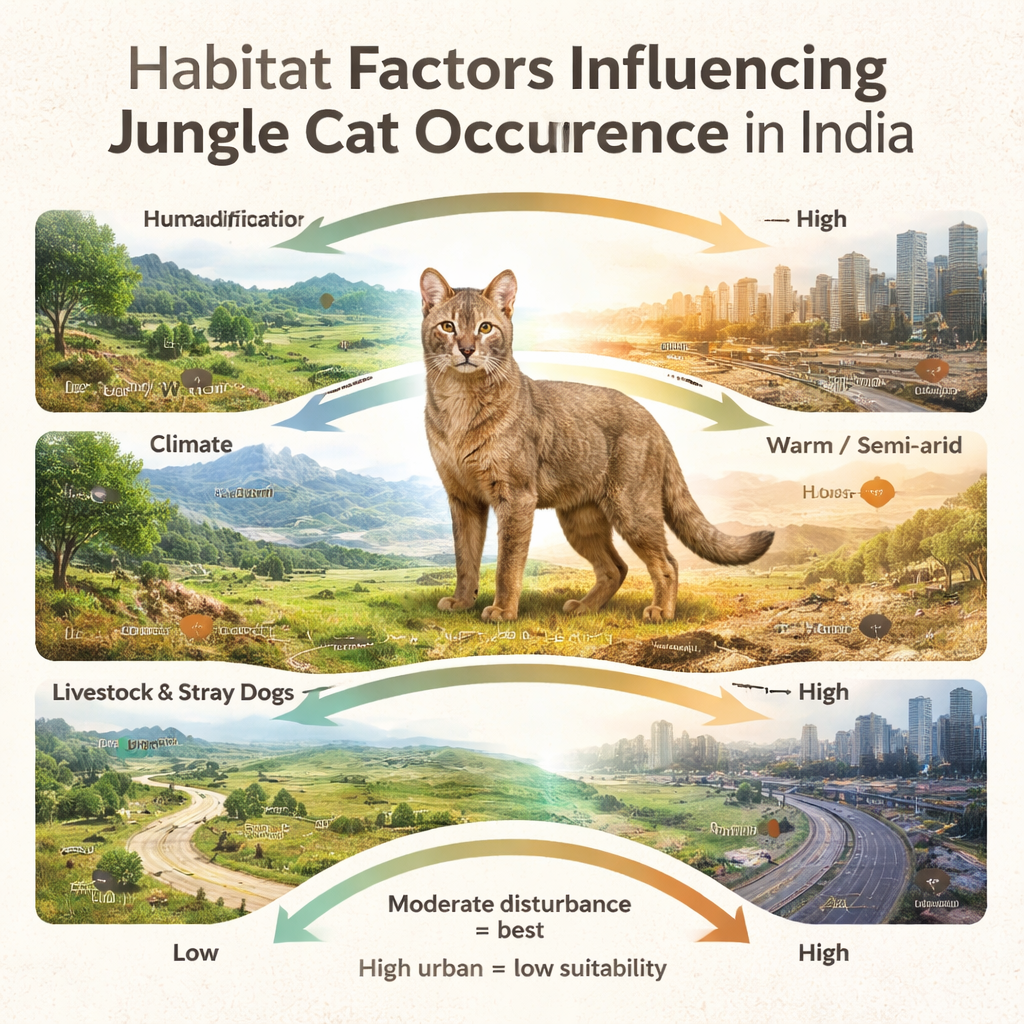
How many jungle cats are left?
To move from habitat maps to population numbers, the researchers combined their nationwide suitability map with information on how much space individual cats use. Using radio‑tracking data from 16 collared animals, they estimated that male jungle cats typically range over about 6–7 square kilometers each year, while females use roughly 2–3 square kilometers. By overlaying these home‑range sizes on the total area predicted to be suitable—about 545,000 square kilometers—they estimated that India may support around 309,000 jungle cats, with wide uncertainty but still a surprisingly large population. The highest numbers are predicted in states such as Madhya Pradesh, Rajasthan, Odisha, and Chhattisgarh, many of which contain extensive semi‑arid and agro‑pastoral landscapes.
Guarding open lands and rural ways of life
Although the jungle cat is officially listed as a species of “Least Concern,” the study shows that its future is closely tied to how India manages its open, working landscapes. Rapid urbanization, expanding roads and railways, increasing numbers of stray dogs, and continuing habitat fragmentation could steadily chip away at the semi‑natural mosaics this species relies on. The authors argue that conserving jungle cats will require more than strengthening national parks. It will mean valuing grasslands, savannas, scrublands, and traditional agro‑pastoral systems; managing stray dog populations and road risks; and integrating small wild cats into larger conservation programs. In doing so, India can protect a quiet but important predator that helps keep rural ecosystems—and the livelihoods that depend on them—healthy and resilient.
Citation: Bandyopadhyay, K., Jain, D., Koprowski, J. et al. Distribution and conservation status of the jungle cat (Felis chaus) across India. Sci Rep 16, 7798 (2026). https://doi.org/10.1038/s41598-026-39033-1
Keywords: jungle cat, India, grassland habitat, agro-pastoral landscapes, small carnivores