Clear Sky Science · en
Bacterial nanocellulose films functionalized with Janus nanoparticles: Preparation and application in chicken meat preservation and safety
Why this matters for your dinner table
Chicken is one of the most popular proteins worldwide, but it spoils quickly and can harbor dangerous germs such as Salmonella. Much of today’s plastic packaging simply wraps meat without actively protecting it. This study explores a new kind of “smart” biodegradable film, made from bacterial nanocellulose and special two-faced particles called Janus nanoparticles, that can actively slow spoilage, fight harmful bacteria, and help keep chicken safer and fresher for longer.
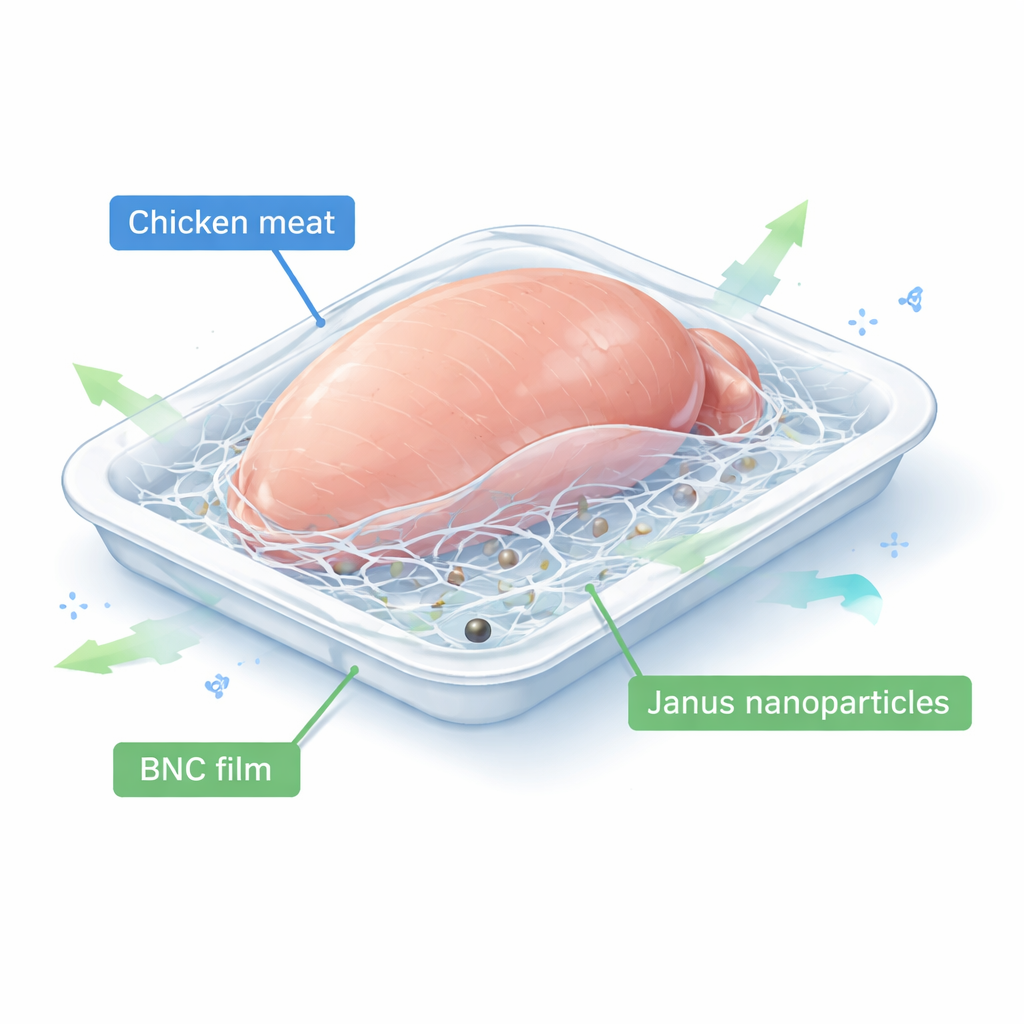
A new kind of natural food wrap
The researchers began with bacterial nanocellulose, a pure, flexible form of cellulose produced by friendly bacteria. It forms thin, transparent, highly porous sheets that are already safe and biodegradable, making them attractive as an alternative to plastic. On their own, however, these sheets do not kill microbes or stop oxidation. To add those abilities, the team incorporated Janus nanoparticles built from a water-loving carbohydrate (carboxymethylcellulose) on one side and tiny water-repelling carbon-based dots on the other. This two-faced design allows the particles to mix well with the wet cellulose film while still being able to interact strongly with bacterial membranes and unstable oxygen-containing molecules that drive rancidity.
Testing safety and structure
Before putting these particles anywhere near food, the scientists evaluated how they affected human cells grown in the lab. They found that only very high nanoparticle levels—far above the amounts planned for the packaging—caused noticeable harm to gastric cancer cells. This suggests that the low levels used in the films should be reasonably safe for food-contact applications, pending formal regulatory review. Using infrared spectroscopy and electron microscopy, the team confirmed that the particles nestled into the nanocellulose network without disrupting its basic fibrous architecture. The treated films became somewhat less strong and stretchy than plain nanocellulose, but they remained robust enough to function as packaging.
Built-in germ fighting and antioxidant power
The modified films were then challenged with Salmonella Typhimurium, a common cause of food poisoning linked to poultry. Even at very low particle loadings (0.01–0.03%), the films produced clear zones where bacteria could not grow, and the size of these zones increased with nanoparticle content. The particles’ hydrophobic side helps them slip into bacterial outer layers, while their highly reactive surfaces can generate oxidative stress that damages vital molecules in the microbes. The same chemical features make the films strong antioxidants: in laboratory tests, plain nanocellulose showed virtually no ability to neutralize free radicals, whereas the Janus-loaded films displayed substantial, dose-dependent radical-scavenging activity.
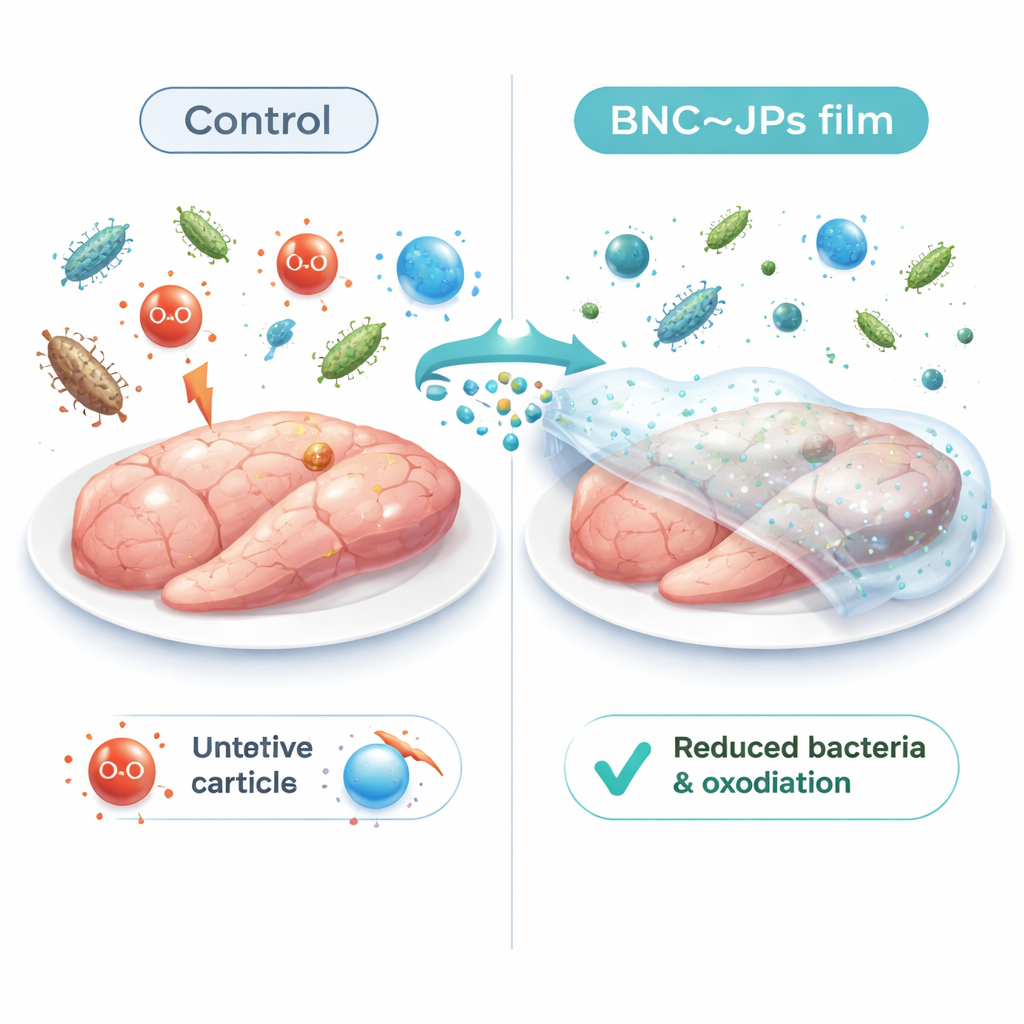
Putting the films to the test on real chicken
The most telling experiments wrapped actual chicken breast pieces in either no film, pure bacterial nanocellulose, or nanocellulose containing different amounts of Janus nanoparticles, and stored them at refrigerator temperature for over two weeks. On chicken deliberately contaminated with Salmonella, the treated films drove bacterial counts down rapidly; by day 16, all nanoparticle-containing films had reduced Salmonella to below detectable levels, while unwrapped and plain-film samples still harbored the pathogen. On regular, non-inoculated chicken, the active films also slowed the growth of general spoilage bacteria by several orders of magnitude compared with controls, and they curbed chemical signs of deterioration, including the build-up of smelly nitrogen compounds and markers of fat oxidation. Sensory panels noted that, after an initial mild vinegary note from the new films, treated meat developed fewer off-odors and maintained more acceptable color and appearance over time.
What this could mean for future food packaging
In simple terms, the study shows that a thin, compostable film can do more than just cover meat: it can actively help protect it. By combining bacterial nanocellulose with cleverly designed Janus nanoparticles, the researchers created a wrap that both attacks dangerous bacteria like Salmonella and slows the chemical reactions that cause rancid smells and color changes. While more work is needed to scale production, confirm long-term safety, and gain regulatory approval, this approach points toward next-generation packaging that could reduce food waste, improve safety, and lessen reliance on conventional plastics in the poultry industry and beyond.
Citation: Alizadeh, N., Moradi, M., Molaei, R. et al. Bacterial nanocellulose films functionalized with Janus nanoparticles: Preparation and application in chicken meat preservation and safety. Sci Rep 16, 7566 (2026). https://doi.org/10.1038/s41598-026-39029-x
Keywords: active food packaging, chicken meat safety, bacterial nanocellulose, Janus nanoparticles, Salmonella control