Clear Sky Science · en
An aquaculture simulator for rainbow trout (Oncorhynchus mykiss) based on a fish schooling behavioral model and a dynamic energy budget
Why simulating fish farms matters
As more of the world’s seafood comes from farms rather than the open ocean, fish farmers face a simple but expensive question: how much should they feed their fish each day? Feed is the single biggest cost in aquaculture, yet testing different feeding plans in real tanks is slow and costly. This study introduces a computer simulator for rainbow trout farming that aims to answer such questions on a screen first, helping farmers fine‑tune feeding strategies, reduce waste, and grow fish more efficiently.
From ocean pens to smart land tanks
Traditional fish farming at sea is running into limits: sheltered coastal areas are already crowded, and uneaten feed and waste can harm surrounding waters. Land‑based tanks avoid many of these issues and offer stable water conditions, but they are expensive to build and run, and feed can account for around 60% of total costs. Because profits depend directly on how fast fish gain weight from the feed they eat, farmers are looking to “smart aquaculture” tools—sensors, cameras, and simulations—that can predict growth under different conditions without having to run long, trial‑and‑error experiments.
Teaching a computer how fish behave
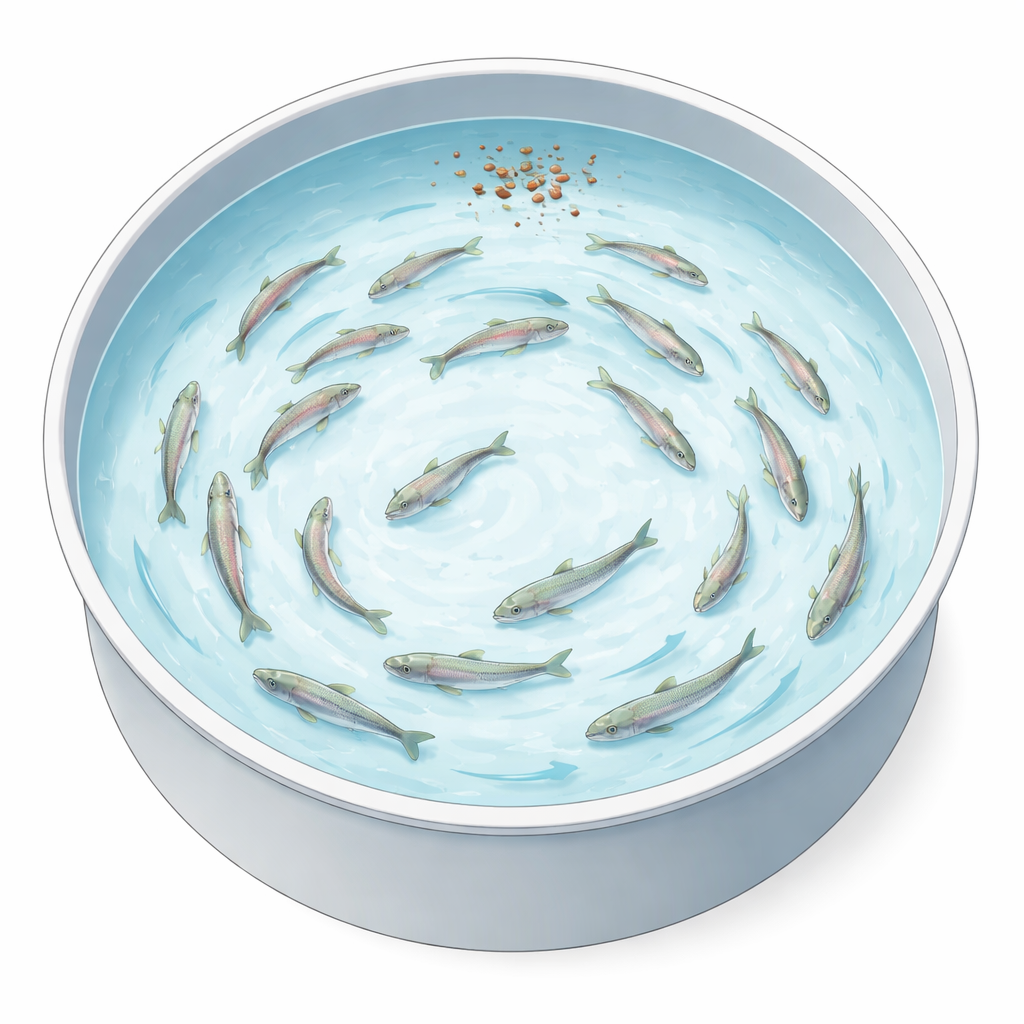
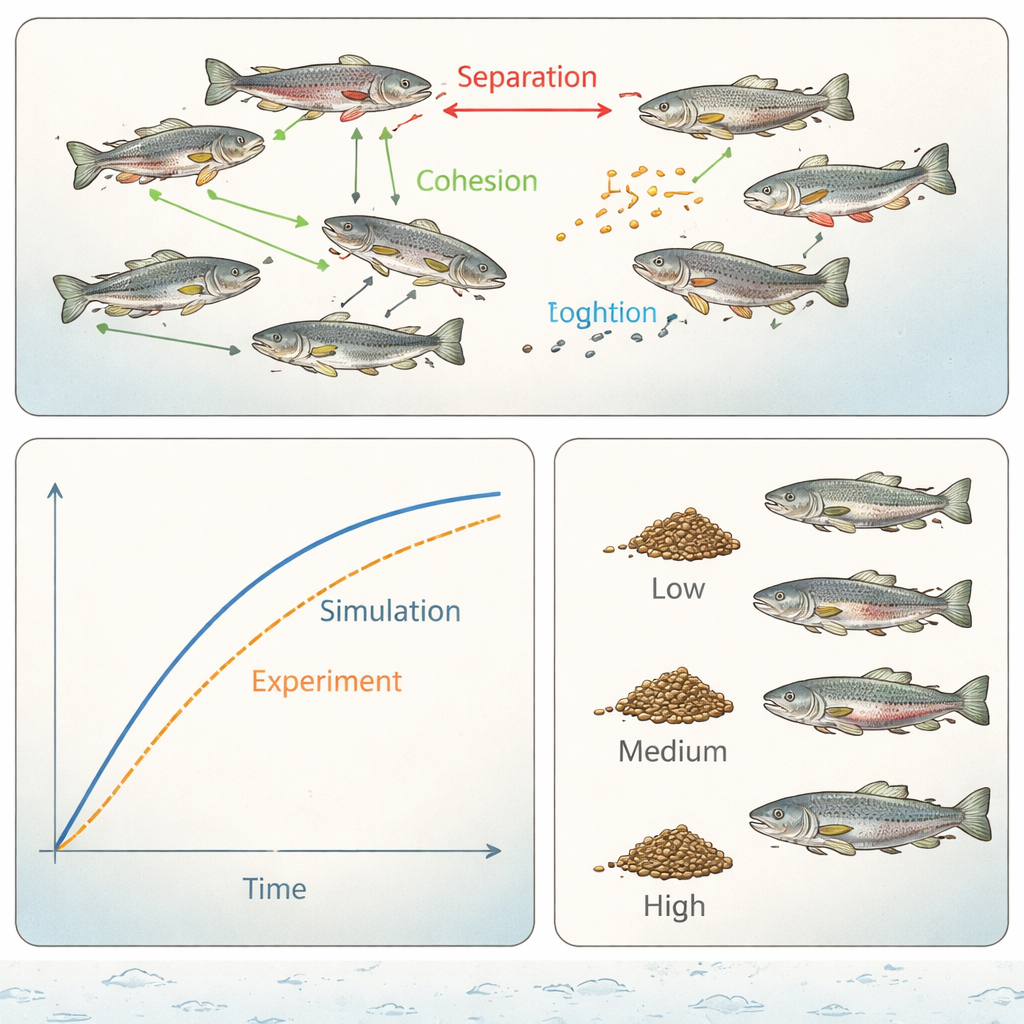
The researchers built their simulator in two main parts. The first part focuses on behavior: how fish swim in groups and rush toward pellets when feed is scattered into the tank. To mimic schooling, the model borrows ideas from computer animation, where “virtual birds” or “boids” follow simple rules—keep some distance, follow the group, and avoid walls. In this study, each trout in the virtual tank reacts to nearby fish, tank boundaries, and sinking pellets. The program calculates where each fish moves every fraction of a second, and counts how many pellets each individual encounters, turning those encounters into that fish’s daily food intake.
Following energy as fish grow
The second part of the simulator tracks what happens to that food inside each fish. Here the team used a framework called a dynamic energy budget, which describes how animals use energy for maintenance and growth. In plain terms, the model asks: of the energy taken in with feed, how much is used just to keep the fish alive, and how much can be invested in getting bigger? By stepping through simulated days, the program predicts each fish’s body weight and length over time. The link between length and weight was calibrated using measurements from real rainbow trout, so that the virtual fish follow realistic size relationships as they grow.
Putting the virtual tank to the test
To check whether the simulator reflects reality, the team ran a 203‑day rearing experiment with hundreds of young rainbow trout in a circular tank. Water temperature was kept steady, and the fish were fed generously while researchers recorded how much feed was eaten each day, along with regular measurements of fish size. They then replayed the same feeding history in the simulator, with the same tank size and number of fish, and compared the computer’s predictions to the actual growth. Early on, virtual and real fish matched closely in both weight and length, and feed conversion—the amount of feed required to gain a unit of weight—was nearly identical. Over longer periods, however, the simulator tended to overestimate body weight and showed more variability among individuals than the real tank.
Exploring different feeding plans
Once validated, even imperfectly, the simulator becomes a sandbox for “what‑if” questions. The researchers tested scenarios where daily feed amounts were reduced to 70% or increased to 130% of the experimental level. As expected, more feed led to bigger fish by day 200. But the efficiency of feed use—the feed conversion ratio—changed with both time and feeding level. In the earliest phase, a moderate feeding level made the best use of feed, while at later stages a slightly higher feeding rate actually gave better efficiency. These patterns suggest that the most economical feeding plan is not fixed, but should adjust with fish size and growth stage, something that can be probed far more easily in silico than in a real facility.
What this means for future fish farming
For non‑specialists, the take‑home message is that the team has created a virtual fish farm where individual trout swim, compete for food, and grow in realistic ways. While the model still needs refinement—such as accounting for crowding effects and oxygen levels—it already reproduces early growth well and can predict how different feeding strategies might play out over months. Tools like this could help aquaculture managers reduce feed waste, plan harvests, and maintain more uniform fish sizes, all while lowering environmental impacts. In time, similar simulators could be adapted to other farmed species, becoming a key part of smarter, more sustainable seafood production.
Citation: Takahashi, Y., Yoshida, T., Yamazaki, Y. et al. An aquaculture simulator for rainbow trout (Oncorhynchus mykiss) based on a fish schooling behavioral model and a dynamic energy budget. Sci Rep 16, 7706 (2026). https://doi.org/10.1038/s41598-026-39028-y
Keywords: aquaculture simulation, rainbow trout, fish feeding, growth modeling, fish farming technology