Clear Sky Science · en
Reduced linguistic coherence in psychosis defies semantic similarity accounts and relates to altered large-scale cortical hierarchy
Why the way we talk matters
Everyday conversation may feel effortless, but it relies on many parts of the brain working together to keep our words on track and make sense to others. In conditions like schizophrenia, this flow of speech can become hard to follow, and clinicians have long used "disorganized" language as a diagnostic clue. With the rise of powerful language-based artificial intelligence, many hoped computers could automatically measure how coherent someone’s speech is, making diagnosis and monitoring more objective. This study asks a simple but crucial question: do popular AI methods actually capture what humans experience as coherent or incoherent speech, and what does disorganized language reveal about how the brain is wired in psychosis?
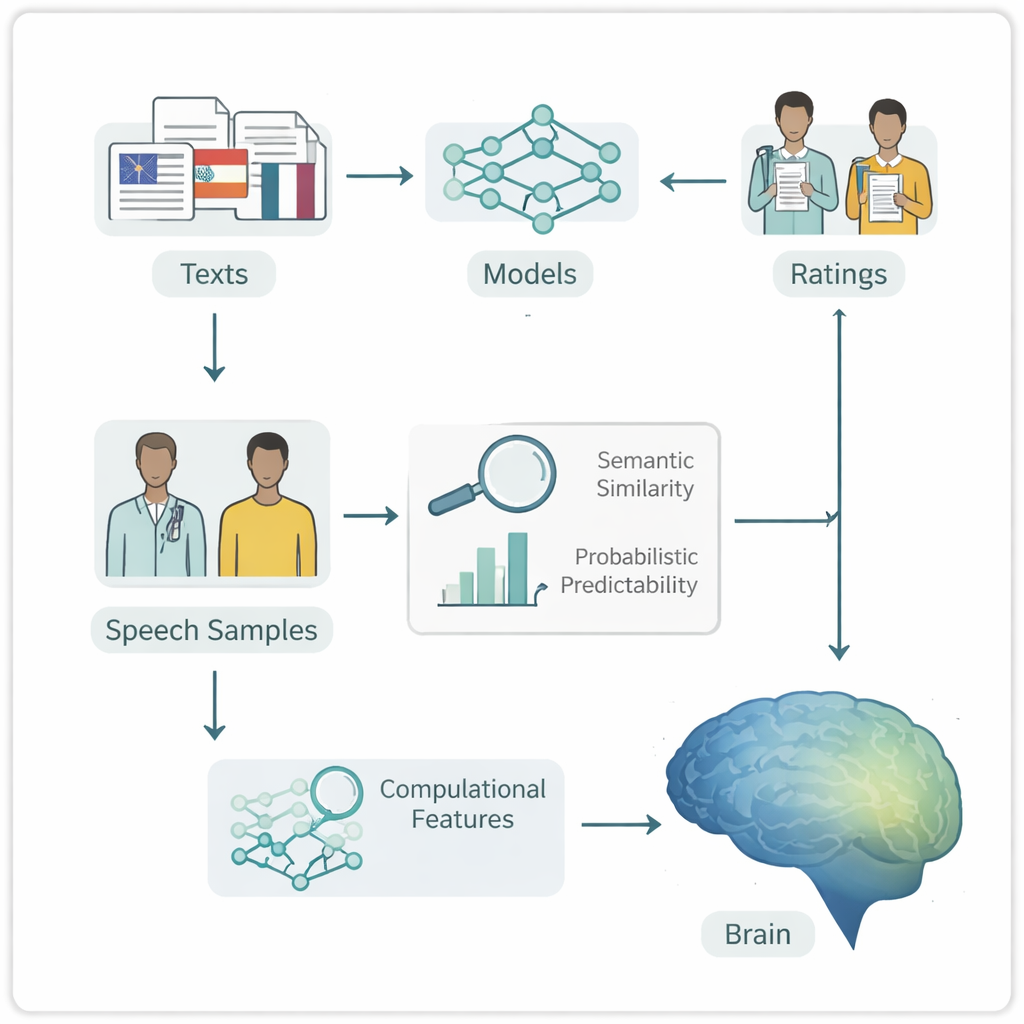
How scientists tried to measure meaning
The researchers assembled three large collections of writing from the general population in English, Chinese, and Danish, where human experts had already rated how coherent each text was. They then used modern language models to turn words, sentences, and short essays into mathematical representations and computed 131 different measures. These included widely used "semantic similarity" scores that estimate how close the meanings of neighboring words or sentences are, as well as newer "probability-based" measures that ask how predictable each next word or sentence is given the preceding context. By comparing all of these numbers to human ratings, they tested which, if any, lined up with our intuitive sense of a text being easy to follow.
What computers missed about coherence
Across all three languages, the answer was sobering. Only six of the 131 measures showed consistent but weak links to human judgments, and none of these were the classic word-to-word semantic similarity scores that dominate current research. In other words, how close in meaning adjacent words are—a common stand-in for coherence—did not reliably tell whether people would find a text understandable. Measures that did perform somewhat better focused on relationships between whole sentences, the overall shape of similarity patterns across a text, and how predictable upcoming words and sentences were. Still, even the best of these correlations were modest, suggesting that coherence is a broad, emergent property of discourse that is hard to capture with any single numerical indicator.
Speech changes along the psychosis spectrum
The team then turned to a clinical cohort of 94 English speakers: healthy volunteers, people at clinical high risk of psychosis, individuals experiencing a first episode of psychosis, and patients with long-standing schizophrenia. All described pictures while their speech was rated for coherence by trained experts. A clear pattern emerged: compared with healthy controls, people in a first episode of schizophrenia showed the strongest drop in coherence, followed by those with chronic illness; the high-risk group showed a milder and statistically uncertain decline. Lower coherence went hand in hand with more severe delusions, unusual thoughts, and disorganized thinking, reinforcing that how someone speaks offers a window into their underlying symptoms.
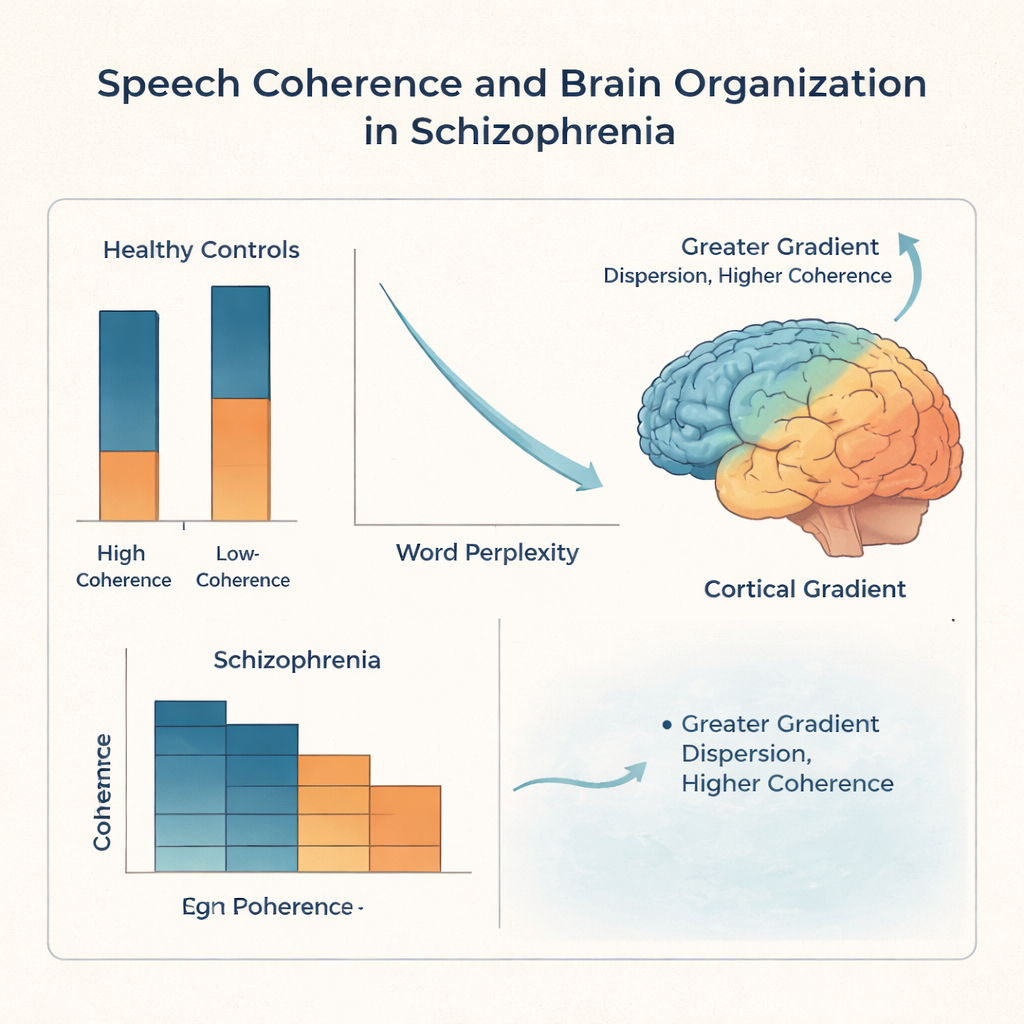
Predictability and brain wiring behind disorganized speech
When the researchers re-applied the most promising computational measures to this clinical speech, they found that word-level unpredictability—captured by a metric called perplexity—was especially informative in first-episode psychosis: the more surprising each word was to the language model, the less coherent human listeners judged the speech to be. In chronic schizophrenia, a different pattern in how sentence meanings were distributed across a narrative related to incoherence. A subset of participants also underwent ultra-high-field MRI scans at rest. Here, the team examined large-scale “gradients” that summarize how brain networks range from basic sensory and motor areas to high-level, internally focused regions such as the default mode network. Individuals whose brains showed a clearer separation—greater dispersion—between these systems tended to produce more coherent speech, suggesting that organizing language depends on a well-structured hierarchy across the cortex.
What this means for future tools and treatment
For non-specialists, the takeaway is twofold. First, speech in schizophrenia really is less coherent in a way that reflects the severity of unusual and disorganized thoughts, and this difference is tied to how large-scale brain networks are arranged. Second, popular shortcuts that treat coherence as simply "how similar neighboring words are" do not match human experience very well. More promising are measures that reflect how predictable the flow of language is and how ideas are organized over sentences, but even these are only partial mirrors of what listeners perceive. To build useful clinical tools, researchers will need richer models that integrate grammar, meaning, and context, and that are informed by how the brain itself coordinates language across its functional hierarchy.
Citation: He, R., Grodzki, R., Altay, N. et al. Reduced linguistic coherence in psychosis defies semantic similarity accounts and relates to altered large-scale cortical hierarchy. Sci Rep 16, 7799 (2026). https://doi.org/10.1038/s41598-026-39025-1
Keywords: schizophrenia, speech coherence, language models, brain connectivity, psychosis