Clear Sky Science · en
Identifying the causal effects of photovoltaic installations on grassland productivity using double machine learning: a case study in inner Mongolia
Solar power meets fragile grasslands
As solar farms spread rapidly across the world, many are being built on dry, delicate grasslands. These open landscapes are important for grazing, wildlife, and storing carbon in soils, but we still know surprisingly little about how rows of solar panels change the health of these ecosystems. This study tackles a simple but pressing question: do large solar installations quietly help grasslands recover, or do they slowly wear them down?
Why scientists worry about sunny plains
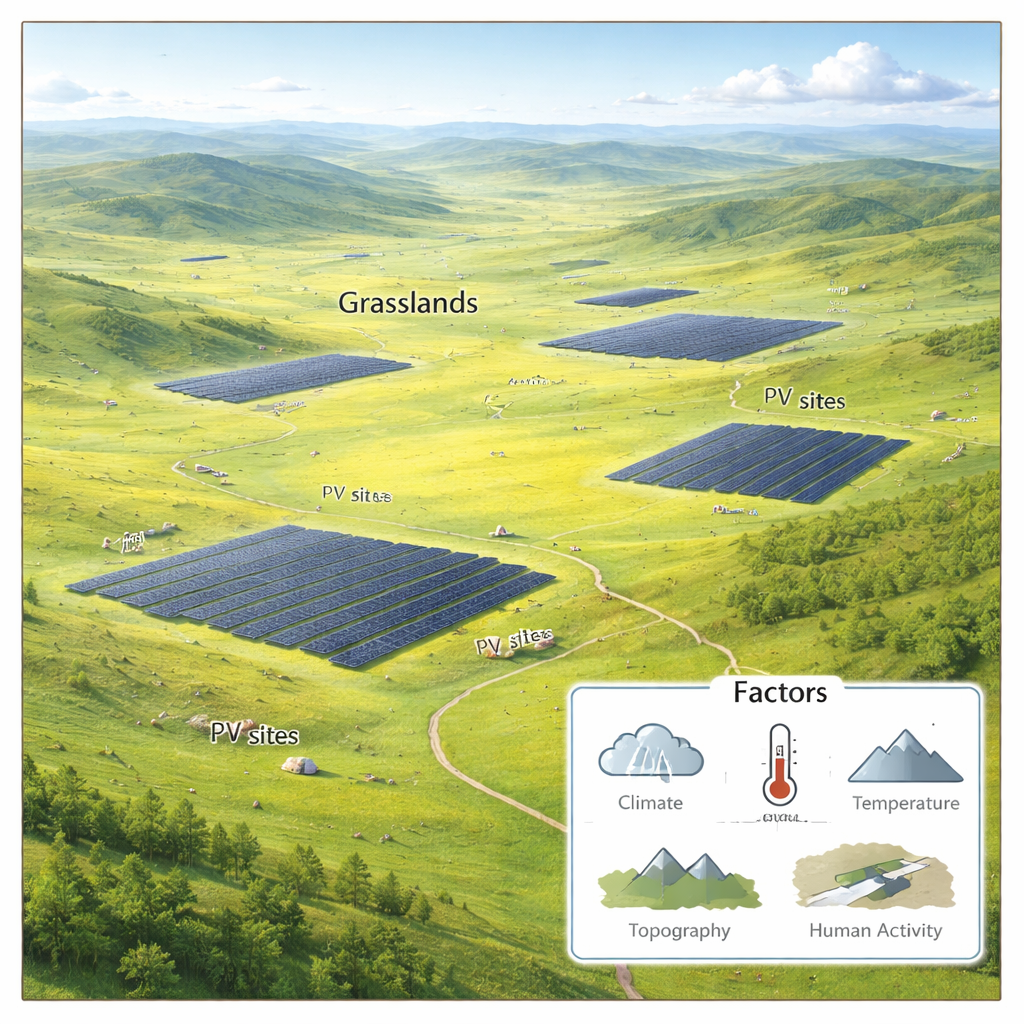
Inner Mongolia in northern China has vast stretches of steppe and meadow that are both ecologically sensitive and attractive for solar power: the land is open, relatively flat, and bathed in sunlight. When thousands of solar panels are added, they do more than generate electricity. They change how much light reaches the ground, how quickly soil dries out, and even how wind and rain move across the surface. Some earlier studies hinted that shade from panels might help plants by saving water, while others warned that blocking rain or light could hurt vegetation. However, most of this work was based on simple correlations, which can be misleading because climate, terrain, and human activity also influence grass growth.
A new way to separate cause from coincidence
To go beyond “what happens together” and get closer to “what causes what,” the authors used a recent statistical approach known as double machine learning. In plain terms, they compared grassland patches that host solar farms with similar patches that do not, while carefully adjusting for many background differences. They combined satellite measurements of plant growth, known as net primary productivity (a measure of how much plant material is produced each year), with detailed data on rainfall, temperature, drought, elevation, soil, and how close each site is to roads, towns, and water bodies. By tracking conditions for five years before and after construction of more than 170 solar sites, they built a kind of large-scale natural experiment over central and eastern Inner Mongolia.
Mixed local outcomes, small overall change
The headline finding is surprisingly modest: on average, solar installations did not significantly change how productive the surrounding grasslands were. Across the whole region, plant growth near solar farms was only slightly lower, and the difference was too small to be sure it was real rather than random noise. But this bland regional average hides a much more interesting story on the ground. At roughly six in ten solar sites, nearby grasslands actually grew a bit better after installation, while a little under four in ten showed declines. In other words, solar power is not inherently good or bad for grasslands; its impact depends heavily on where and how it is built.
Water, heat, and people tip the balance
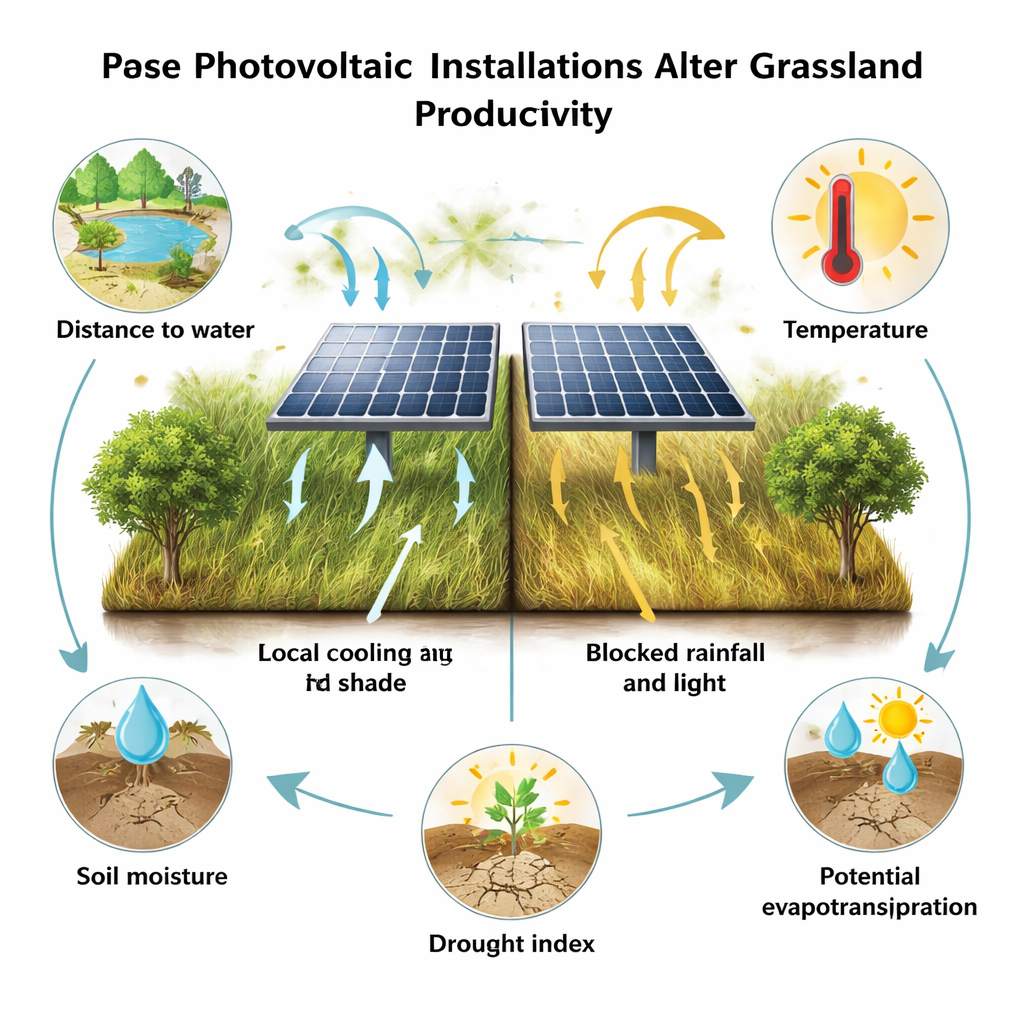
To understand why some sites fared better than others, the team examined which local conditions were most closely linked to these gains or losses. They found that a handful of factors stood out. Solar farms closer to rivers or lakes tended to have more positive effects on grass growth, probably because extra moisture buffers any drying or shading impacts. By contrast, hotter areas with high “thirst” in the air, where evaporation demands are strong, were more likely to see weakened benefits or negative outcomes. Soil moisture and overall drought conditions also mattered, as did how far the sites were from towns and villages: grasslands with less day-to-day human disturbance seemed more responsive and, in many cases, better off. Rather than a single simple rule, the pattern looks like a tug-of-war between shade that can save water and panel structures that can block rainfall and sunlight.
Designing solar farms that work with nature
For non-specialists, the key message is reassuring but nuanced. Building solar farms on grasslands in Inner Mongolia has not, on the whole, devastated plant growth—but neither is it risk-free. The outcome depends on local water availability, heat, soils, and how heavily people use the land. The study shows that with careful site selection and management, it is possible to expand clean energy while keeping grassland ecosystems largely intact, and sometimes even slightly improved. It also warns that in ecologically fragile spots, especially hot and very dry areas, extra care, monitoring, and restoration may be needed to avoid slow, hidden damage beneath the panels.
Citation: Yu, Z., Zhang, Z. & Yuan, R. Identifying the causal effects of photovoltaic installations on grassland productivity using double machine learning: a case study in inner Mongolia. Sci Rep 16, 7526 (2026). https://doi.org/10.1038/s41598-026-39023-3
Keywords: solar farms, grassland ecosystems, photovoltaic development, causal inference, Inner Mongolia