Clear Sky Science · en
Associations of pre-stroke function disability and post-stroke cognitive impairment among older adults in China
Why everyday abilities matter after a stroke
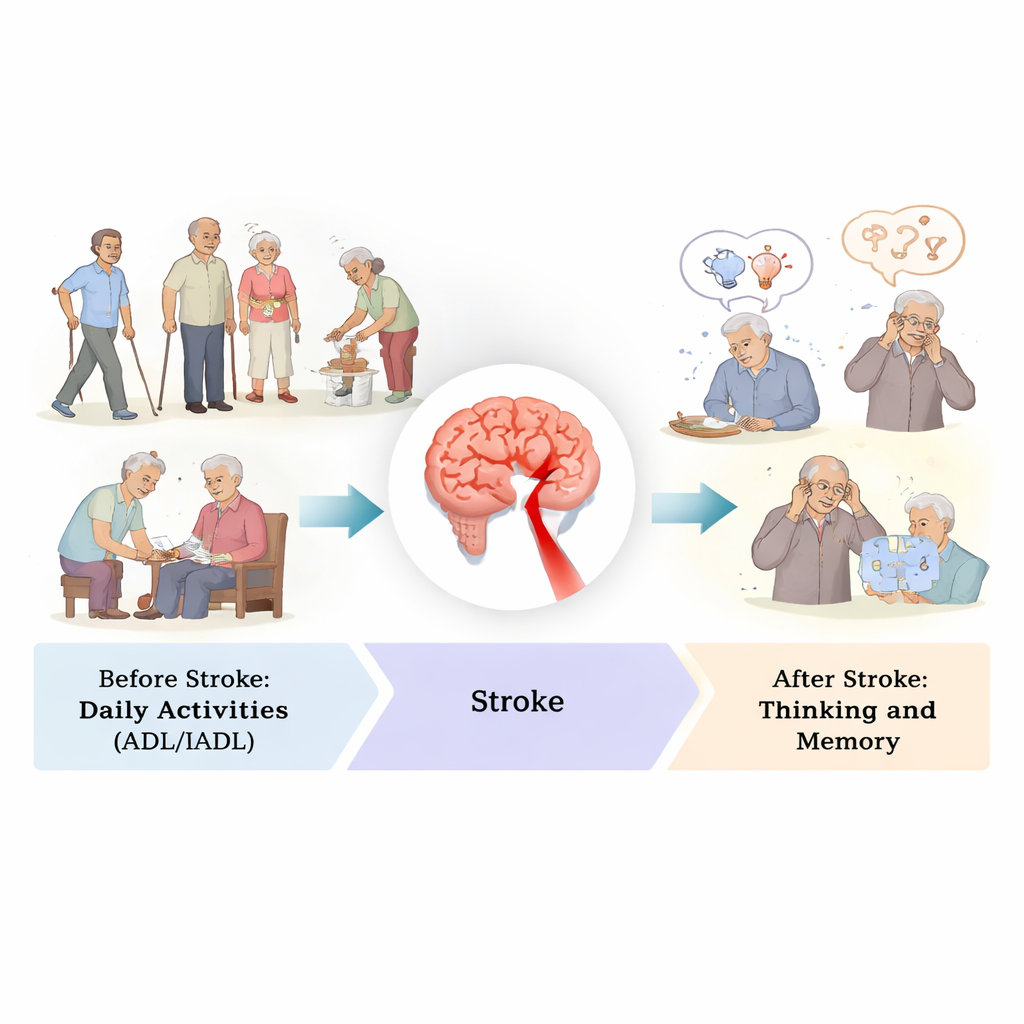
Most people know that stroke can affect movement or speech, but fewer realize it can also quietly erode memory and thinking. This study asks a simple, practical question with big consequences for families: can trouble with everyday tasks—like bathing, shopping, or managing money—years before a stroke warn us who is most likely to have memory problems afterward? Using a large, national survey of middle-aged and older adults in China, the researchers show that early difficulties in daily life are a clear warning sign of later cognitive decline after stroke.
Looking at daily life before stroke
The team drew on data from the China Health and Retirement Longitudinal Study, which regularly interviews adults aged 45 and over across the country. They focused on 404 people who were free of serious thinking problems in 2015, then went on to have a stroke before the 2018 follow-up. Before any strokes occurred, participants reported how easily they managed basic self-care tasks—such as dressing, bathing, eating, getting out of bed, and using the toilet—as well as more complex chores like cooking, shopping, doing housework, taking medicines, and handling finances. Any difficulty or need for help with at least one of these activities counted as a disability in daily living.
Testing memory and thinking after stroke
Three years later, after some of these adults had suffered a stroke, the researchers checked how well their minds were working. They used simple tests that mimic real-world mental challenges: remembering a list of words, copying a shape, telling the correct date and season, and subtracting numbers step by step. Scores from these tasks were combined into an overall measure of cognitive performance. People whose scores fell well below the group average were classified as having cognitive impairment, meaning noticeable trouble with memory and thinking.
Who was at higher risk?
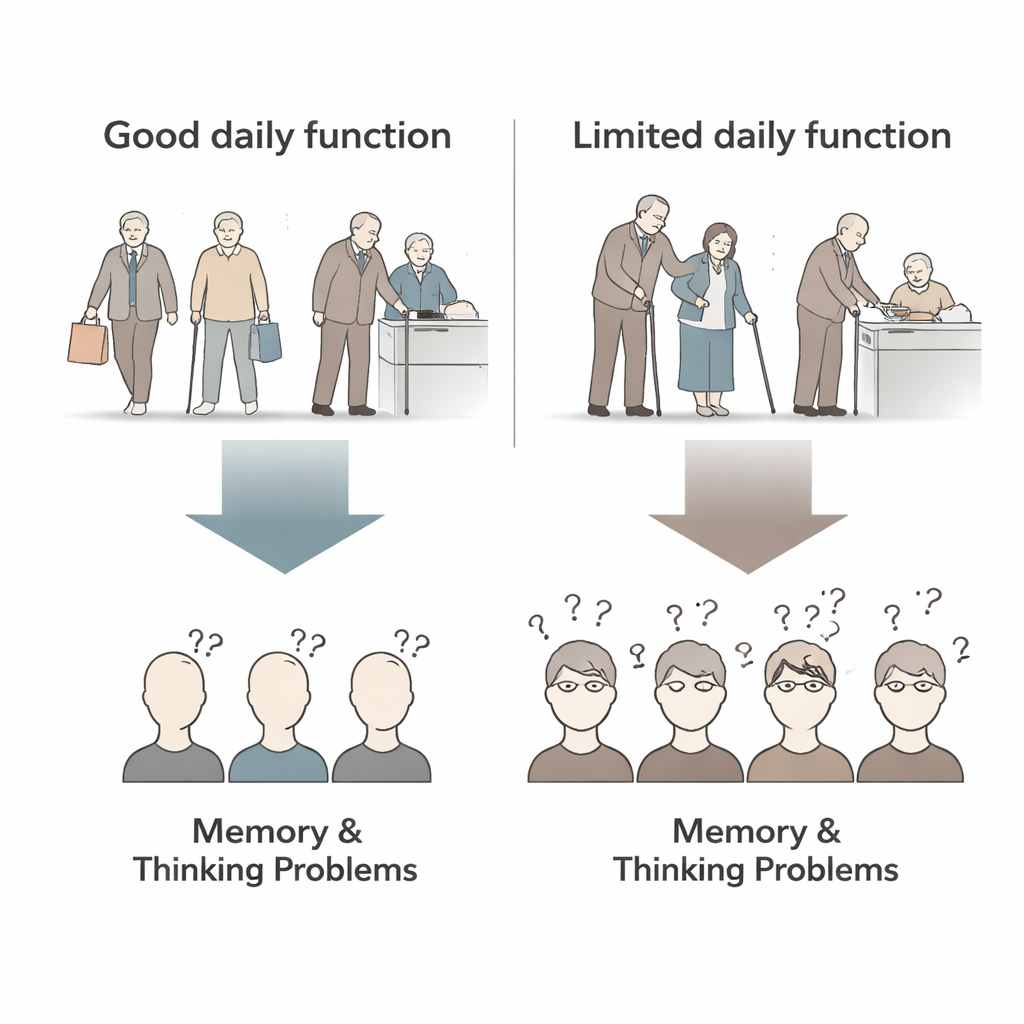
Nearly one in five participants—18.1 percent—showed cognitive impairment after their stroke. Those who had problems with daily tasks before the stroke were much more likely to be in this group. People with basic self-care difficulties had about twice the odds of later cognitive problems, while those struggling with more complex chores had more than three times the odds. Even after taking into account age, sex, smoking and drinking habits, other illnesses, body weight, mood, and earlier thinking scores, limitations in household and community tasks remained a strong predictor of post-stroke cognitive decline. In short, trouble managing everyday life before a stroke signaled a brain that was already more vulnerable.
Unequal risks for women, older adults, and rural residents
The study also revealed who is most at risk within this vulnerable group. Women, people aged 60 and above, residents of rural areas, and those with only primary schooling were especially likely to experience thinking problems after stroke if they already had daily-life limitations beforehand. This pattern suggests that social and economic disadvantages—such as fewer health resources, heavier physical workloads, or limited access to medical care—may amplify the impact of early disability on the brain. The findings echo other research showing that reduced physical ability, slower walking, and weaker grip strength all go hand in hand with later memory decline.
What this means for families and health systems
For non-specialists, the take-home message is straightforward: paying attention to how well older adults manage ordinary tasks can offer an early warning system for brain health. Difficulties with bathing, shopping, or handling money are not just practical inconveniences; they may signal long-standing damage to the blood vessels and wiring of the brain that sets the stage for serious problems after a stroke. By routinely checking these abilities in adults over 45—and offering support such as physical activity programs, rehabilitation, and better control of blood pressure and other conditions—clinicians and families may be able to identify people headed for trouble and intervene earlier to preserve memory and independence.
Citation: Huang, X., Tang, Z. & Xiong, T. Associations of pre-stroke function disability and post-stroke cognitive impairment among older adults in China. Sci Rep 16, 7678 (2026). https://doi.org/10.1038/s41598-026-39018-0
Keywords: stroke, cognitive decline, daily living disability, aging, China