Clear Sky Science · en
The spectral power distribution prediction of LED light source based on Gaussian mathematical model and improved residual network
Why smarter light matters
Most of us now spend our days under LED lighting, whether at home, at work, or on the street. The exact mix of colors in that light—its spectral power distribution, or SPD—affects not only how objects look, but also how our bodies feel and function. It influences color quality, eye comfort, and even our internal clocks. Designing LEDs with precisely tuned spectra is therefore crucial for healthy, pleasant lighting, yet doing so typically requires slow, expensive trial-and-error experiments. This paper presents a way to predict and design LED spectra rapidly and accurately using a blend of physics-based modeling and modern artificial intelligence.
From ingredients to a light fingerprint
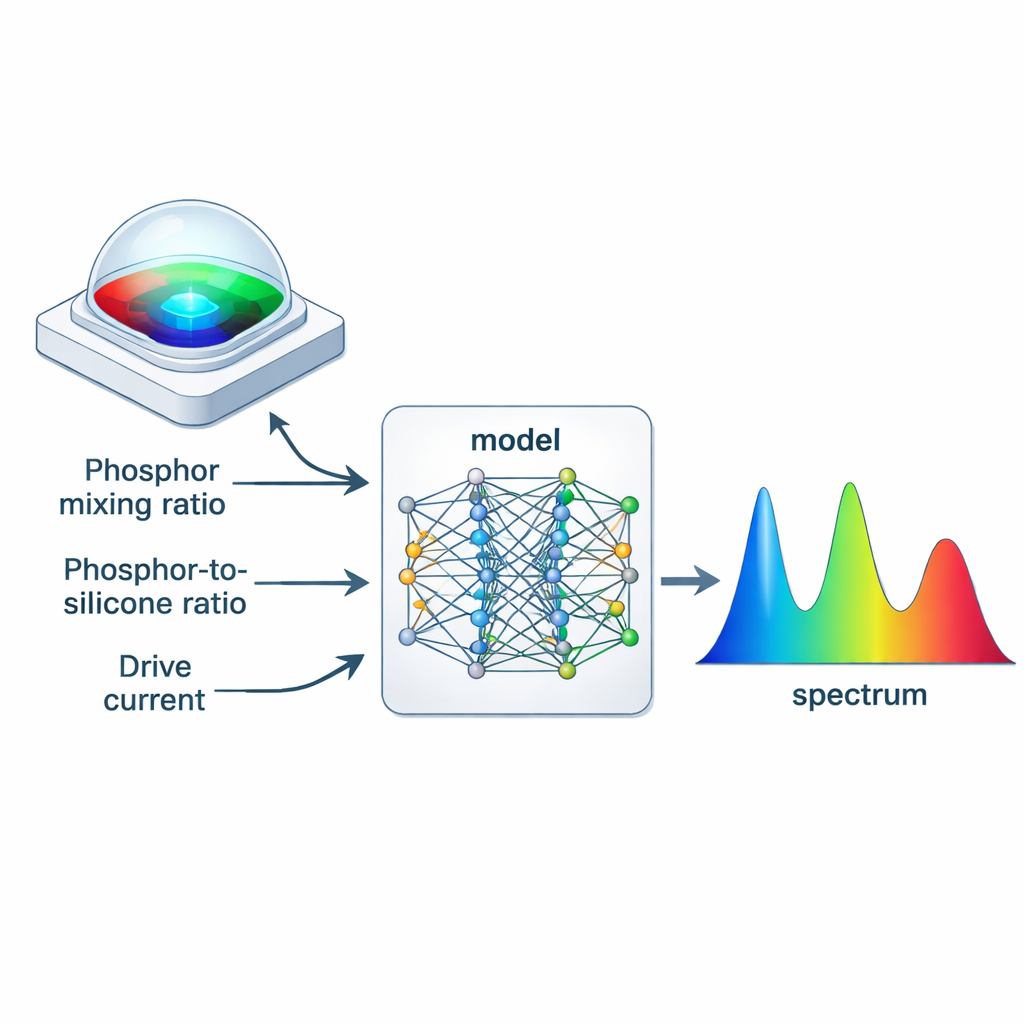
An LED’s spectrum is like its optical fingerprint: it tells you how much light is emitted at each wavelength from violet through red. That fingerprint depends on several “ingredients”: the blue semiconductor chip, one or more light-converting phosphors (often red and green), how much phosphor is mixed into silicone, and the electrical current driving the device. Changing any of these can subtly or strongly reshape the spectrum. Until now, engineers typically had to fabricate many test devices and measure each one to see the effect of a new recipe. The authors instead aim to learn a direct mapping from these controllable ingredients—phosphor amounts, phosphor-to-silicone ratio, and drive current—to the full spectrum, so that new designs can be explored on a computer before a single sample is made.
Describing complex spectra with simple peaks
Rather than predicting hundreds of data points across all wavelengths, the researchers first compress each measured spectrum into just a few meaningful numbers. They approximate the spectrum as the sum of three smooth bell-shaped curves, each described by its height, central color, and width. This mathematical description, based on Gaussian functions, mirrors the main physical emission components: the blue chip, green phosphor, and red phosphor. Using data from real LED packages, they show that three such peaks are enough to recreate the measured spectra with very high fidelity, with a statistical match better than 0.99. This step keeps the essential color information while making the prediction problem much simpler and more interpretable.
Teaching a neural network to read the recipe
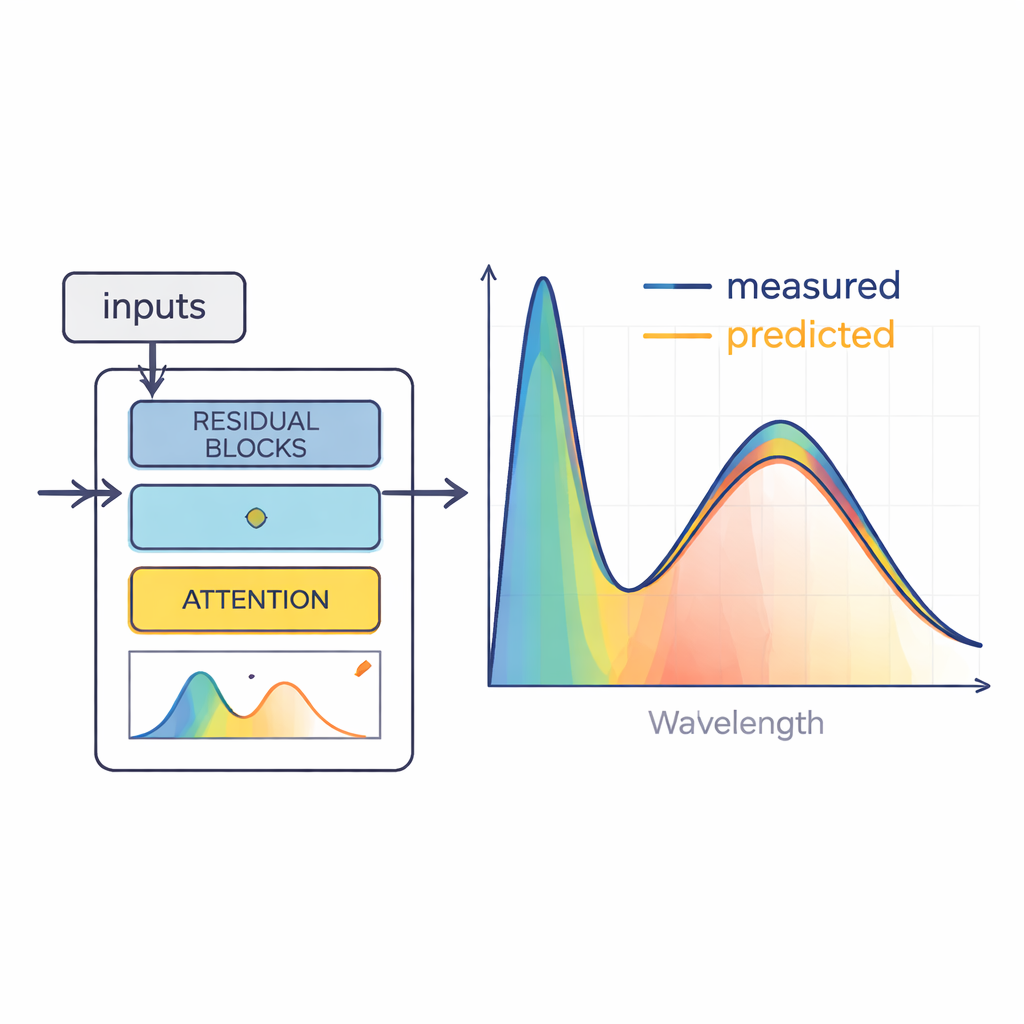
With this compact representation in hand, the team trains neural networks to predict the Gaussian peak parameters directly from the LED recipe. They compare a standard backpropagation network, a deeper residual network (which uses shortcut connections to stabilize learning), and an improved residual network that adds a multi-head attention mechanism. Attention allows the model to focus on how specific inputs, such as blue-chip current or phosphor ratio, interact to shape different parts of the spectrum. The improved network learns from 360 experimentally measured spectra, augmented with carefully designed noise and interpolated samples that mimic real manufacturing variations. It then reconstructs the full spectrum from the predicted peak parameters.
Sharper predictions and reliable color
When tested on LED formulations and operating currents it had never seen before, the improved network produces spectra that overlay the measured curves very closely. It cuts key errors in half compared with the basic residual network and performs substantially better than the conventional neural network and other machine-learning approaches such as support vector machines, decision trees, random forests, and Gaussian process regression. In particular, it is much more accurate at predicting the height of the dominant blue-related peak, which is closely tied to how efficiently blue light is converted into warmer colors. The predicted spectra also yield very small shifts in color coordinates, meaning that the perceived color of the light remains highly faithful to the real device.
What this means for future lighting
For non-specialists, the key outcome is a fast, reliable digital tool that turns LED material recipes and drive currents into realistic spectra in a few thousandths of a second on a standard computer. This could let manufacturers virtually prototype high–color-rendering and health-oriented lighting—adjusting warmth, color fidelity, and potential impacts on sleep and alertness—before building hardware. While the current study focuses on a system with two phosphors and does not yet model long-term aging, the same framework can be extended to more complex mixtures and additional performance targets. In essence, the work shows how combining a simple, physically grounded spectral model with an advanced neural network can greatly accelerate the design of smarter, healthier LED light sources.
Citation: Wu, L., Li, Y., Chen, H. et al. The spectral power distribution prediction of LED light source based on Gaussian mathematical model and improved residual network. Sci Rep 16, 7751 (2026). https://doi.org/10.1038/s41598-026-39015-3
Keywords: LED spectrum, healthy lighting, neural networks, phosphor mixing, spectral design