Clear Sky Science · en
Decentralized optimization for effective coordination of transmission and distribution systems with dynamic DER aggregation
Why Our Power Grid Needs a New Kind of Teamwork
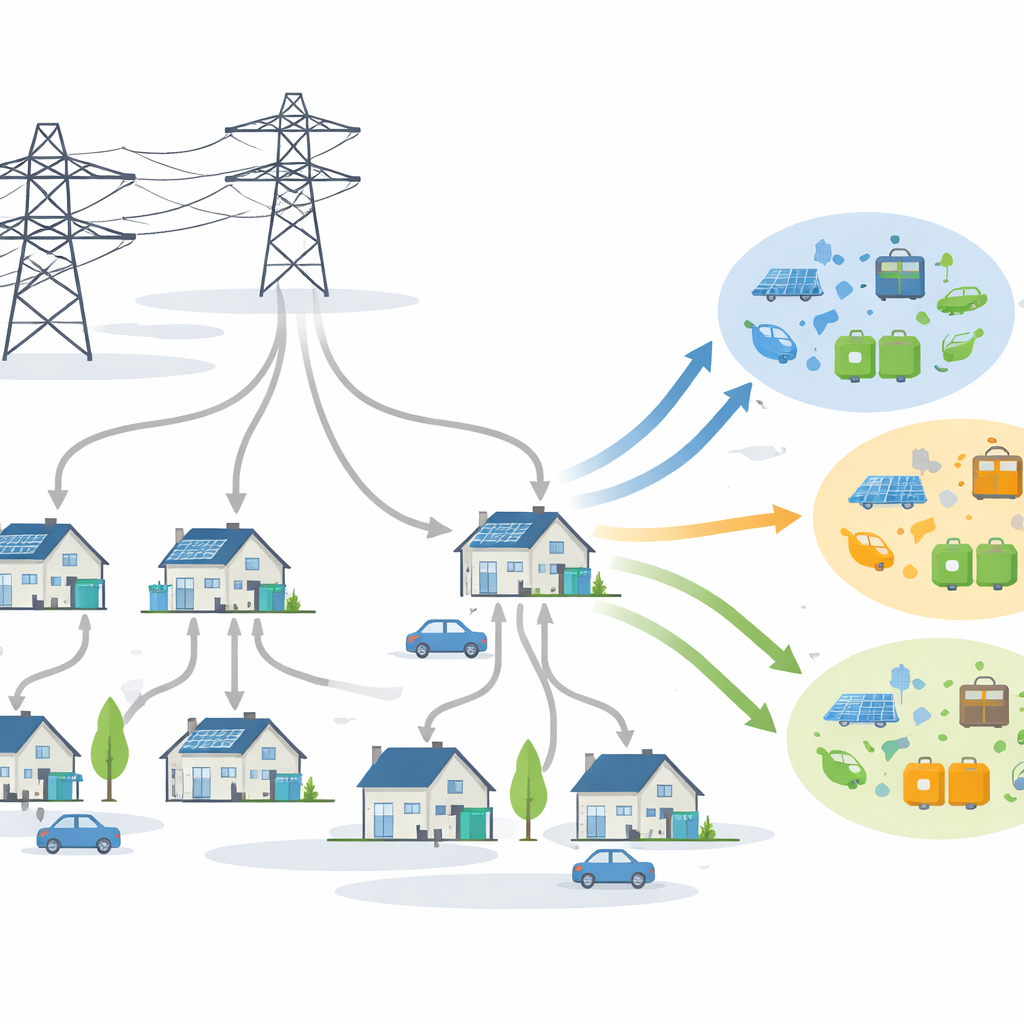
Electricity is no longer a one‑way street from distant power plants to our homes. Rooftop solar panels, electric vehicles, batteries, and smart appliances—all known as distributed energy resources, or DERs—are turning neighborhoods into miniature power plants. This paper explores how to coordinate these millions of small devices with the big high‑voltage grid so that lights stay on, costs stay low, and clean energy keeps growing, without overwhelming today’s market and control systems.
The Promise and Problem of Neighborhood Power
Regulators in the United States have opened wholesale electricity markets to DERs so that owners of solar panels, batteries, and flexible loads can get paid like traditional generators. In theory, this should boost efficiency, cut carbon emissions, and lower consumer bills. In practice, the large power plants live on high‑voltage transmission lines, while DERs are scattered across tangled, lower‑voltage distribution networks. These neighborhood‑scale grids are more complex, more changeable, and less visible to regional grid operators. If markets treat an entire city feeder as a single, simple device, they risk ordering power flows that look fine on paper but overload real‑world wires or push local voltages out of bounds.
From Grand Central Control to Layered Decision Making
One way to avoid these mismatches would be "Grand Central" control: the regional operator could model every neighborhood, every wire, and every rooftop panel in a giant, all‑knowing optimization. The authors explain why this is unrealistic. The math describing detailed power flows is nonlinear and heavy, and adding thousands of distribution nodes would bog down market software that already runs on tight deadlines. An alternative is "layered" coordination. Here, local distribution operators collect offers from DERs, bundle them up, and send a simplified picture to the regional operator. After the market clears, they unpack the bulk instructions back into device‑level schedules. This layered approach protects privacy and keeps computations manageable—but only if the simplifications still reflect the physics of the real networks.
Turning Many Small Devices into Virtual Power Plants
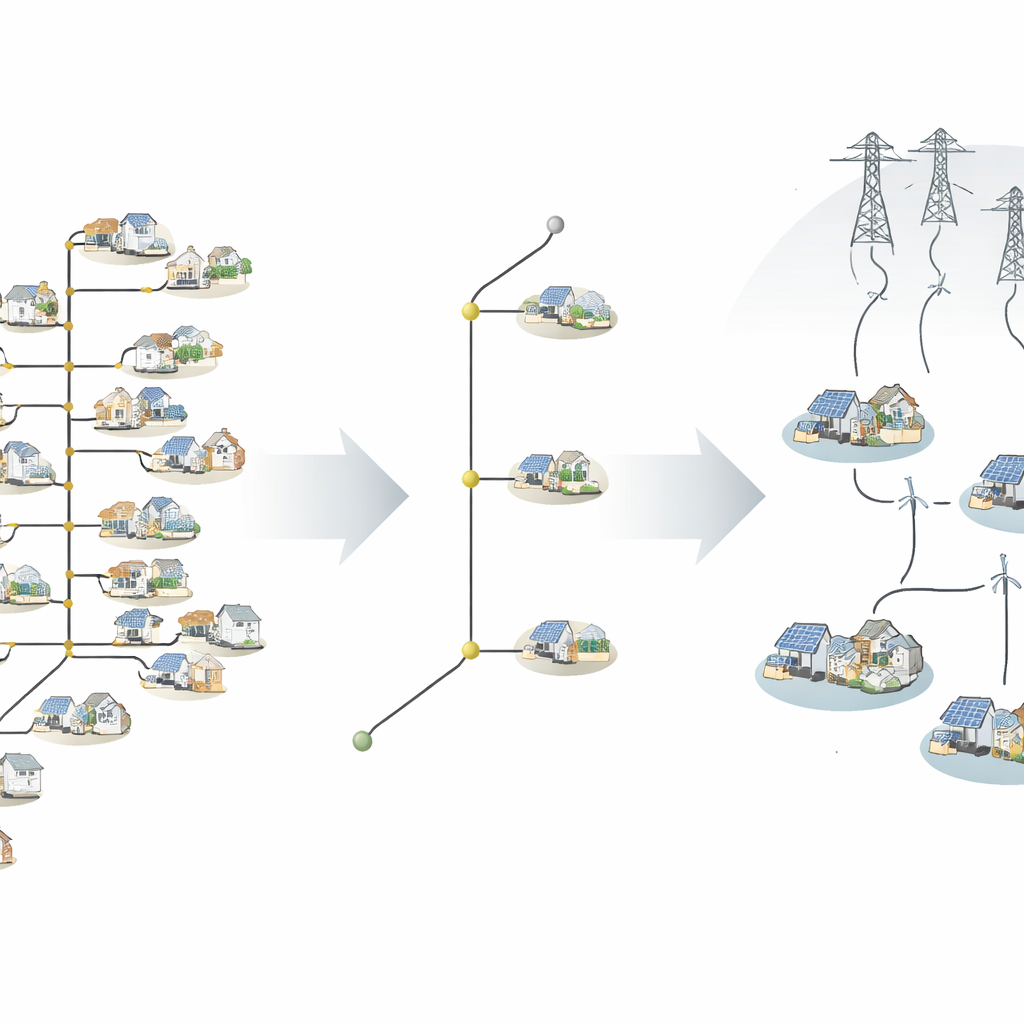
The core idea of this paper is a smarter way to build those simplified pictures. Instead of representing an entire distribution area as a single black box, the authors construct a reduced map that keeps only the "main trunk" of each feeder and groups side branches into a handful of zones. Each zone becomes a virtual power plant, a cluster of DERs that can inject or absorb power within certain limits and at certain costs. Using a well‑known power‑flow engine (MATPOWER), they repeatedly solve a detailed physical model while nudging the power in and out of each zone. From these experiments they derive smooth curves that describe how much extra power each virtual plant can offer or consume, and how costly it is, while still respecting local limits such as line ratings and voltages.
Building a Realistic Playground to Test the Idea
To see whether this approach holds up under stress, the authors design a five‑stage “testbed.” First, they generate many random operating conditions by varying customer demand and transmission line limits. Second, they create aggregated bids for each virtual plant using their detailed simulations. Third, a regional‑scale optimization chooses the cheapest combination of conventional generators and virtual plants for each scenario. Fourth, local operators translate those bulk instructions back into individual DER setpoints. Finally, the team checks whether these schedules remain feasible when plugged into a full, integrated model of both transmission and distribution. If not, they measure how far each device’s output must be nudged away from its scheduled value to recover a physically workable solution, and how much that nudging increases total cost.
What the Simulations Reveal About Future Grids
The researchers test their method on systems of increasing size: a tiny 6‑bus grid with two distribution networks, a mid‑sized 118‑bus grid with ten networks, and a large 300‑bus grid with fifty. Across hundreds of scenarios, their reduced‑network approach reliably finds schedules whose total cost is within a fraction of a percent of a full "god’s‑eye" centralized solution. More importantly, when they check against the complete physical models, their layered schedules need smaller corrections than those produced by traditional aggregation schemes, especially when neighboring distribution networks are interconnected. In big, crowded systems, the classic methods sometimes require large last‑minute adjustments or even fail to find feasible schedules at all, while the new approach keeps deviations modest and preserves more of the planned market outcomes.
What This Means for Everyday Energy Users
In plain terms, this work shows how grid operators can let millions of small devices participate in wholesale energy markets without drowning in data or risking unsafe power flows. By compressing neighborhood grids into simplified yet physics‑aware virtual power plants, the authors’ method keeps market models close to reality, even when distribution networks are linked together and heavily loaded. That translates into more reliable operations, fairer prices, and better use of clean local resources. As solar panels, electric vehicles, and batteries continue to multiply, such layered, decentralized optimization may become a key ingredient of a flexible, low‑carbon, and consumer‑friendly electric grid.
Citation: Raghunathan, N., Wang, Z., Chen, F. et al. Decentralized optimization for effective coordination of transmission and distribution systems with dynamic DER aggregation. Sci Rep 16, 8795 (2026). https://doi.org/10.1038/s41598-026-39014-4
Keywords: distributed energy resources, virtual power plants, power system coordination, electricity markets, distribution networks