Clear Sky Science · en
MoVe: an integrated tool to explore the relationship between human mobility and vector-borne disease
Why movement matters for mosquito-borne disease
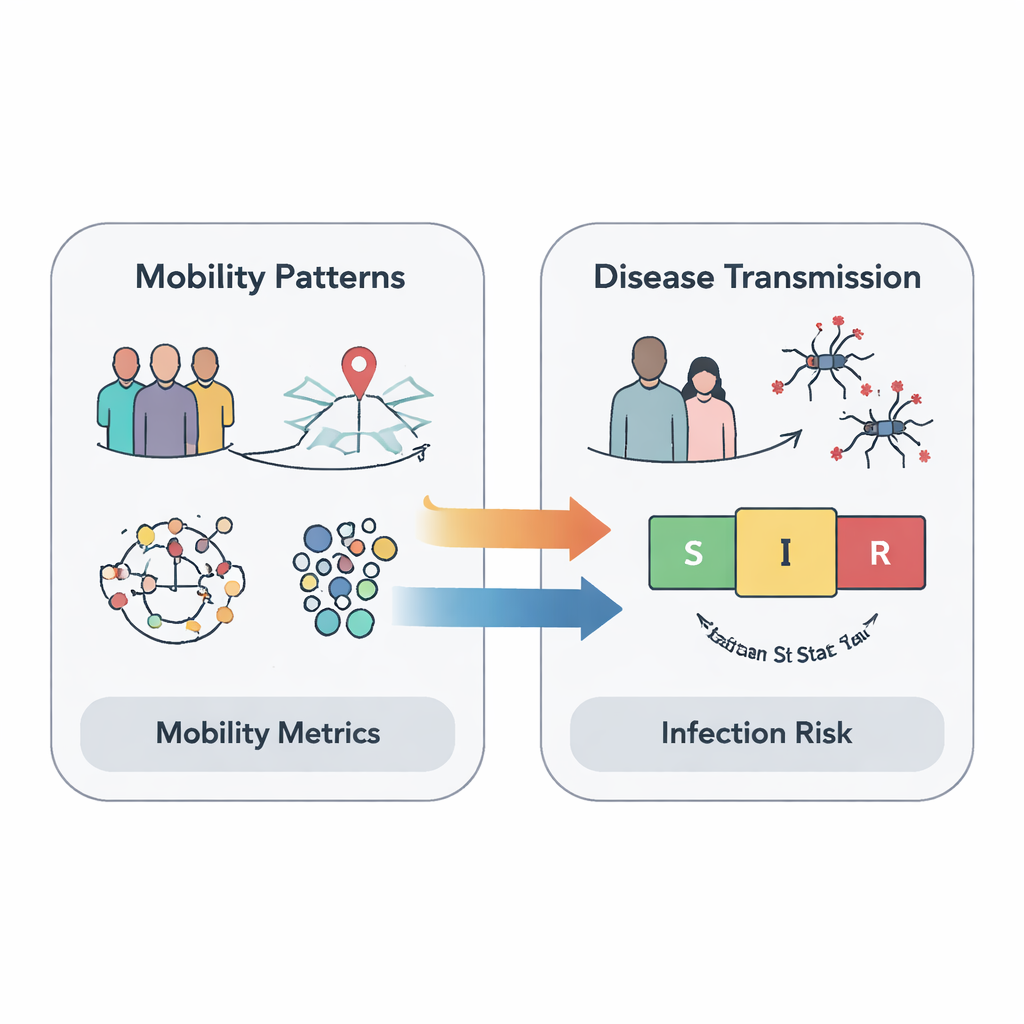
Where people go, diseases can follow. Many infections carried by mosquitoes, such as malaria, depend not only on where the insects live but also on how people move through risky areas. This article introduces MoVe, a new software platform that helps scientists and public health officials connect detailed human travel patterns with the spread of mosquito-borne diseases. By turning raw location data from mobile phones into maps, networks, and simulations, MoVe makes it easier to ask practical questions like: Which workers are most at risk? Which villages feed infections into others? And what would happen if certain trips simply stopped?
From phone traces to meaningful places
MoVe starts with high-resolution mobility data: sequences of GPS points tagged with time and basic information about each person, such as age, home village, and occupation. Rather than treating every recorded position as equally important, the system focuses on "stop locations"—the places where people stay relatively still and are most likely to be bitten by mosquitoes. To find these, MoVe first removes fast movements such as driving, then groups the remaining, slower points into clusters that represent villages, farms, or other frequently visited spots. Built-in checks help judge how well these clusters match real-world places, and interactive maps allow users to visually inspect and refine the results.
Drawing invisible roads of infection
Once key locations are identified, MoVe reconstructs the routes people actually travel, how often they move between each pair of places, and how long they typically stay. These relationships are shown as simple network graphs: locations are nodes, and travel paths are arrows whose thickness reflects travel volume. Behind the scenes, MoVe also converts these patterns into probability tables that describe how likely it is for a person in one location to move to another within a given time step. These tables are built for different demographic groups and seasons, turning messy raw data into clean inputs that can drive realistic simulations of disease spread.
Simulating people, mosquitoes, and chance
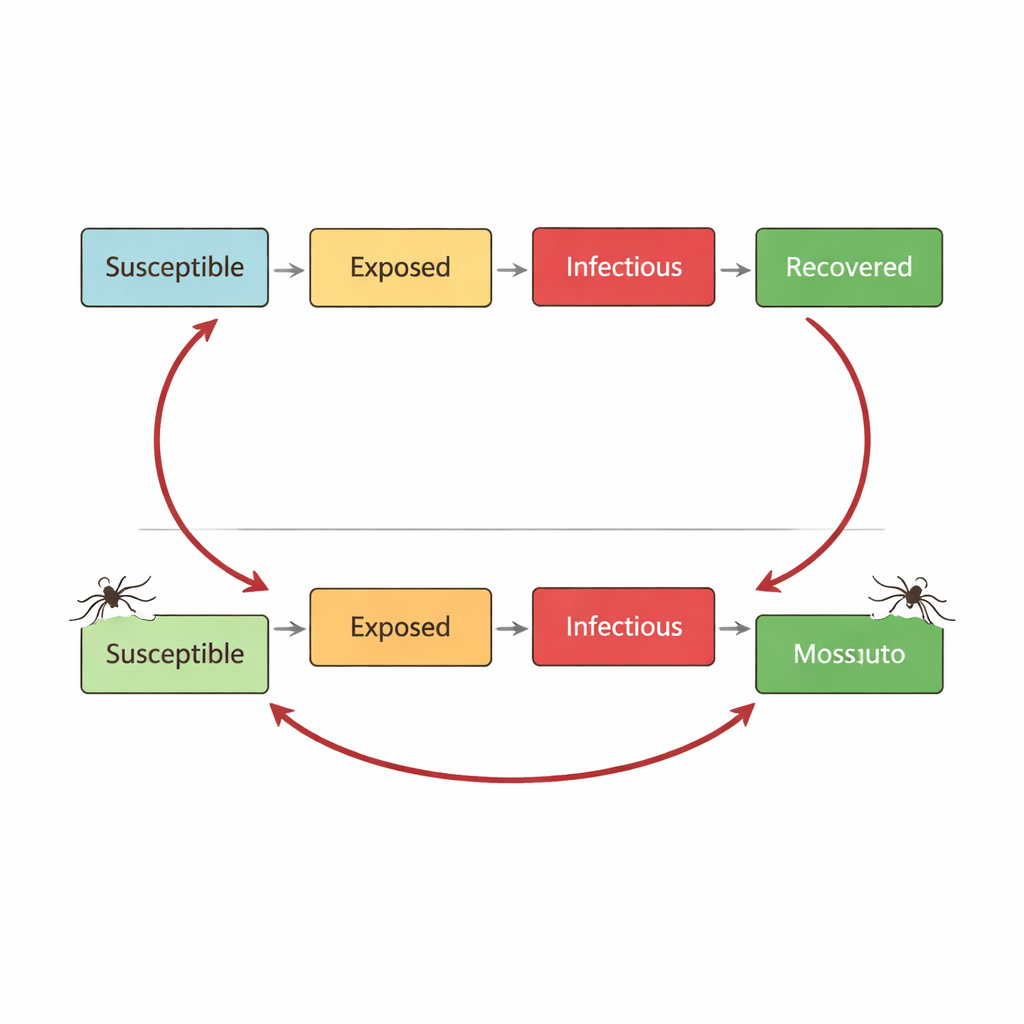
The second part of MoVe is an agent-based simulation that plays out how infections move through people and mosquitoes over time. Each person in the virtual world can move between locations according to the observed mobility patterns and can switch between health states: susceptible, exposed, infectious, and recovered. Mosquito populations at each location have their own life cycle and infection stages. Using published values for mosquito biting rates, death rates, and incubation times, as well as estimates of how likely an infectious bite leads to infection, the simulation calculates changing risks at every place and for every group. Users can easily adjust seasonal conditions, population sizes, and movement patterns to explore different "what-if" scenarios.
A real-world test on the Thai–Myanmar border
To show what MoVe can do, the authors applied it to malaria transmission along the Thai–Myanmar border, an area where Thailand has greatly reduced local malaria but still struggles with imported cases. They tracked 164 Thai residents for eight months using smartphone GPS, then used MoVe to find six main clusters of activity: five locations in Thailand and one in neighboring Myanmar. Farmers emerged as the most mobile group crossing the border in both wet and dry seasons, while merchants rarely crossed. Simulations based on these patterns showed that regular cross-border travel by Thai residents drives a substantial portion of malaria cases in the wet season, whereas infected short-term migrants from Myanmar contribute strongly to a second peak of cases in the dry season, especially around the harvest months.
What this means for fighting malaria and beyond
For non-specialists, the key message is that fine-scale human movement can strongly shape when and where mosquito-borne diseases persist, even when overall case numbers are low. By combining mapping, analysis, and simulation in one tool, MoVe helps public health teams see which occupations, routes, and seasons matter most, and test how changes in travel or targeted protection might reduce infections. Although the case study focuses on malaria in one border region, the approach is general and could be applied to other diseases and locations where mosquitoes and human mobility intertwine.
Citation: Sa-ngamuang, C., Yin, M.S., Barkowsky, T. et al. MoVe: an integrated tool to explore the relationship between human mobility and vector-borne disease. Sci Rep 16, 5238 (2026). https://doi.org/10.1038/s41598-026-39007-3
Keywords: human mobility, malaria, vector-borne disease, agent-based simulation, cross-border migration