Clear Sky Science · en
Species diversity and grass cover change following the invasion of Lantana camara in a woodland ecosystem
Why a thorny shrub matters to people and pasture
Across much of the tropics, a showy garden shrub called Lantana camara has escaped from yards and parks into the wild. In eastern Ethiopia’s Somali Region, this plant is now taking over dry woodlands that local communities depend on for grazing their cattle and goats. This study asks a simple but pressing question: as lantana spreads, what happens to the mix of native plants and the grasses that feed livestock?
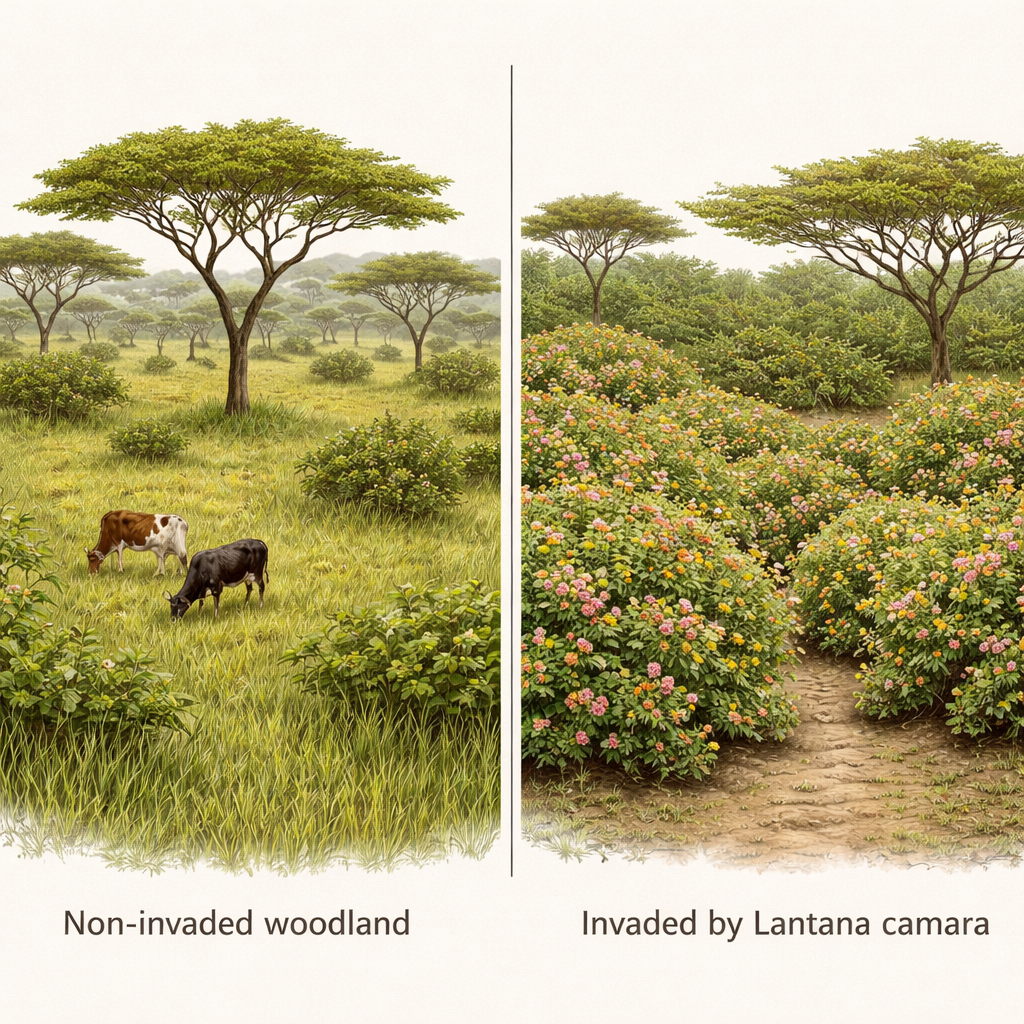
A tale of two neighboring woodlands
The researchers compared two nearby patches of semi-arid woodland in the Fafan Zone of Ethiopia: one heavily invaded by lantana, and another where lantana is largely absent. These landscapes are typical of the region—dry forests and woodlands dotted with hardy trees such as acacias and Balanites, and used mainly by pastoral and semi-pastoral communities. By looking at paired areas under the same climate and soils, the team could focus on how lantana itself is linked to changes in vegetation.
How the scientists counted trees, shrubs, and grasses
To get a detailed picture of the plant community, the team laid out straight lines (transects) in both invaded and non-invaded sites and set up a series of square plots along them. In larger plots they measured all trees and shrubs, recording their trunk thickness and height; in small subplots they counted seedlings, saplings, herbs, and grasses. Using standard ecological measures of diversity and “evenness” (how evenly individuals are shared among species), they then compared the two sites. They also estimated how much ground was covered by lantana and by grasses and other low plants.
What happens when lantana takes over
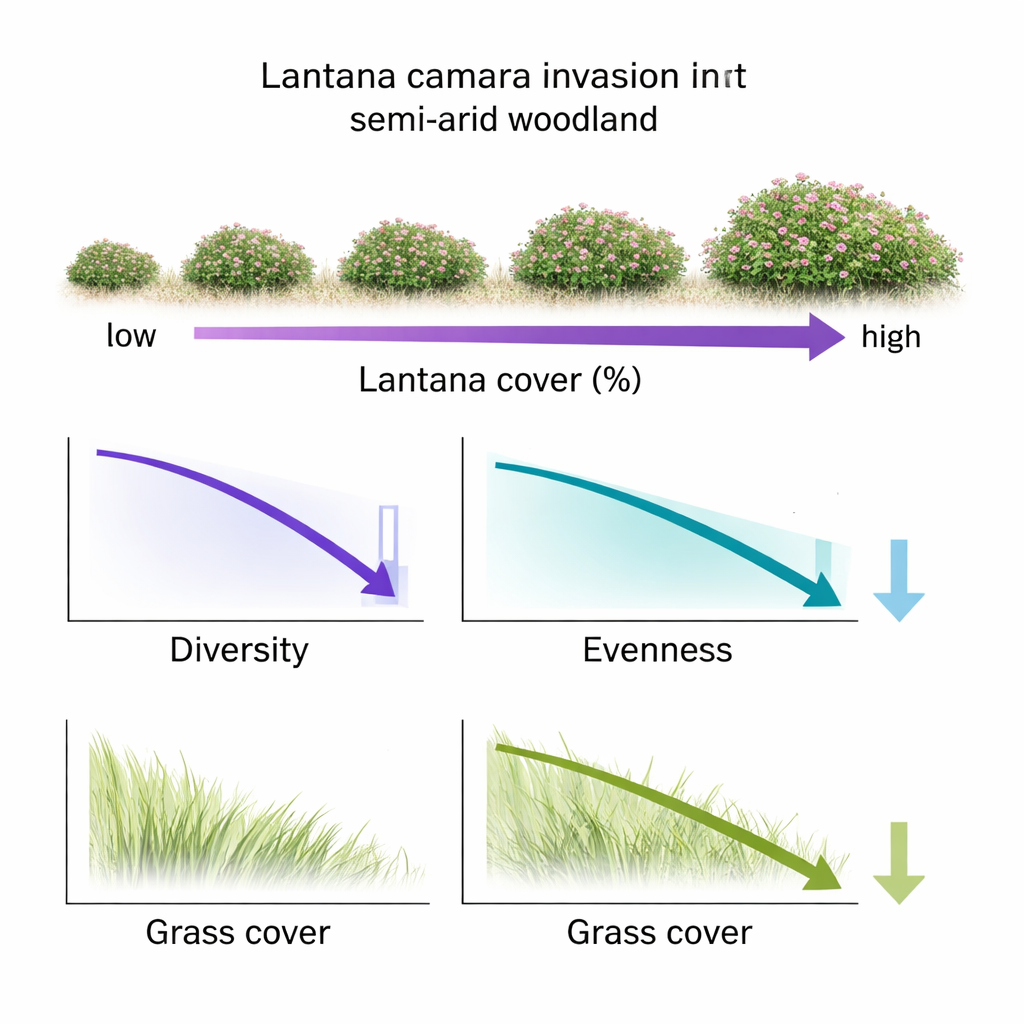
Overall, the woodland still hosted 23 species from 12 plant families, but these species were distributed very differently between the two sites. The non-invaded area had more kinds of trees and more young plants—seedlings and saplings—suggesting healthy renewal of the forest. In contrast, the invaded area had fewer tree species and fewer young trees. A single native tree, Vachellia tortilis, dominated among the survivors, likely because it can better tolerate or even chemically repel competitors. Statistical analyses showed that as lantana cover increased, both overall plant diversity and evenness declined sharply, meaning communities shifted toward a few hardy winners and many losers.
Vanishing grass under lantana thickets
For local herders, the fate of grasses and herbs is especially important. Here the contrast was stark: in non-invaded plots, about three-quarters of the ground (around 78%) was carpeted with grasses and herbs; in invaded plots, coverage dropped to roughly 30%. The relationship was not subtle—plots with more lantana almost always had less grass. This likely reflects both simple shading and competition for water and nutrients, and also lantana’s ability to release chemicals that suppress neighboring plants. As lantana thickets spread, they squeeze out the grasses that livestock depend on, undermining a key resource in a region already stressed by low and erratic rainfall.
What this means for people and landscapes
To a lay observer, lantana might look like just another shrub, but this study shows it can quietly reshape an entire woodland. In the Somali Region site, areas with dense lantana had fewer plant species, fewer young trees to replace older ones, and far less grass for grazing animals. Left unchecked, this invasion risks turning diverse, productive rangeland into shrub-dominated thickets with limited forage and reduced ecological resilience. The authors argue that understanding how lantana interacts with native plants, soils, and microbes is essential for crafting control strategies—work that will help protect both biodiversity and the livelihoods of communities who depend on healthy grass-rich woodlands.
Citation: Mulatu, A., Edmealem, K., Tesema, H.A. et al. Species diversity and grass cover change following the invasion of Lantana camara in a woodland ecosystem. Sci Rep 16, 7677 (2026). https://doi.org/10.1038/s41598-026-39006-4
Keywords: Lantana camara, invasive plants, grassland grazing, woodland biodiversity, Ethiopia semi-arid ecosystems