Clear Sky Science · en
Comparative analysis of fractional thermoelastic vibrations of a nonlocal nanobeam exposed to travelling and static thermal loads
Why tiny heated beams matter
Engineers are building ever‑smaller devices—such as ultra‑sensitive sensors and components for miniature machines—that rely on hair‑thin beams a few nanometers thick. These beams heat up and cool down as the device works, and that thermal activity can make them vibrate, bend or even fail. This study explores a new way to predict how such nanobeams respond when they are struck by both a moving burst of heat and a slowly rising background heating, helping designers keep future nano‑devices accurate, stable and long‑lived.
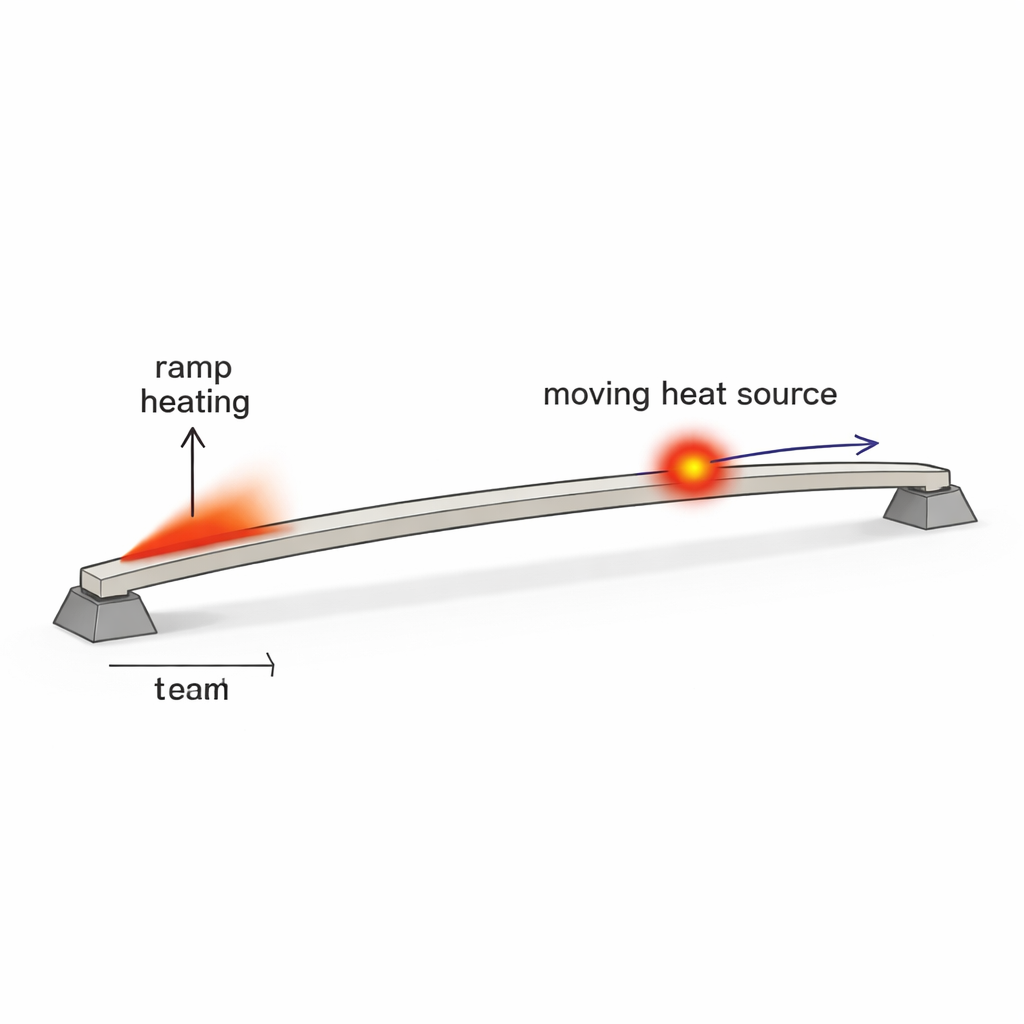
Heat on the move in a tiny beam
The authors focus on a slender silicon nanobeam that is simply supported at both ends, much like a small-scale bridge. Two kinds of heating act on it at once. At the left end, the temperature rises gradually over a short time, mimicking a “ramp” in background heat. At the same time, a concentrated hot spot travels along the beam at constant speed, similar to a scanning laser or a moving electrical hot region. These thermal inputs cause the beam to warm unevenly, bend, and vibrate, which in turn generates internal stresses that can degrade performance or trigger failure in real applications such as nano‑sensors and nano‑electromechanical resonators.
A more realistic model of heat and memory
Conventional heat‑flow theories often assume that heat spreads instantly and that the material has no “memory” of its past. Those assumptions break down at the nano‑scale, where the structure’s size and history matter. This work adopts a newer framework called the Moore–Gibson–Thompson (MGT) model, which limits the speed of heat waves and includes a built‑in delay in how heat responds. The authors go further by using “fractional” derivatives—a mathematical tool that naturally encodes memory, so that the current temperature and deformation depend on what happened earlier. They also include “nonlocal” effects, meaning that the stress at a point in the beam depends not just on the strain right there but also on the behavior of neighboring regions, which is essential when structures are only a few hundred atoms thick.
From equations to beam behavior
Using these ideas, the team builds a set of coupled equations describing temperature, bending, sideways deflection, and internal forces in the nanobeam. They solve these equations analytically in a transformed mathematical space and then convert the solutions back into real time using a numerical inversion technique. This allows them to calculate, for realistic silicon properties, how temperature, displacement, bending moment and deflection evolve along the beam for different choices of model parameters. They systematically compare the MGT framework, with and without fractional “memory,” against older theories of heat conduction that are widely used in engineering.
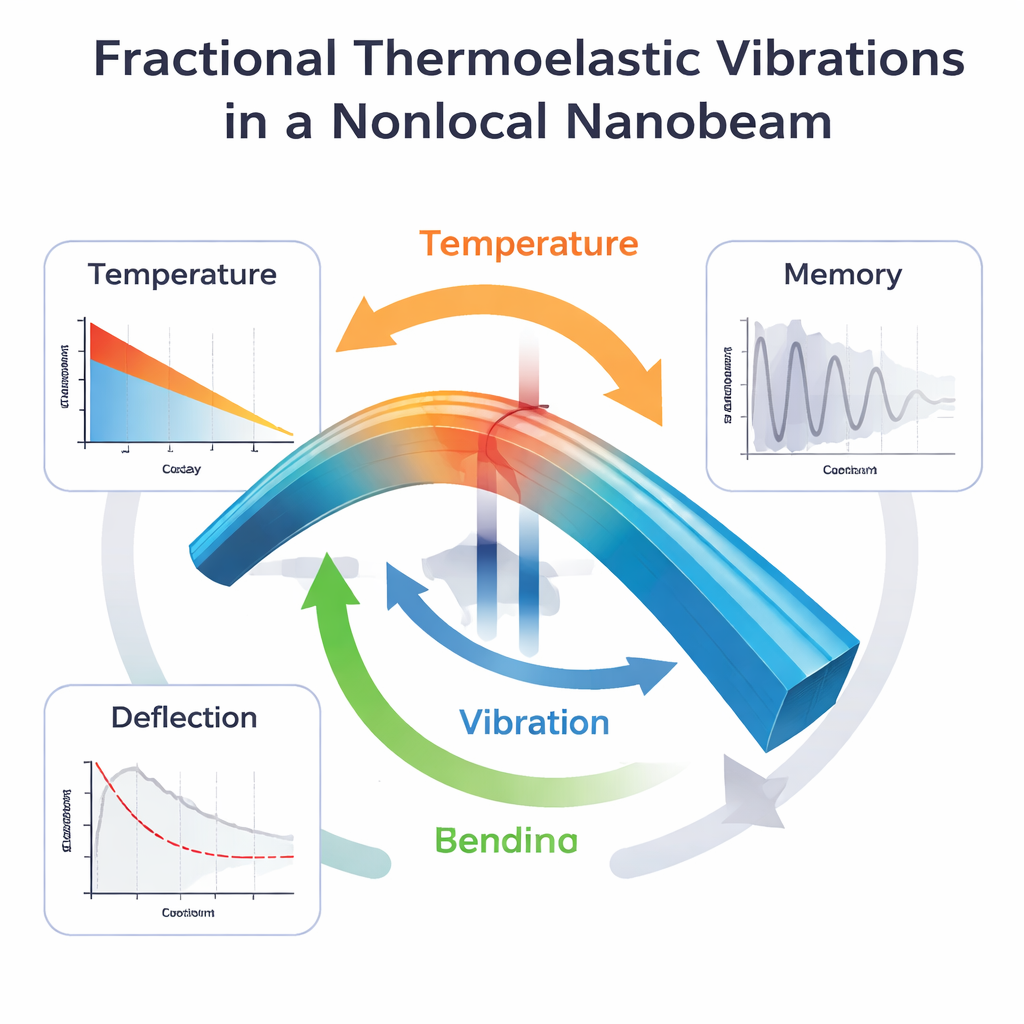
What controls vibration, stress and stability
The results reveal clear design rules. First, the MGT and a related “GN‑II” heat model predict noticeably lower temperatures, deflections and bending moments than classical theories, especially when fractional (memory‑based) terms are included. Lower peaks mean lower thermal stress and less risk of structural damage. Second, increasing the strength of the fractional term reduces vibration amplitudes and bending, cutting energy loss and frequency noise—valuable for high‑precision resonators and sensors. Third, stronger nonlocal effects, which capture size‑dependent behavior, smooth out the response and shrink the region over which large stresses occur. Finally, both the duration of the ramp heating and the speed of the moving hot spot strongly influence how sharply the beam responds: longer ramps and slower moving loads generally reduce extreme peaks, while faster loads raise energy and deflection.
What this means for future nano‑devices
In plain terms, the study shows that if engineers account for size effects, delayed heat response and material memory using the fractional MGT framework, they can predict smaller, more stable thermoelastic vibrations in nanobeams than classical models suggest. This points to safer and more efficient designs for nano‑scale structures—from tiny mechanical sensors to components in advanced computing and manufacturing—where carefully shaping heat inputs and choosing the right beam dimensions and materials can significantly boost sensitivity, durability and reliability.
Citation: Tiwari, R., Gupta, G.K. & Shivay, O.N. Comparative analysis of fractional thermoelastic vibrations of a nonlocal nanobeam exposed to travelling and static thermal loads. Sci Rep 16, 7805 (2026). https://doi.org/10.1038/s41598-026-39005-5
Keywords: nanobeam vibrations, thermoelasticity, fractional models, nonlocal elasticity, moving heat source