Clear Sky Science · en
Effects of cryogenic cooling on cutting temperature and surface roughness in turning of AA7075 aluminum alloy
Why Cooling Matters in Metal Cutting
Whenever a car, airplane, or even a bicycle is built, many of its metal parts are shaped by cutting material away on machines called lathes and mills. This cutting creates a lot of heat and can leave tiny ridges and flaws on the surface, which may shorten the life of the part. The study in this paper looks at how using extreme cold, supplied by liquid nitrogen, can cool the cutting process of a high-strength aluminum alloy widely used in airplanes and cars, and how that cooling changes both the temperature and the smoothness of the finished surface.
A Strong but Sensitive Aluminum
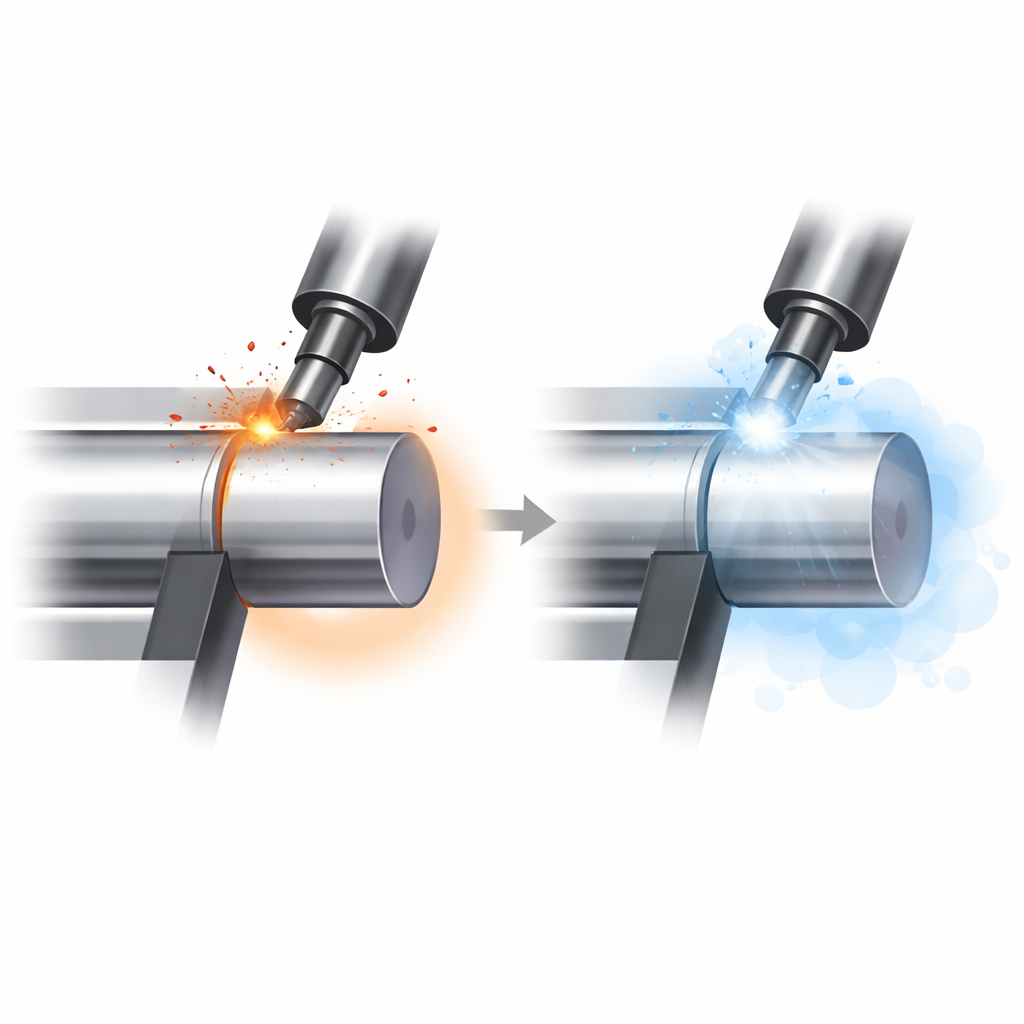
The researchers focused on AA7075 aluminum alloy, a material prized in aerospace and automotive applications because it is both strong and light. Those same properties make it important that the surface of each part is in top condition, since roughness and hidden damage can lead to cracks and fatigue over time. When metal is cut on a lathe, three main settings control how the process unfolds: how fast the workpiece spins (cutting speed), how quickly the tool moves along it (feed rate), and how deep the tool bites into the metal (depth of cut). Together, these settings determine how much heat is generated and how smooth the surface becomes. The team wanted to understand how these settings interact under normal "dry" cutting and under "cryogenic" cutting, where liquid nitrogen is sprayed right where the tool meets the metal.
How the Experiments Were Run
To study this, the authors turned small AA7075 cylinders on a conventional lathe using a hard tungsten carbide cutting insert. They prepared seven different combinations of cutting speed, feed rate, and depth of cut, and repeated those same combinations twice: once in dry air and once with liquid nitrogen cooling. A thermal camera watched the cutting zone from a fixed distance to record the maximum temperature during each pass. After each cut, a handheld roughness meter traced the surface at three points and reported an average roughness value. This set of measurements allowed the team to compare, in a controlled way, how each parameter and each cooling method affected both heat in the cutting zone and the texture of the finished surface.
What Happens to Heat and Surface Smoothness
The results showed a clear contrast between dry and cryogenic cutting. Under dry conditions, raising the cutting speed and especially the depth of cut caused temperatures to climb sharply, in some cases above 130 °C. Feed rate and depth of cut also tended to increase surface roughness, meaning the finished parts had more pronounced microscopic peaks and valleys. By comparison, when liquid nitrogen was sprayed onto the tool–workpiece contact, the cutting-zone temperature dropped dramatically, often by more than 50 °C, and stayed almost constant even when speed, feed, or depth of cut were changed. This cooling also improved surface quality in many cases, particularly at moderate speeds and low feed rates, where roughness values were noticeably lower than in dry cutting.
Subtle Trade-Offs at Extreme Cold
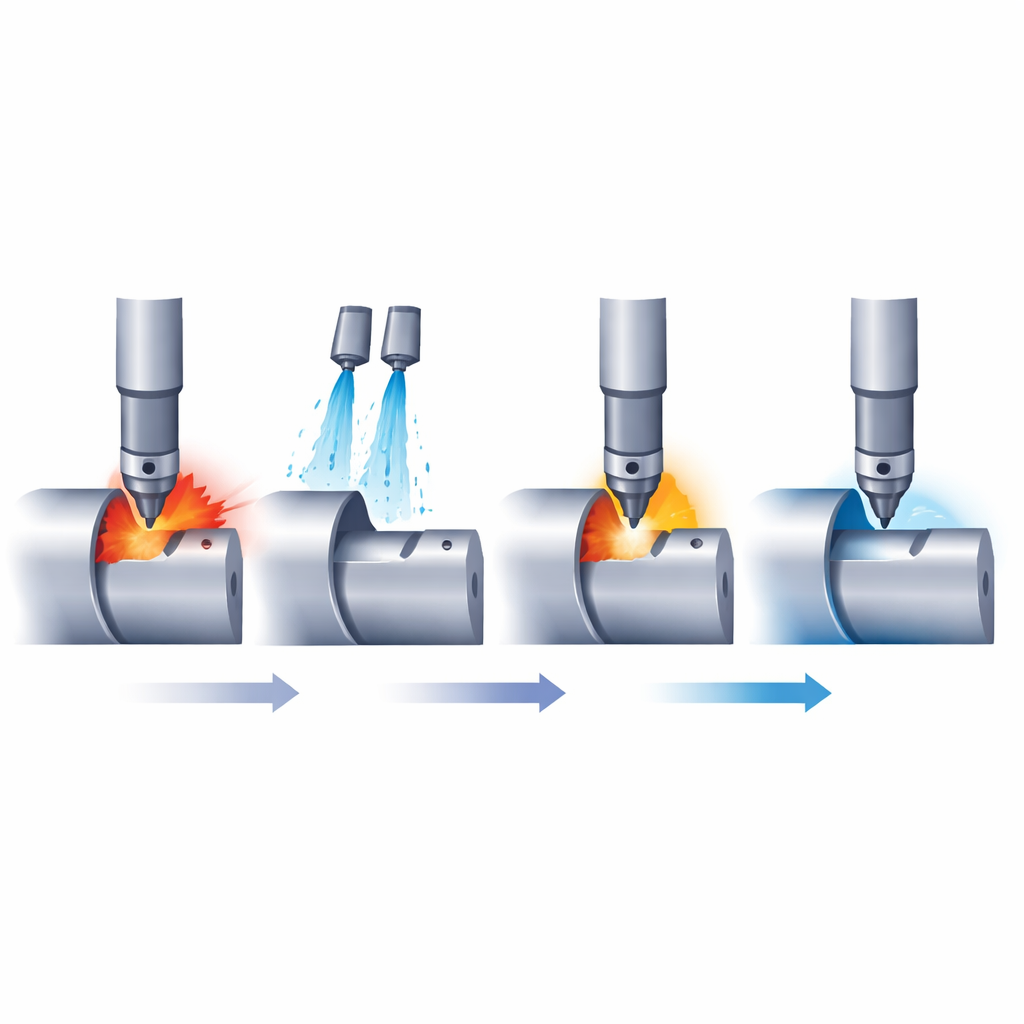
The study also uncovered more complex behavior at certain settings. At low cutting speeds under cryogenic cooling, the surface sometimes became rougher than in dry cutting. The authors suggest that very intense local freezing may disturb the way chips of metal break off, making them more irregular and more likely to mark the surface. Likewise, at high feed rates and larger depths, the combination of heavy cutting and strong cooling increased roughness in cryogenic mode, probably because thicker chips, stronger forces, and colder, more brittle material led to unstable chip flow. These findings show that while cooling is powerful, it does not automatically guarantee a smoother surface at every setting; the cutting parameters still need to be chosen carefully.
What This Means for Real-World Parts
For manufacturers, the study suggests that using liquid nitrogen in turning AA7075 aluminum can greatly reduce cutting temperatures, limit hidden damage in the surface layer, and improve smoothness—factors that together can extend the fatigue life and reliability of critical components. Liquid nitrogen has practical advantages as well: it evaporates into harmless nitrogen gas, leaves no residue, and avoids the waste-handling issues linked to traditional liquid coolants. However, the work also highlights that cryogenic cutting is not a one-size-fits-all solution; the best gains in both temperature control and surface quality come from pairing the cooling with well-chosen speeds, feeds, and depths. In simple terms, the paper shows that smart use of extreme cold can make strong, lightweight aluminum parts last longer and perform more safely.
Citation: Ranjbar, S., Foorginejad, A., Emam, S.M. et al. Effects of cryogenic cooling on cutting temperature and surface roughness in turning of AA7075 aluminum alloy. Sci Rep 16, 7914 (2026). https://doi.org/10.1038/s41598-026-39003-7
Keywords: cryogenic machining, liquid nitrogen cooling, surface roughness, aluminum alloy AA7075, turning process