Our phones, sensors, and future quantum devices increasingly rely on ripples of sound that skim along a chip’s surface. These surface acoustic waves can push electric charges around, creating tiny voltages used to read out signals or move single electrons. This paper asks a deceptively simple question with big practical consequences: when you send these waves to the left or to the right, do they behave exactly the same, or can the device quietly favor one direction over the other? The answer turns out to depend on the deep symmetries of the crystal and on how those ripples combine at nanometer scales.
Sound that rides the surface
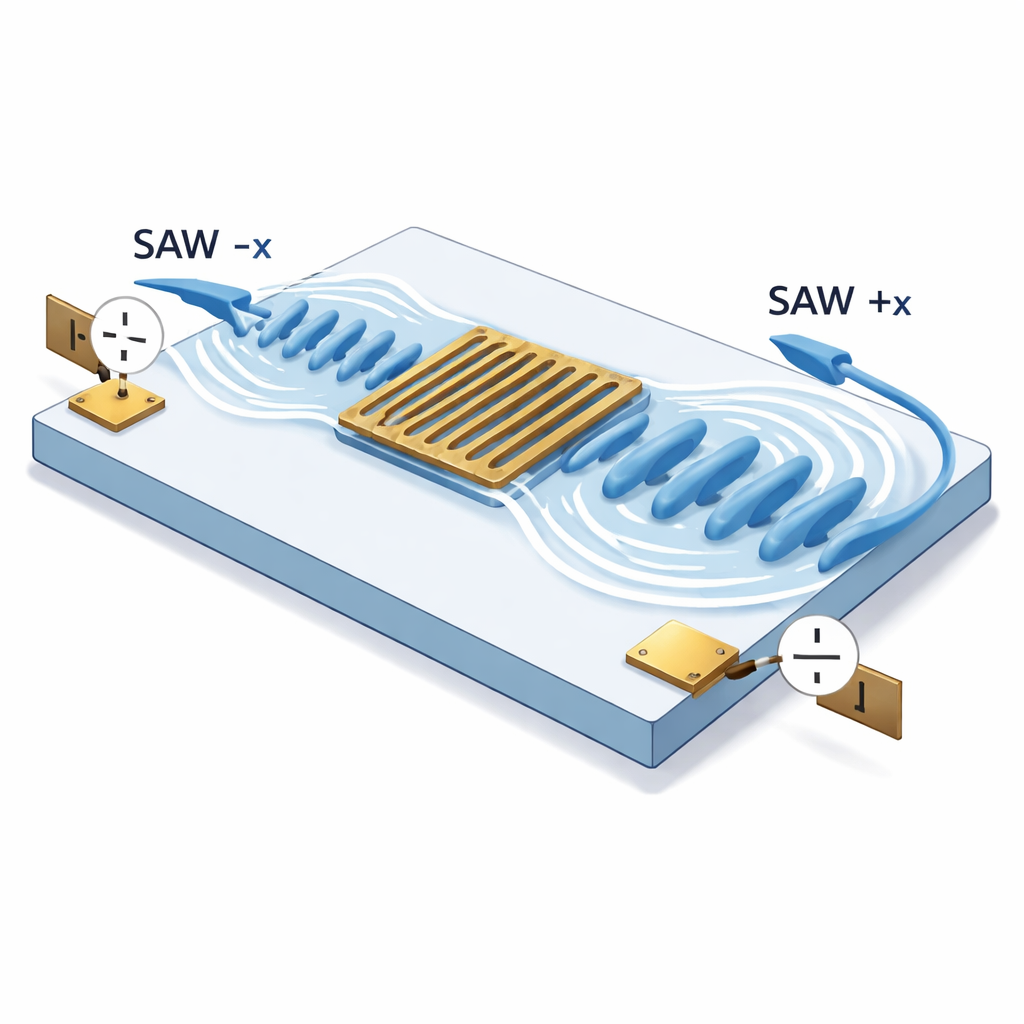
Surface acoustic waves are like miniature earthquakes guided along the face of a solid, fading away within about one wavelength into the bulk. Because their speed is set by the speed of sound in the solid, they are far slower than light yet share the same clean, wave-like behavior. Engineers pattern comb-shaped metal electrodes, called interdigital transducers, on piezoelectric crystals such as lithium niobate and lithium tantalate. When driven by radio-frequency signals, these structures launch surface waves that in turn drag mobile charges in a nearby thin metal film, producing a tiny “acoustoelectric” voltage that reveals how the waves are moving.
Hearing the waves with ultra-sensitive electronics Figure 1.
The authors developed a highly sensitive way to measure these acoustoelectric voltages using an audio-frequency lock-in technique. Instead of trying to detect a direct current signal that is easily swamped by noise and stray currents, they gently modulate the radio signal that drives the transducer and listen for the voltage response at a much lower frequency. This approach suppresses radio-frequency interference and allows them to map the wave response over a range spanning four orders of magnitude. By varying how many electrode pairs are used, they show how the spectrum of the generated waves changes from a sharp “Sinc-squared” profile, expected when reflections are negligible, to a broader Lorentzian shape once multiple reflections inside a long array of fingers become important.
When left and right look the same
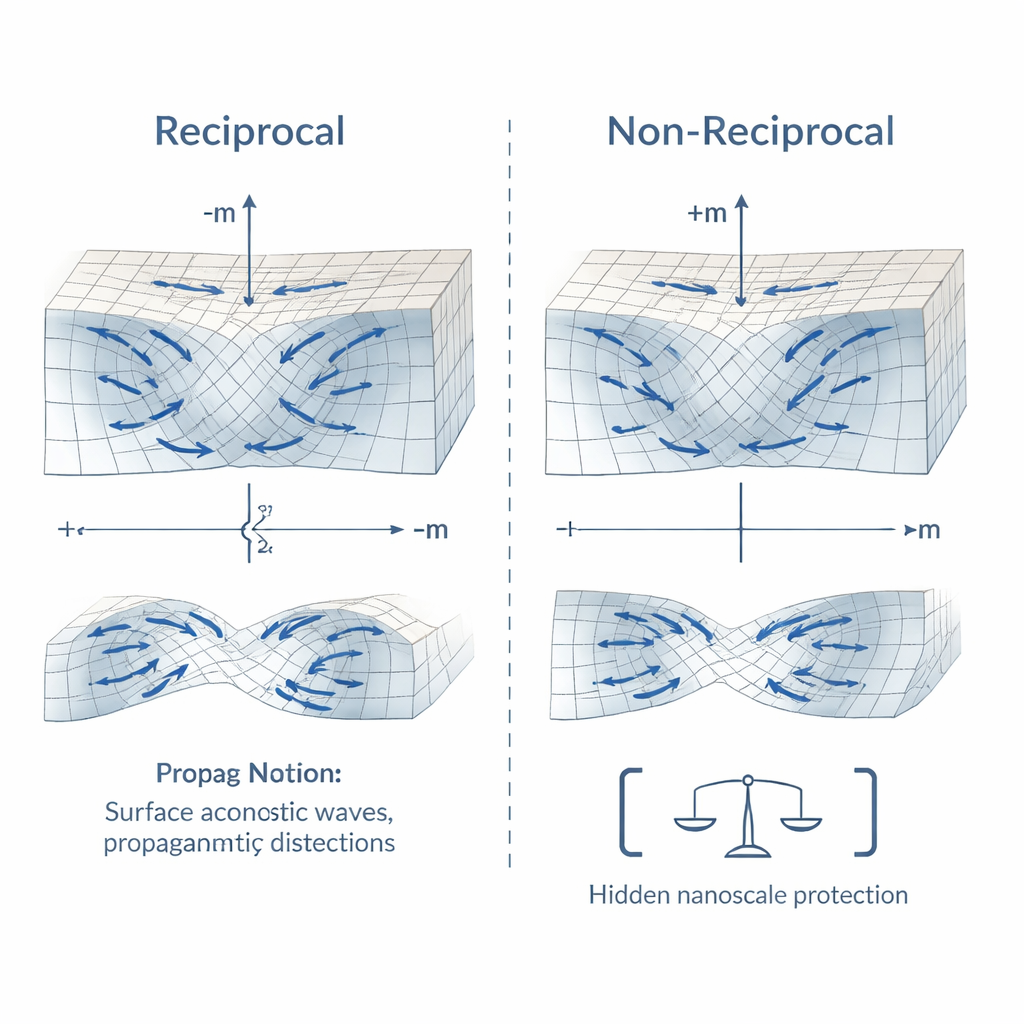
To test whether sound propagation is reversible, the team compared waves traveling in opposite directions on carefully designed devices. They placed identical metal pads on both sides of a single transducer so that the only difference between the two measurements was the direction of wave travel. In some orientations of the crystal, the acoustoelectric voltage profiles from left- and right-moving waves matched perfectly, no matter how they tuned the device geometry. This “reciprocal” behavior arises when the wave direction is tied to a mirror plane or a two-fold rotation axis of the crystal that still holds for the semi-infinite half-space of the substrate. In these cases, a symmetry operation of the crystal maps a wave traveling one way into an equivalent wave traveling the other way.
When the chip secretly favors one way Figure 2.
In other crystal cuts and propagation directions, the team found clear and often dramatic differences between the signals from oppositely traveling waves, even though the metal films were simple, non-magnetic, and identical. The asymmetry grew as they increased the number and thickness of the metal fingers, confirming that multiple reflections and mass loading at the transducer can combine into a “natural unidirectional” behavior. Using a setup with two transducers driving waves alternately from opposite sides, they could mathematically separate the average acoustoelectric response from the truly one-way part, and even demonstrate frequencies where waves effectively traveled only in one direction. Intriguingly, they also identified cases where no obvious global symmetry related the two directions, yet the waves still behaved reciprocally because of a hidden balance built into the underlying equations of motion.
Hidden protection at the nanoscale
At the heart of this work is the realization that the mathematical description of surface waves treats motion along the propagation direction and motion into the depth of the crystal in a structurally symmetric way. Each tiny volume of the material participates in both compressional and shear motions, locked together by a symmetric strain tensor. Even when the macroscopic crystal surface no longer respects a mirror or rotation symmetry, this local, nanoscale symmetry in the equations can enforce reciprocity for certain pairs of wave and surface directions. The authors show that this hidden protection explains puzzling experimental reports and clarifies when designers can safely assume perfect standing waves and when they must expect drift and one-way behavior. For technologies that rely on precise control of surface waves—from quantum circuits and advanced sensors to the manipulation of exotic magnetic textures—knowing exactly when sound treats left and right equally is essential.
Citation: Vijayan, S., Suffit, S., Cooper, S.E. et al. Nanoscale symmetry protection of the reciprocal acoustoelectric effect.
Sci Rep16, 7637 (2026). https://doi.org/10.1038/s41598-026-38987-6