Clear Sky Science · en
Highly sensitive hierarchically structured Si-based UV sensor–photodetectors via optimized ZnO–Al2O3 nanocomposite architectures
Why protecting against invisible sunlight matters
Ultraviolet (UV) light from the sun is invisible, but it can burn our skin, damage eyes, fade materials, and even interfere with electronics. As our lives fill with satellites, wearable health trackers, air and water monitors, and security systems, we need tiny, cheap sensors that can spot UV rays quickly and accurately, even in harsh environments. This paper explores a new way to build highly sensitive UV detectors on ordinary silicon chips by adding an ultra-thin, carefully engineered coating made from zinc oxide and aluminum oxide nanoparticles.

Turning everyday silicon into a sharp UV watcher
Silicon, the workhorse of the electronics industry, is great at detecting visible and infrared light but struggles with UV. Its bandgap—the energy window that determines which light it responds to—is too narrow, so it picks up lots of background light and misses weak UV signals. The researchers tackle this by adding a “filter–amplifier” layer on top of silicon, made from wide-bandgap metal oxides. These oxides strongly absorb UV while ignoring most visible light, and they can be grown as nanostructured coatings that steer electric charges efficiently toward the silicon underneath.
Designing the best coating on the computer first
Before mixing any chemicals, the team used quantum-level computer simulations to compare several oxide choices: pure zinc oxide (ZnO), titanium dioxide (TiO2), aluminum oxide (Al2O3), and two hybrids, ZnO–TiO2 and ZnO–Al2O3. They examined how electrons are arranged in each material, how easily they can move, and how strongly the surfaces might interact with their surroundings. The calculations showed that combining ZnO with Al2O3 narrows the effective energy gap for charge motion, increases the material’s polarity, and improves the pathways for electrons to flow. In simple terms, the ZnO–Al2O3 blend should move charges more easily and respond more strongly to UV than the other candidates.
Building a rough, porous skin for catching more light
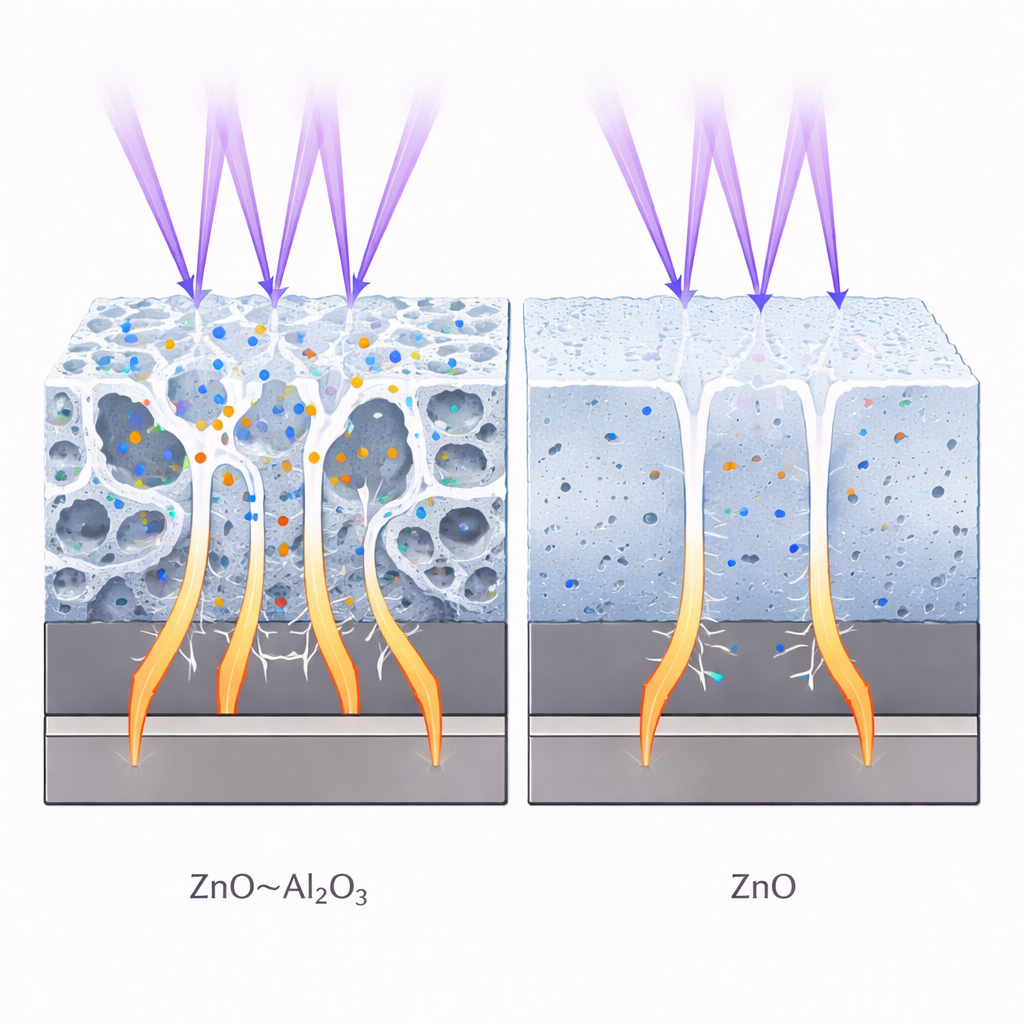
Guided by the simulations, the researchers synthesized ZnO and Al2O3 nanoparticles using water-based, low-temperature methods, then blended them into a nanocomposite and spin-coated it onto silicon wafers. Advanced X-ray, electron microscope, and spectroscopy measurements confirmed that the two oxides formed a clean, well-mixed structure without unwanted phases. Crucially, adding Al2O3 reshaped the surface: the coating became rougher and more porous, with larger, interconnected pores and a hierarchical architecture. This rough, sponge-like skin scatters incoming UV light, increasing the distance it travels inside the film and boosting the chance it will be absorbed and converted into electrical charges. The extra pore surfaces also provide more active sites where light-triggered reactions can take place.
How a smart blend speeds up the signal
The team then tested how these coated silicon devices behaved electrically and optically. Optical measurements showed that the ZnO–Al2O3 films absorb UV strongly between about 250 and 450 nanometers, while remaining almost blind to visible light. The composite’s bandgap is slightly larger than that of pure ZnO, which sharpens its preference for UV. Electrical tests revealed that the nanocomposite conducts significantly better than pure ZnO, even though Al2O3 by itself is an insulator. Detailed impedance measurements—essentially, how easily charges move and where they get stuck—showed that the hybrid layer has lower resistance to charge transfer and fewer “trap” sites where charges can die out. As a result, under UV light the ZnO–Al2O3 device produces roughly double the electrical response of a pure ZnO device, while turning on and off quickly and repeatedly without fatigue.
Lasting performance for real-world UV sensing
Beyond raw sensitivity, a practical sensor must be stable over time. The researchers aged their devices under UV illumination and found that the ZnO–Al2O3 detectors kept about 92% of their original performance after 100 hours, better than pure ZnO. The aluminum oxide component acts as a protective, passivating shell around the zinc oxide grains, shielding them from moisture and other environmental damage while still letting UV light in. Together, the rough, porous structure and the oxide blend give a strong, selective, and durable signal whenever UV is present.
What this means for future UV-sensing technologies
To a non-specialist, the bottom line is that this study shows how a carefully designed nanoscale coating can turn ordinary silicon into an excellent UV watcher. By combining zinc oxide’s natural UV sensitivity with aluminum oxide’s protective and passivating role, and by shaping them into a rough, porous film, the authors achieve sensors that are more sensitive, faster, and more stable than those made from zinc oxide alone. Because the approach uses materials and processes compatible with mainstream chip manufacturing, it could be scaled up for UV badges, smart windows, spacecraft monitors, and networked environmental sensors that quietly and reliably keep track of the part of sunlight we cannot see.
Citation: Abdelhamid Shahat, M., Khamees, A.S., Ghitas, A. et al. Highly sensitive hierarchically structured Si-based UV sensor–photodetectors via optimized ZnO–Al2O3 nanocomposite architectures. Sci Rep 16, 8497 (2026). https://doi.org/10.1038/s41598-026-38984-9
Keywords: ultraviolet sensors, nanocomposite coatings, zinc oxide, silicon photodetectors, optoelectronics