Clear Sky Science · en
AI-assisted video analysis of the Trendelenburg test: a feasibility study
Watching How We Stand on One Leg
Many hip and knee problems show up in simple everyday actions, like standing on one leg to put on a sock. Doctors often use a quick bedside check called the Trendelenburg test to see how well the muscles around the hip are working. But this test is usually judged by eye, which can miss subtle problems. This study explores whether ordinary smartphone video, paired with artificial intelligence (AI), can turn that simple test into an objective, numbers-based measurement that might improve diagnosis and rehabilitation.
A Simple Test with Hidden Complexity
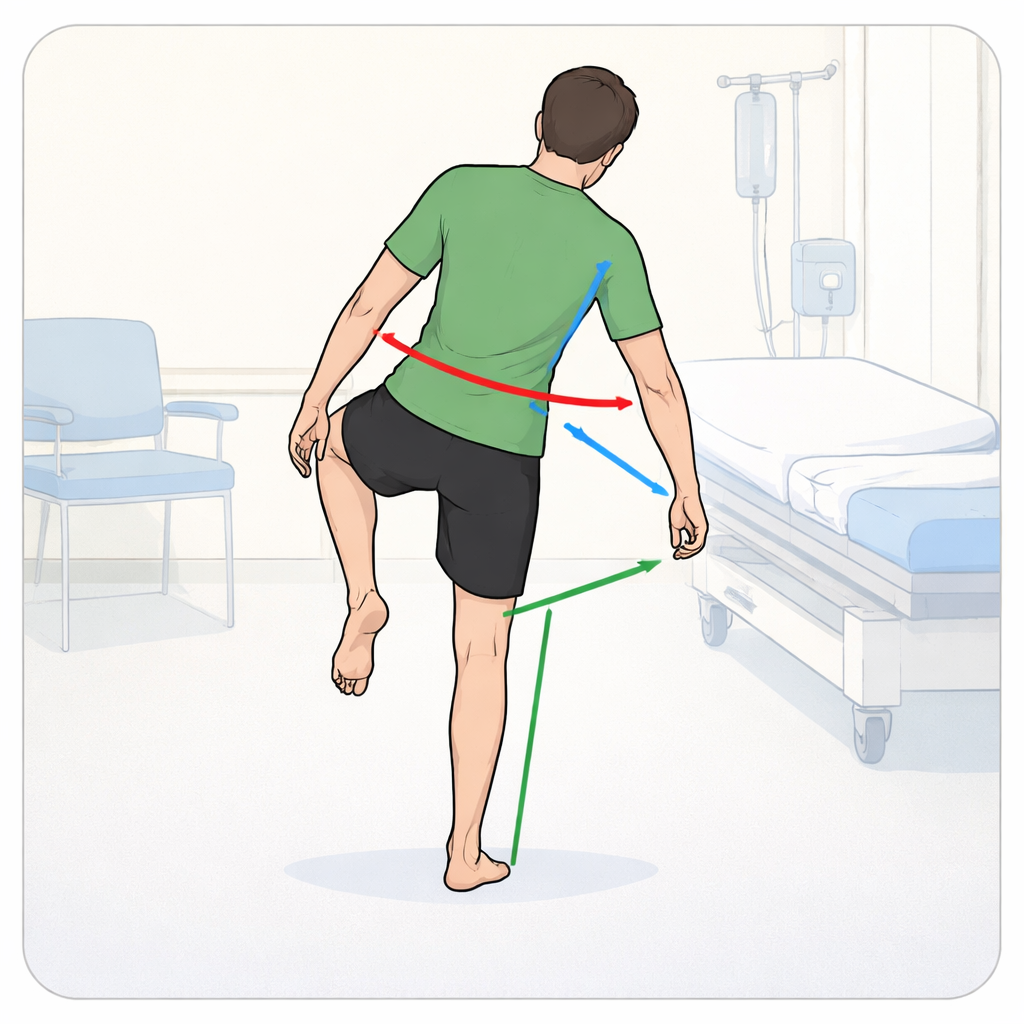
In the Trendelenburg test, a person stands on one leg while lifting the other leg, a bit like a slow-motion march. Traditionally, a visible drop of the lifted side of the pelvis has been taken as a sign that the stance-side hip muscles are weak. However, patients can also compensate by leaning their upper body toward the standing leg, which can disguise pelvic drop and mislead the examiner. On top of that, what the knee does during this maneuver may affect how forces travel through the leg, possibly influencing joint wear over time. All of this makes the test more complex than it seems at first glance.
Turning Clinic Video into Measurable Angles
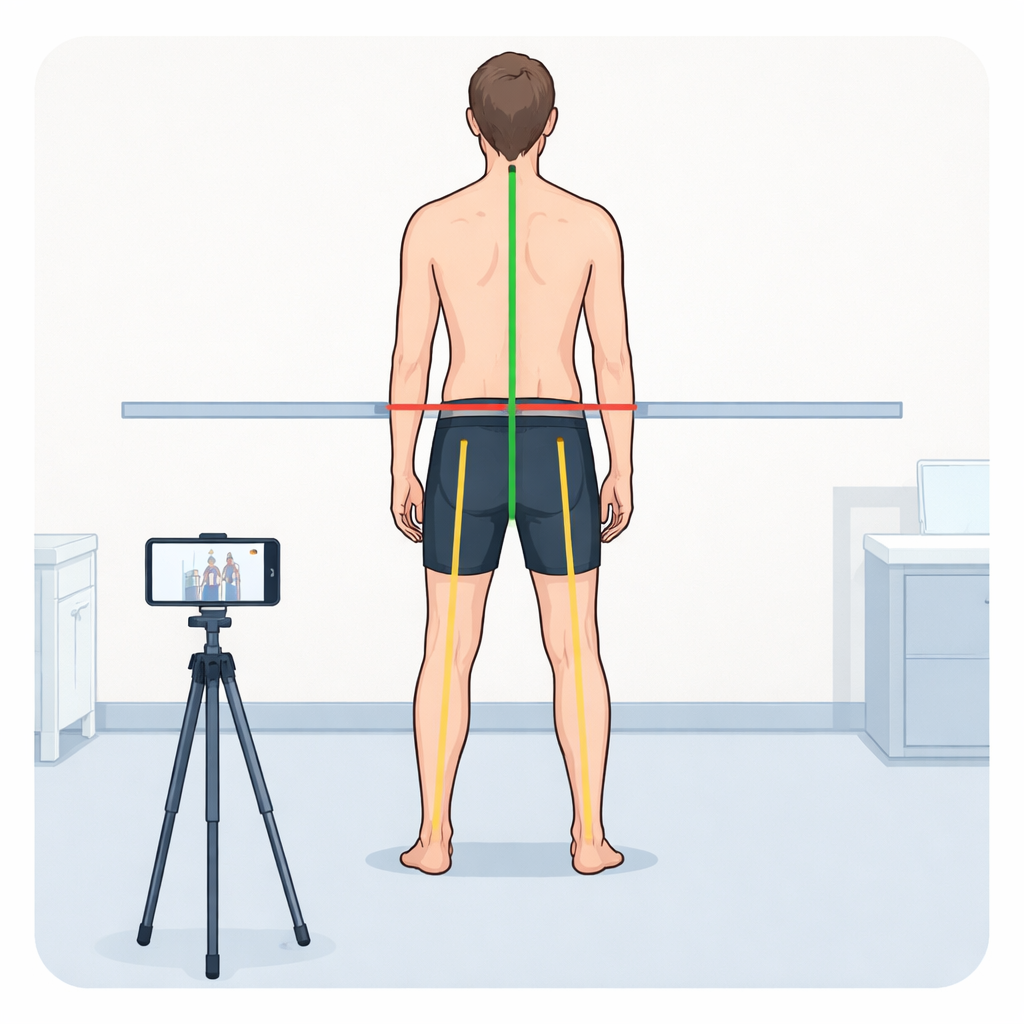
The researchers set up a practical system that could fit into a busy orthopedic clinic. Twelve adults with hip problems took part: seven had undergone total hip replacement and five had hip pain without artificial joints. Each person was filmed from behind with a single smartphone mounted on a tripod while performing the Trendelenburg test on each leg. An AI-based, markerless motion app automatically identified key body points from the video. Using these points, the team measured three things: how level the pelvis stayed, how much the trunk leaned to one side, and how the angle at the knee changed between standing on two legs and on one leg. The full process—recording and analysis—took a median of about three and a half minutes per patient, and all videos were usable.
How People Really Compensate
The measurements revealed that large pelvic drops were actually rare. Across the group, the pelvis stayed close to level when people balanced on one leg. What stood out instead was the trunk. Many patients, especially those with hip replacements, leaned their upper body toward the stance leg, a strategy that can reduce the workload on weakened hip muscles. Half of all participants, and five out of seven with artificial hips, showed trunk lean beyond a conservative cut-off used in earlier research. Changes at the knee were also common: two-thirds of the patients showed at least a three-degree shift at the knee in the front view, suggesting that the way the hip copes with weakness may redistribute forces further down the leg.
What the Numbers Can Offer Doctors
By putting numbers on pelvic tilt, trunk lean, and knee alignment, the AI-assisted approach goes beyond the usual yes-or-no grading of the Trendelenburg test. Instead of simply saying the test is positive or negative, clinicians could document exactly how many degrees the trunk leans or the pelvis tilts, and track those values over time as patients recover from surgery or work through rehabilitation. Because the system uses an ordinary smartphone and an off-the-shelf app, it could be adopted widely if it proves accurate enough. The study did not test accuracy against high-end laboratory systems or include healthy volunteers, so its results are best seen as proof that the method is workable, not yet as a replacement for gold-standard tools.
From Feasibility to Everyday Practice
In everyday terms, this research shows that a quick smartphone video can capture subtle shifts in how the body balances on one leg—information that would be hard for the naked eye to quantify. Patients with hip replacements, in particular, often keep their pelvis level by leaning their trunk and changing how their knee lines up, rather than by visibly dropping the pelvis. With further testing in larger and more varied groups, and with comparison to advanced 3D motion systems, this simple setup could evolve into a practical way to monitor hip function and guide safer, more effective rehabilitation in regular clinics.
Citation: O’Sullivan, K., Doyle, T., Quinn, E. et al. AI-assisted video analysis of the Trendelenburg test: a feasibility study. Sci Rep 16, 7733 (2026). https://doi.org/10.1038/s41598-026-38980-z
Keywords: hip abductor weakness, Trendelenburg test, AI motion analysis, total hip replacement, gait assessment