Clear Sky Science · en
Boulder concentration effects on sediment transport and deposition
Why big rocks in rivers matter
Walk along a mountain stream and you will often see large boulders breaking the surface, with pools, riffles, and patches of sand and gravel around them. These rocks do far more than simply decorate the riverbed: they shape how water moves and where sediment settles, which in turn affects flood risks and habitats for fish and insects. This study uses advanced computer simulations to explore how the number and spacing of boulders in a river control the movement and deposition of sand on the riverbed.
From lone rocks to crowded clusters
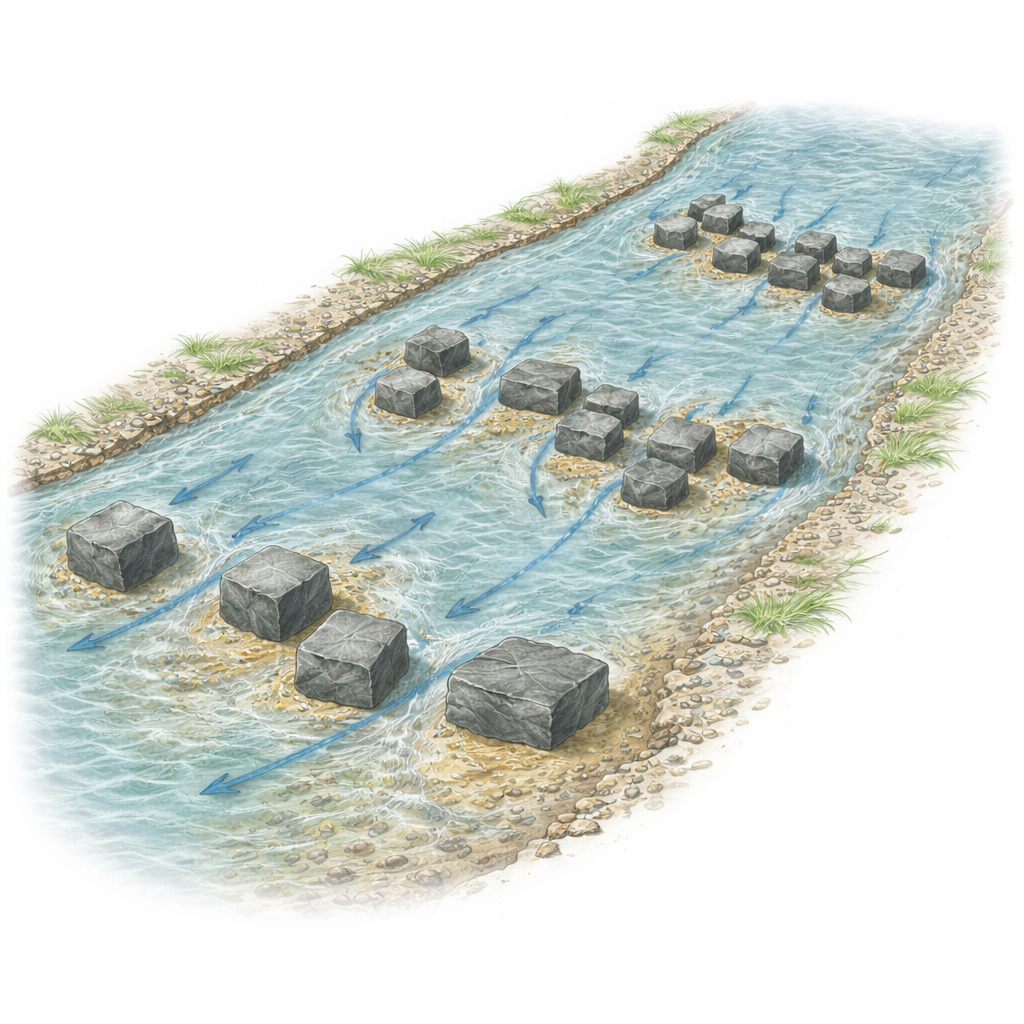
The researchers focused on three idealized riverbeds dotted with cube-shaped boulders placed in regular patterns. In one case the boulders were widely spaced, in another they were moderately spaced, and in the third they were packed closely together. These setups represent three common flow regimes that engineers and geomorphologists talk about: isolated wakes behind single obstacles, wakes that interfere with each other, and a “skimming” flow that glides over dense roughness. By comparing these cases under the same overall flow speed and water depth, the team could isolate the effect of boulder concentration on how water and sediment behave.
Simulating water and sand grain by grain
To peer inside the flow in ways that are hard to achieve in laboratory flumes, the study used a coupled Computational Fluid Dynamics–Discrete Element Method (CFD–DEM). In simple terms, the water is modeled as a swirling, turbulent fluid whose large eddies are directly resolved, while each sand grain is tracked as an individual particle responding to gravity, collisions, and drag from the water. The two models constantly exchange information: the fluid pushes on the grains, and the grains, in turn, affect the local flow. This approach allowed the authors to follow not just how fast sand moved on average, but exactly where it was picked up, where it slowed down, and where it came to rest around and between the boulders.
How boulder spacing reshapes the flow
The simulations show that boulder spacing dramatically reshapes the near-bed flow. With large gaps between boulders, each rock behaves like a stand-alone obstacle. Water slows and briefly reverses direction in a wake just behind the boulder, then gradually recovers to something like flow over a flat bed. As boulders are moved closer together, these wakes start to collide. At moderate spacing, the slowed flow behind an upstream boulder already affects the flow approaching the next one. When the boulders are packed tightly, their wakes merge into a broad recirculating zone that fills the space between them. In this crowded case, the water near the bed between boulders is much slower and even flows backward in places, and the usual strong swirling vortices around each rock are weakened.
Where the sand moves and where it stays
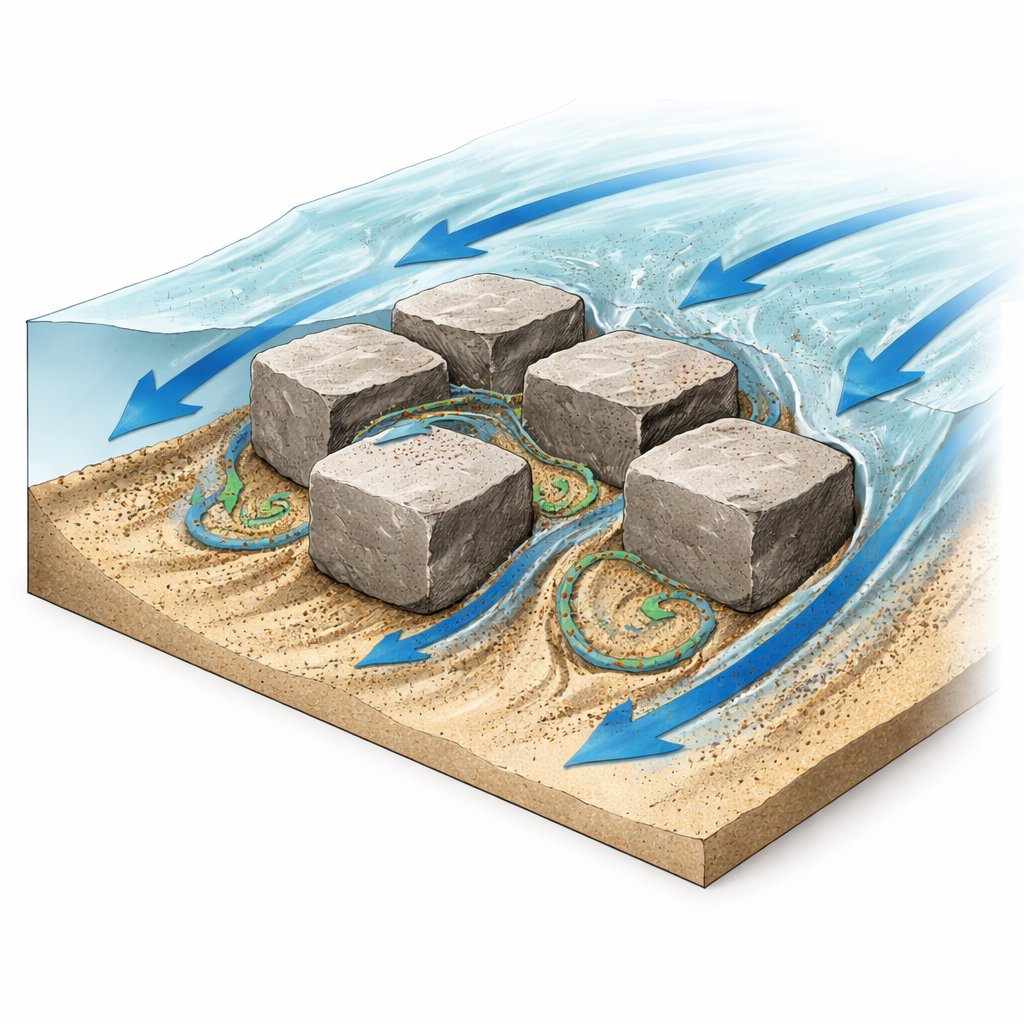
These changes in flow translate directly into different sediment patterns. For widely spaced boulders, sand is scoured from the front of each rock and swept around the sides, then settles in compact patches in the sheltered wake downstream. Each boulder creates its own small deposition zone, and the overall sand transport rate remains relatively high. At moderate spacing, those wake patches still appear, but the wakes of neighboring boulders start to overlap, subtly shifting where sand comes to rest. When the boulders are very close together, the picture changes sharply: the merged, slow-moving recirculation between boulders produces elongated "corridors" of deposited sand that run along the array. At the same time, the weaker near-bed flow means fewer grains are strong enough to keep moving, and the total sand transport rate drops by roughly half compared with the more open arrangements.
What it means for rivers and restoration
For non-specialists, the main takeaway is that adding more boulders to a stream does not simply make the flow rougher; it can fundamentally reorganize the currents near the bed and strongly reduce how much sand is carried downstream. Dense boulder clusters tend to trap sediment in stable belts between the rocks, while sparse boulders leave sand more mobile and deposits more scattered. These insights are valuable for river restoration projects that use engineered boulder placements to create habitat, stabilize beds, or manage erosion. By choosing boulder size and spacing carefully, practitioners can encourage sand to settle where it protects the bed and forms refuges for aquatic life, while avoiding unwanted clogging or excessive scouring elsewhere.
Citation: Teng, P., Nilsson, D.A., Andersson, A.G. et al. Boulder concentration effects on sediment transport and deposition. Sci Rep 16, 5881 (2026). https://doi.org/10.1038/s41598-026-38978-7
Keywords: river boulders, sediment transport, turbulent flow, river restoration, aquatic habitat