Clear Sky Science · en
Movement speed of an autonomous prosthetic limb shapes embodiment, usability and robotic social attributes in virtual reality
Why how a robotic arm moves really matters
Robotic prosthetic limbs are becoming more capable every year, promising not only to restore movement after limb loss but also to feel like a natural part of the body. Yet one surprisingly simple question has not been well studied: does the speed at which an autonomous prosthetic arm moves change how “natural,” safe, and usable it feels to the person wearing it? This study used virtual reality to explore how different movement speeds shape people’s sense that a robotic arm belongs to them, responds on their behalf, and behaves like a trustworthy partner rather than a jittery machine.
Trying on a virtual robotic arm
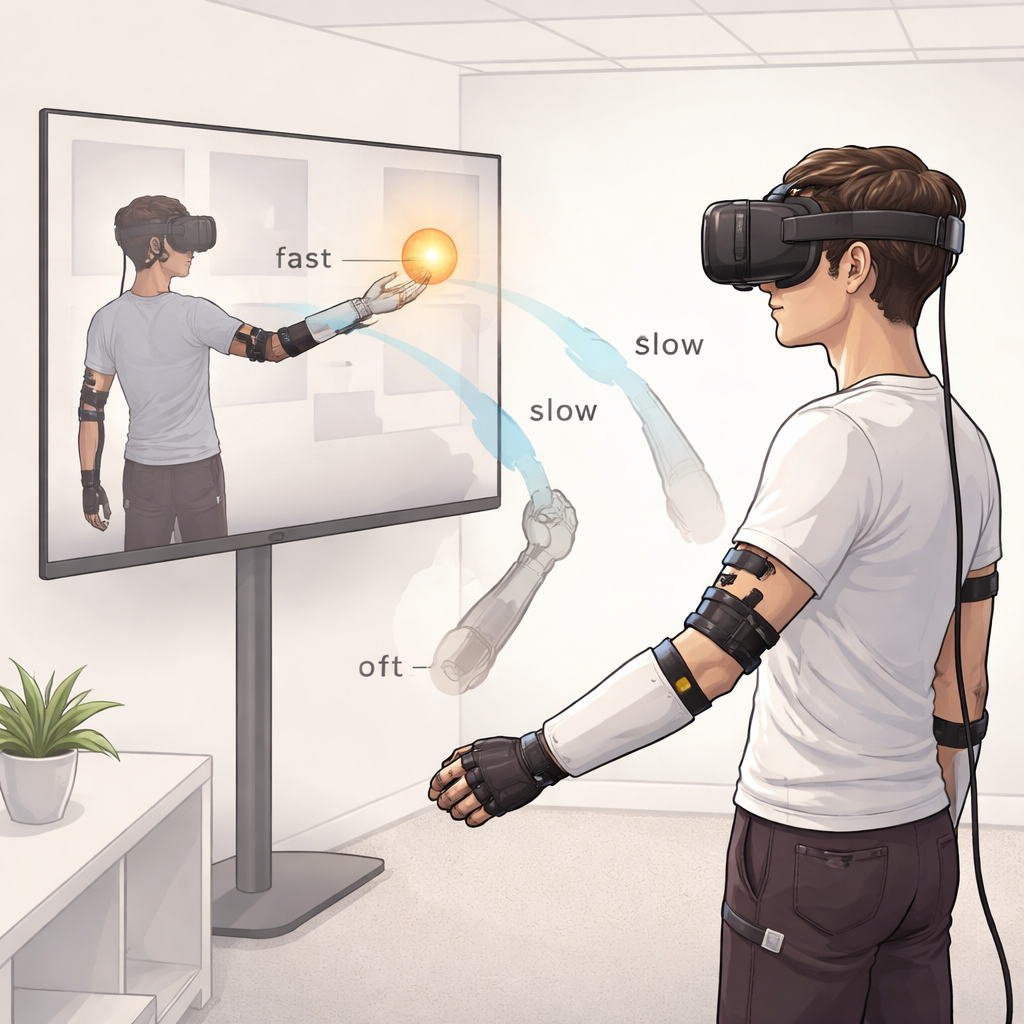
To tackle this question, the researchers placed volunteers in an immersive virtual reality environment and gave them a digital body with an amputated left forearm. In the virtual world, the missing section of the arm was replaced by a sleek robotic forearm that could bend on its own. Participants controlled their upper arm and shoulder, but when their virtual elbow got close enough to a glowing target, the prosthetic forearm automatically swung in to complete the reach. The motion followed a smooth “minimum-jerk” path, a kind of gently curving trajectory known to resemble natural human movement.
Six different speeds, one simple task
The key twist was that the automatic bend of the prosthetic forearm could be very fast or very slow. The team tested six motion durations, from a blistering 125 milliseconds to a leisurely 4 seconds, with several steps in between. In each speed condition, volunteers performed a series of reaching trials, trying to touch appearing targets as quickly as possible. After each block of trials, they rated how strongly they felt the arm was their own (body ownership), how much they felt the movements were “their” movements (sense of agency), how usable the system was, and how the arm scored on robot-like social traits such as competence, warmth, and discomfort. The researchers also measured how quickly people moved their real upper arm toward the target before the prosthetic took over.
Medium speed feels most like part of the body
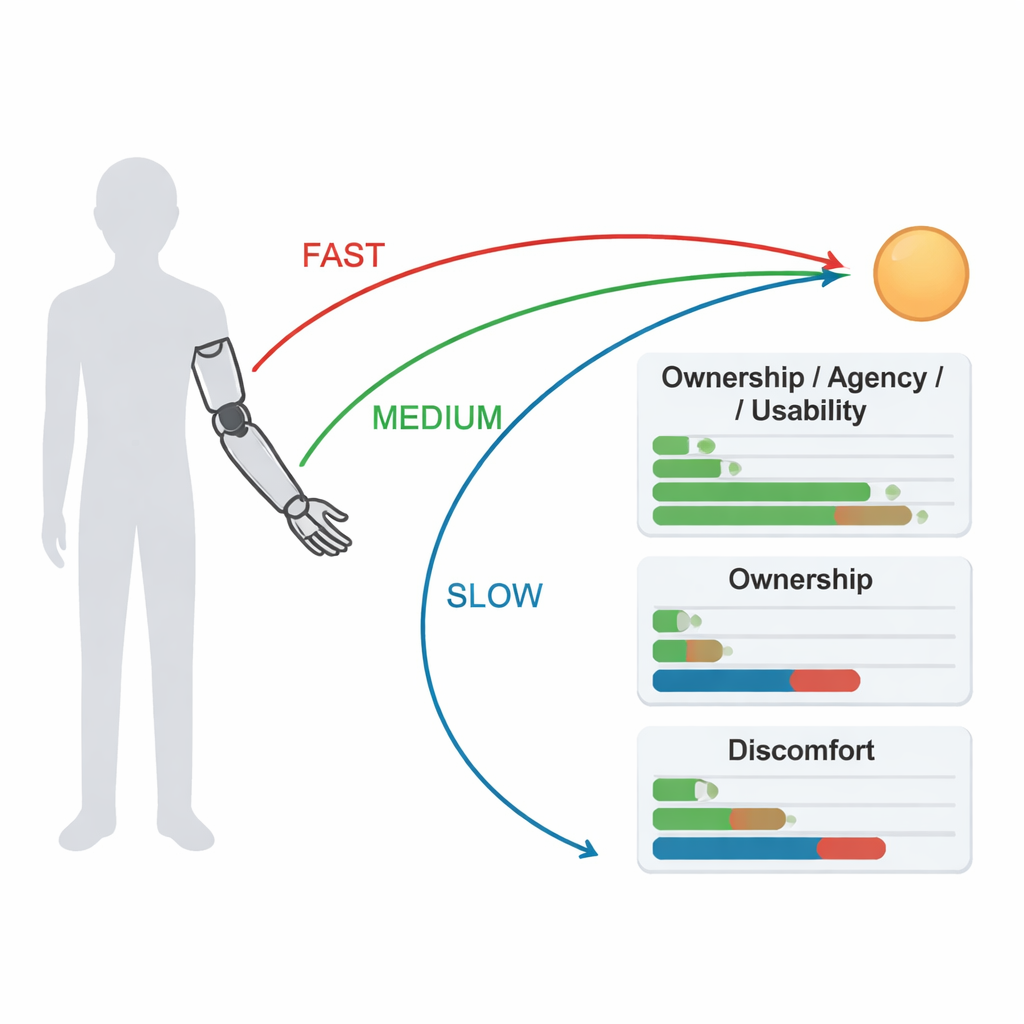
The results painted a clear picture: a moderate movement duration of about one second produced the strongest sense of body ownership and agency, as well as the highest usability scores. When the prosthetic moved either much faster (125 ms) or much slower (4 s), people felt less that it was part of their body and less that it was acting on their behalf. A slightly quicker half‑second motion also performed well, maintaining high ownership and agency compared with the extremes. This pattern suggests there is a sweet spot in speed where an autonomous limb feels both natural and helpful, and that rushing or dragging the movement makes it harder for the brain to integrate the device into its body image.
Comfort, competence, and how people adapt
The way the arm’s speed shaped its “personality” was just as revealing. Movements at moderate speeds were judged to be more competent than the slowest motions, while the very fastest movements made people feel the most discomfort, echoing earlier findings with stand‑alone robots. Interestingly, ratings of warmth—roughly, how friendly and approachable the arm seemed—did not change much with speed. People also subtly changed their own behavior: when the prosthetic moved slowly, they tended to move their real upper arm more slowly toward the target, as if unconsciously matching the robot’s pace. This adaptation hints that once an autonomous limb is partly embodied, the user may tune their own movements to better coordinate with it.
What this means for future prosthetic limbs
For non‑experts, the takeaway is straightforward: how fast an autonomous prosthetic moves is not just a technical setting; it directly shapes whether the user feels that the device is truly part of them and whether it feels safe and competent. In this virtual reality study with healthy participants, movements lasting around one second struck the best balance, maximizing feelings of ownership, control, and usability while avoiding the unease triggered by ultra‑fast motions. As more advanced prosthetic and wearable robotic devices enter everyday life, carefully tuning movement speed—and keeping it within a human‑like, comfortable range—may be just as important as adding more sensors or smarter algorithms if we want these devices to be both effective tools and genuinely livable extensions of the body.
Citation: Hapuarachchi, H., Inoue, Y., Shigemasu, H. et al. Movement speed of an autonomous prosthetic limb shapes embodiment, usability and robotic social attributes in virtual reality. Sci Rep 16, 7750 (2026). https://doi.org/10.1038/s41598-026-38977-8
Keywords: prosthetic limbs, virtual reality, embodiment, human-robot interaction, movement speed