Clear Sky Science · en
The expression of MALAT1 long non-coding RNA is associated with good prognosis in mantle cell lymphoma
Why this cancer study matters
Mantle cell lymphoma is an aggressive form of blood cancer that often returns after treatment and can be difficult to control. This study looks at a little-known type of genetic material called MALAT1, a long non-coding RNA that does not make proteins but can still influence how cells behave. By following more than 200 patients, the researchers discovered that higher levels of MALAT1 — and a partner molecule called TALAM1 — are linked to slower-growing tumors and longer survival. Their findings could help doctors better predict outcomes and may point to new ways to make treatments more effective.
A hidden RNA with a surprising message
Most people have heard of genes that code for proteins, but our DNA also produces many long non-coding RNAs that act more like managers than workers. MALAT1 is one of these and has attracted attention because it is altered in many cancers. In several solid tumors, extra MALAT1 has been tied to more aggressive disease, leading many to view it as a cancer-promoting molecule. The researchers wanted to know whether this was also true in mantle cell lymphoma, a B-cell cancer that is usually fast-growing and largely incurable. They also examined TALAM1, a natural “mirror” transcript of MALAT1 that helps process MALAT1 into its active form.
Tracking patient outcomes and tumor behavior
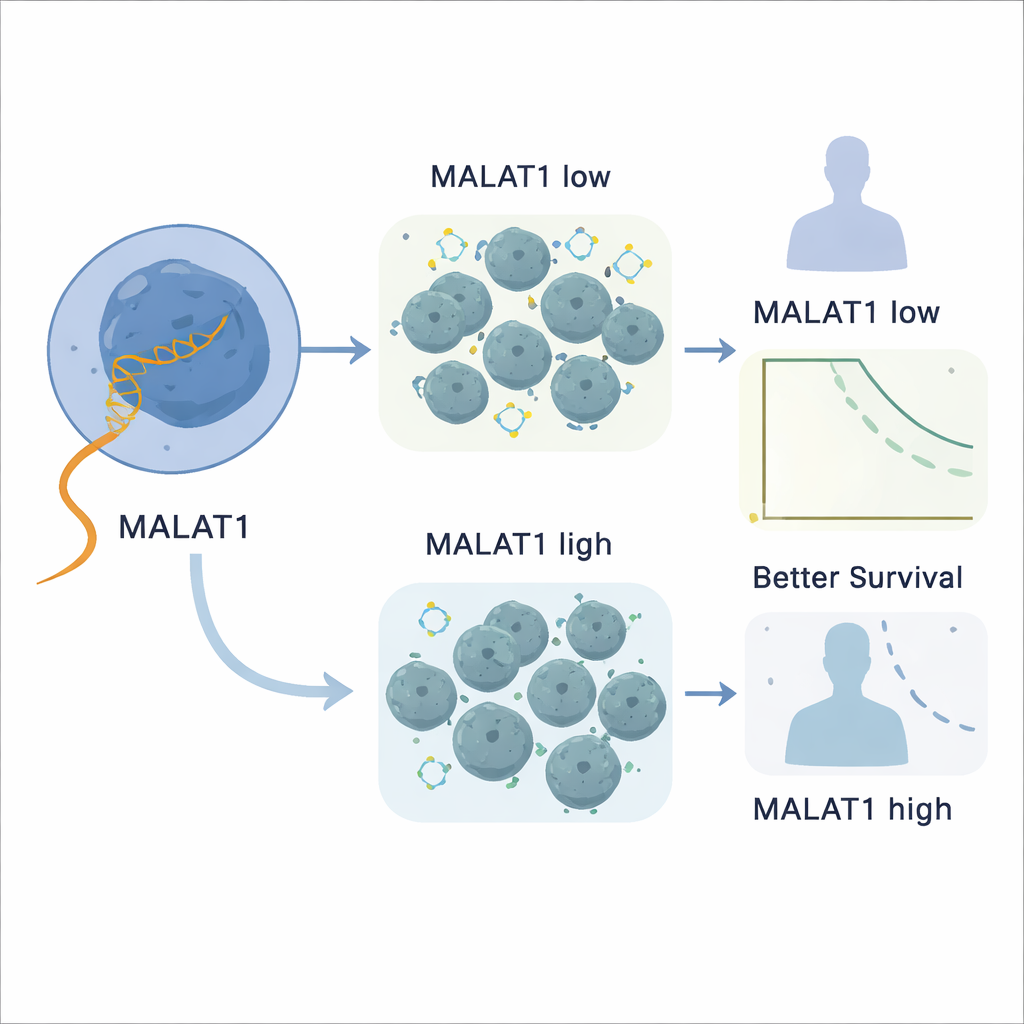
The team analyzed MALAT1 and TALAM1 levels in three independent groups of mantle cell lymphoma patients, together covering 219 primary tumors from lymph nodes and blood. They compared RNA levels with clinical details such as how long patients lived after sampling, what the tumor cells looked like under the microscope, and whether they carried known high-risk genetic changes. In two well-characterized cohorts, patients whose tumors had high MALAT1 or TALAM1 expression lived significantly longer than those with low levels. This benefit appeared in both nodal and leukemic forms of the disease and was independent of markers like SOX11 status or TP53 alterations, suggesting that MALAT1 and TALAM1 provide additional prognostic information rather than simply mirroring other risk factors.
Slower growth and quieter signaling
To understand why high MALAT1 and TALAM1 might be favorable, the scientists looked at gene expression “signatures” that capture how active certain cellular programs are. In lymph node samples, they used a validated 35-gene panel that scores how rapidly mantle cell lymphoma cells are proliferating. Tumors with higher MALAT1 and TALAM1 tended to have lower proliferation scores and clustered with a gene group previously linked to better patient outcomes. In blood samples, they studied a 27-gene signature of B‑cell receptor signaling, a pathway that, when highly active, drives more aggressive disease. Here, too, cases with strong signaling had lower MALAT1, while those with higher MALAT1 showed quieter signaling patterns. Altogether, the molecular data aligned with the clinical picture: more MALAT1/TALAM1 went hand-in-hand with less aggressive tumor behavior.
Testing cause and effect in 3D tumor models
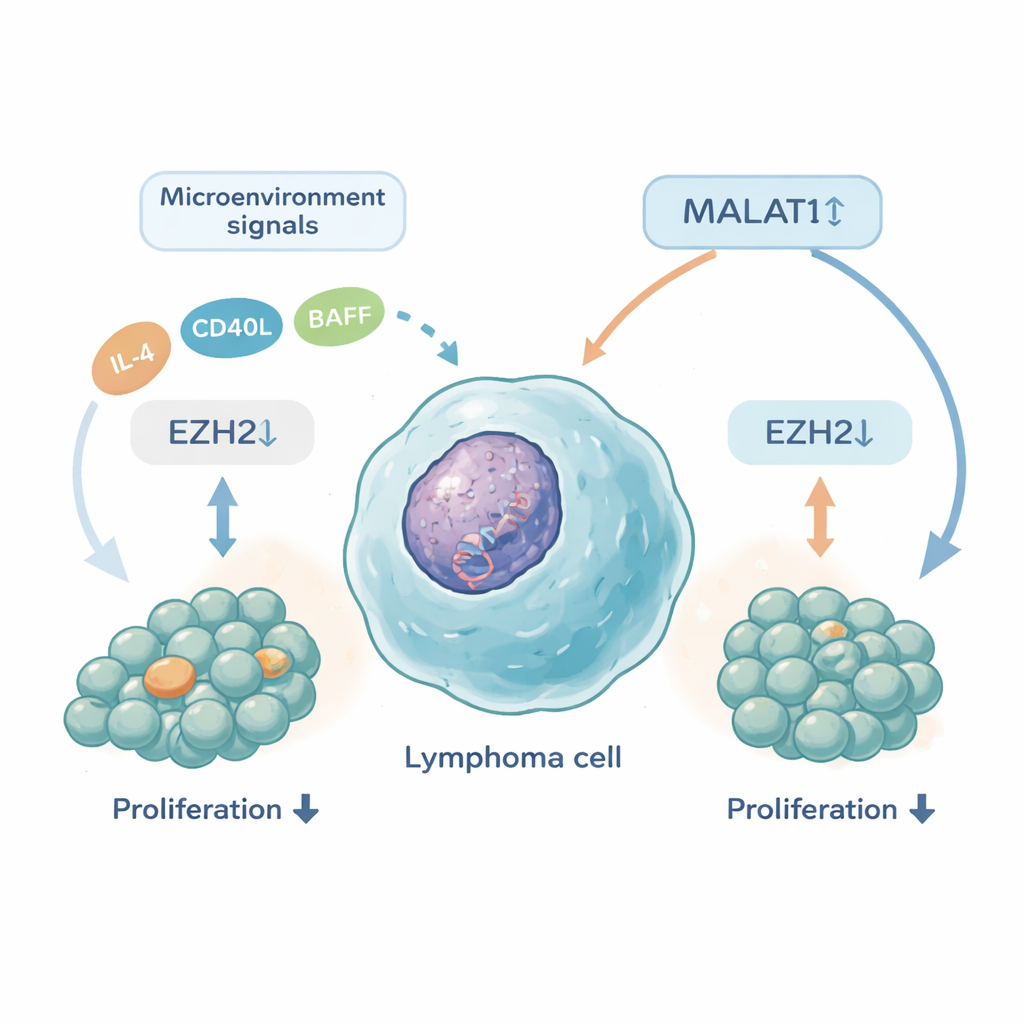
Association alone does not prove that MALAT1 influences how lymphoma cells grow, so the researchers turned to three-dimensional “spheroid” cultures made from patients’ own tumor cells. In this model, cells are exposed to growth and survival signals that mimic the lymph node microenvironment. When only a survival factor (BAFF) was present, cell growth slowed and MALAT1 levels rose; adding strong growth signals (IL‑4 and CD40L) reversed this pattern, boosting cell division while lowering MALAT1. The team also studied EZH2, an epigenetic enzyme previously linked to poor prognosis. Under pro-growth conditions, EZH2 increased and MALAT1 dropped, while blocking EZH2 activity with a drug drove MALAT1 levels up and reduced cell growth. Silencing MALAT1 directly nudged cells toward more proliferation and higher EZH2, reinforcing the idea that MALAT1 helps restrain, rather than fuel, tumor expansion in this setting.
What it means for patients and future therapies
For people with mantle cell lymphoma, these findings suggest that measuring MALAT1 and TALAM1 could help separate patients whose disease is likely to behave more calmly from those at higher risk, beyond what is captured by current genetic tests. More broadly, the work shows that the same RNA molecule can act as a promoter of cancer in some tissues and as a brake in others, depending on the surrounding signals. In mantle cell lymphoma, high MALAT1 seems to oppose microenvironment-driven growth programs and the cancer-linked enzyme EZH2. While it is too early to use MALAT1-targeted therapies in the clinic, strategies that preserve or enhance its activity might one day complement existing treatments and help counteract the powerful growth cues that tumor cells receive from their neighborhood.
Citation: Fernández-Garnacho, E.M., Martínez-Muñoz, C., Nadeu, F. et al. The expression of MALAT1 long non-coding RNA is associated with good prognosis in mantle cell lymphoma. Sci Rep 16, 7655 (2026). https://doi.org/10.1038/s41598-026-38971-0
Keywords: mantle cell lymphoma, MALAT1, long non-coding RNA, EZH2, prognostic biomarker