Clear Sky Science · en
Comparative assessment of machine learning models for daily streamflow prediction in a subtropical monsoon watershed
Why river forecasts matter to everyday life
Rivers in monsoon regions can rise from calm to catastrophic within hours, threatening lives, homes, and water supplies. Accurately predicting how much water will flow down a river each day underpins flood warnings, reservoir operations, and the taps that supply cities. This study looks at a subtropical river system in South China and asks a practical question with global relevance: among today’s popular machine‑learning tools, which ones actually do the best job of forecasting daily river flow, especially during dangerous floods?
A storm‑prone river under pressure
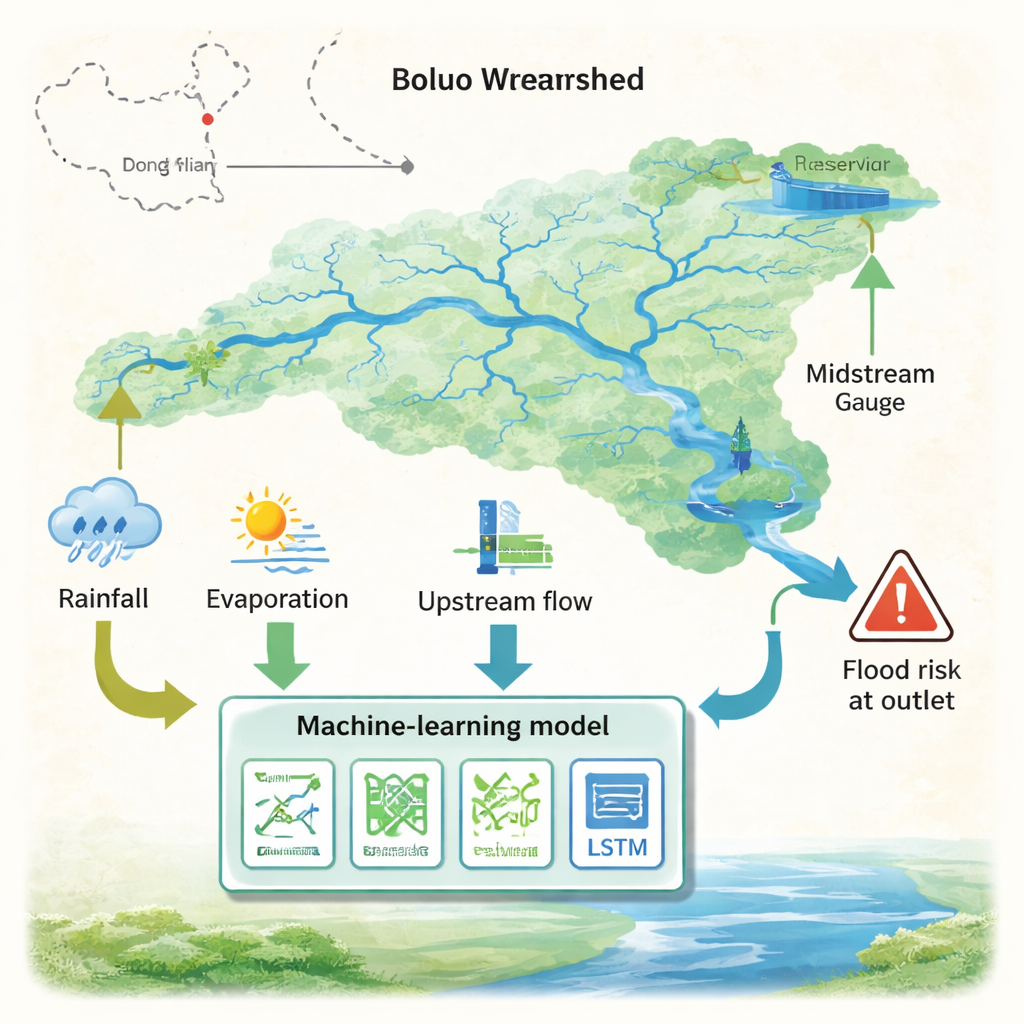
The research focuses on the Boluo watershed, part of the Dongjiang River that helps supply water to the Guangdong–Hong Kong–Macao Greater Bay Area. The region has a classic monsoon climate: most rain falls in a few intense months, often delivered by frontal systems and typhoons. On top of this natural volatility, a major reservoir and other human activities reshape the timing and size of flows. The authors assembled decades of daily data from rain gauges, weather stations, and river‑flow gauges at key locations, then split the records into training years and test years to mimic real‑world forecasting. This allowed them to see how different algorithms cope with a river system that is both highly seasonal and heavily managed.
Seven digital forecasters go head‑to‑head
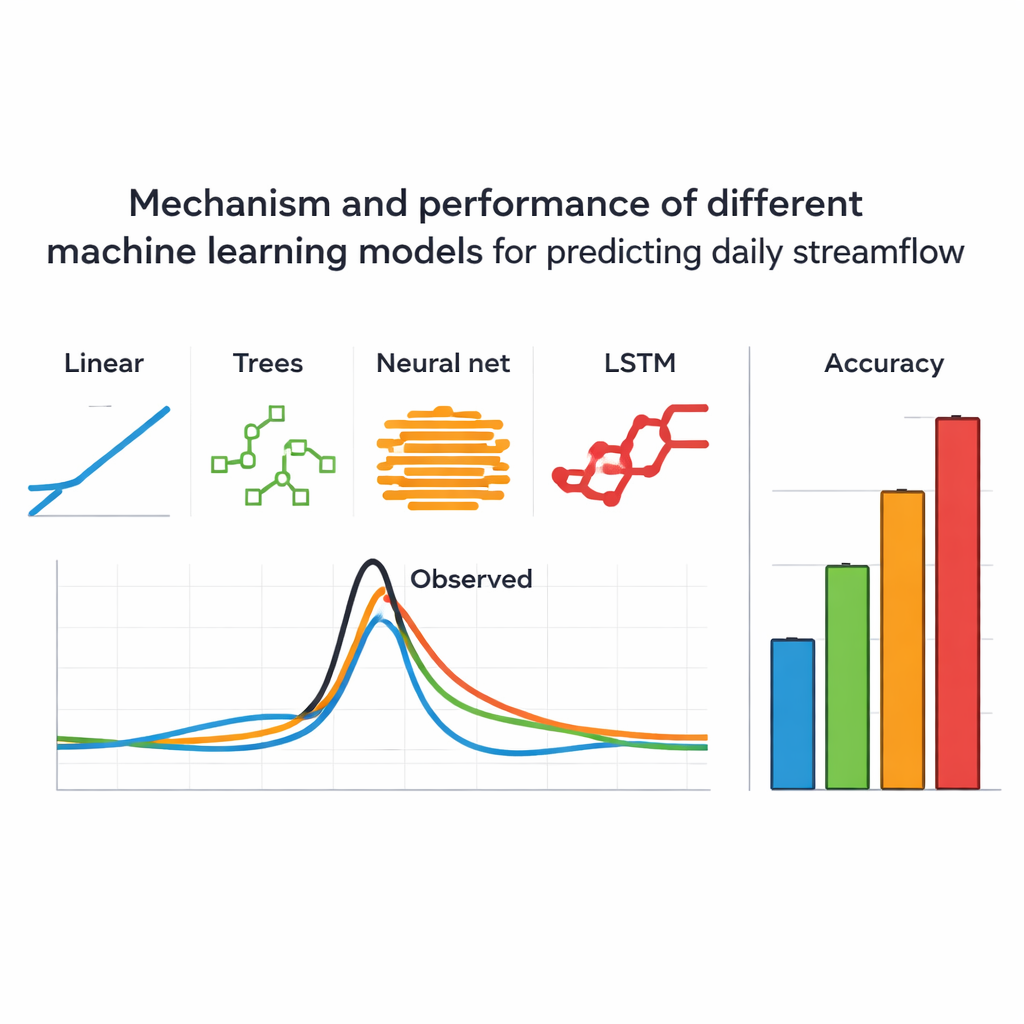
The team compared seven widely used machine‑learning models: a simple Linear Regression, three types of tree‑based ensembles (Random Forest, Extra Trees, and Gradient Boosting, including XGBoost), a classic Artificial Neural Network, and a more advanced Long Short‑Term Memory (LSTM) neural network designed to handle sequences over time. Each model was carefully tuned using the same procedures and evaluated with several accuracy scores. Across the full range of conditions, all seven produced reasonably good forecasts, confirming that data‑driven approaches are powerful tools for river prediction. However, clear differences emerged. The LSTM model came out on top, closely followed by the conventional neural network, while the plain linear model performed surprisingly well and beat all of the tree‑based methods.
How models behave when rivers roar
Floods are where forecasting really counts, so the authors zoomed in on high‑flow days and on three of the largest flood events in the record. Under these extreme conditions, the contrasts sharpened. The LSTM kept its footing, remaining the most accurate when flows exceeded the 90th, 95th, and even 99th percentiles—days when the river is at its most dangerous. It still underestimated some peaks, but typically by less than 20 percent. The standard neural network did reasonably well, whereas tree‑based models often missed peak sizes by 30 to 50 percent and performed worse than simply using the long‑term average on the very highest‑flow days. Yet most models correctly timed the day of the peak within about one day, which is crucial for issuing warnings, even if the exact height is off.
What really drives the river’s ups and downs
To move beyond “black box” predictions, the study examined which inputs mattered most to the models. Multiple techniques, including a game‑theory‑inspired method called SHAP, pointed to the same answer: the flow measured at an upstream gauge called Lingxia dominated the forecasts. In other words, yesterday’s river level upstream was usually more informative than today’s rainfall totals. This reflects a kind of hydrological memory, where the river integrates the effects of recent storms, soil wetness, and groundwater into its current flow. When the researchers removed upstream‑flow data, the LSTM’s skill dropped sharply; when they removed rainfall data, performance barely changed. This suggests that in daily forecasting for this watershed, tracking how much water is already in the system may matter more than adding more rain gauges.
What the findings mean for flood safety
For non‑specialists, the takeaway is straightforward: smart models that remember yesterday’s conditions, like LSTMs, can give more reliable river forecasts than many popular alternatives, particularly when floods loom. At the same time, a well‑designed simple model can still be surprisingly effective, especially when good upstream‑flow measurements are available. The work underscores that improving flood prediction is not just about using fancier algorithms or more rainfall data; it is about capturing the river’s built‑in memory and combining data‑driven tools with physical understanding. Such advances can help water managers in monsoon‑affected regions make earlier, more confident decisions when the next big storm approaches.
Citation: Zhang, Z., Xiao, Y., Chen, R. et al. Comparative assessment of machine learning models for daily streamflow prediction in a subtropical monsoon watershed. Sci Rep 16, 7341 (2026). https://doi.org/10.1038/s41598-026-38969-8
Keywords: streamflow prediction, flood forecasting, machine learning, LSTM neural networks, monsoon rivers