Clear Sky Science · en
Orbital-resolved tuning of electronic thermal conductivity in monolayer h-B2O via doping in the diffusive regime
Why a one-atom-thick sheet matters for heat
As our phones, laptops, and future quantum devices shrink, getting rid of heat becomes one of the biggest engineering headaches. This paper explores a new ultra-thin material called honeycomb borophene oxide (h‑B2O), only one atom thick, that carries heat in an unusual and highly directional way. By understanding and controlling how electrons move heat through this sheet, scientists hope to design tiny components that either spread heat efficiently or deliberately keep it trapped for energy-harvesting devices. 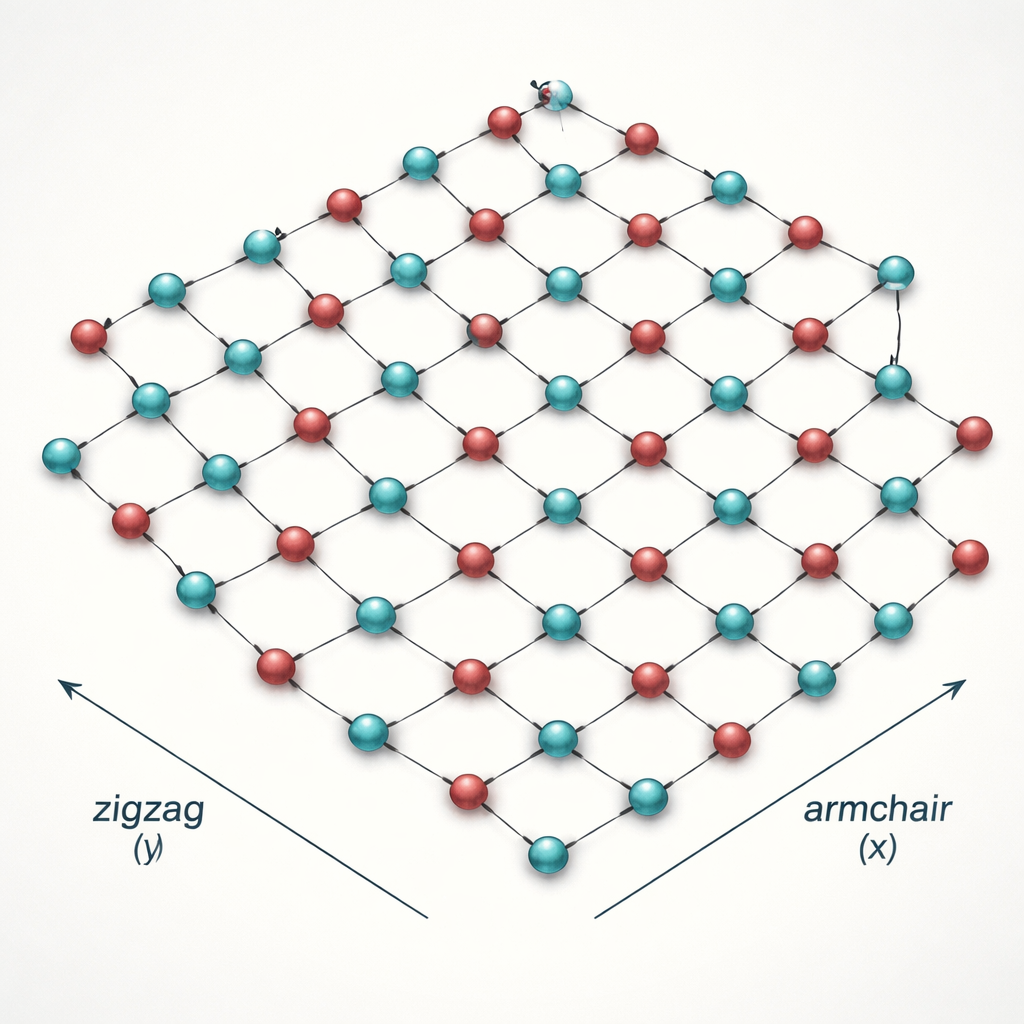
A new cousin of graphene
Since the discovery of graphene, researchers have been hunting for other single-atom-thick crystals with special electronic and thermal properties. Boron, a neighbor of carbon, can form its own flat networks called borophene, and when oxygen atoms are added in just the right way, the result is h‑B2O, a stable, perfectly flat, honeycomb-like sheet. Earlier studies showed that this material is mechanically robust, can host exotic electronic states called nodal loops, and might even become superconducting at low temperatures. This makes h‑B2O a promising platform for next‑generation electronics, hydrogen storage, and catalysis, if its thermal behavior can be fully mapped out.
Following the electrons, not just the vibrations
In solids, heat can travel in two main ways: through vibrating atoms (phonons) and through moving electrons. For h‑B2O, the vibration‑based part had already been calculated, but the electron‑based part remained unknown. The authors build a simplified yet accurate mathematical model that focuses on two specific electronic states of boron atoms, called Py and Pz orbitals. These two “channels” dominate how electrons behave near the energy levels that matter for transport. Using a quantum‑mechanical approach known as the Kubo–Greenwood formalism, they compute how much heat electrons can carry in three directions: along one lattice axis (“armchair”), along the other (“zigzag”), and sideways, in an effect analogous to a thermal Hall response. 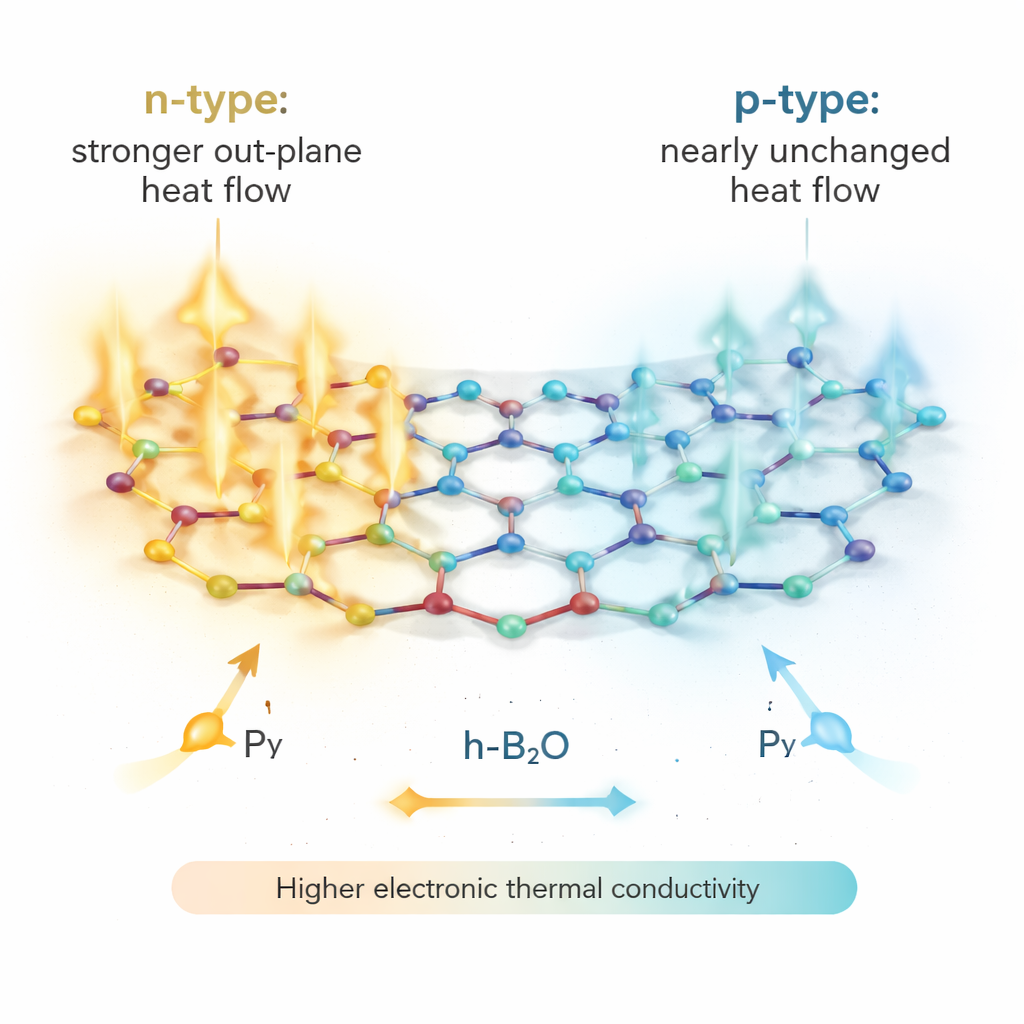
Heat prefers one direction and one orbital
The calculations reveal that electronic heat flow in h‑B2O is strongly one‑sided: along the zigzag direction it is far larger than along the armchair direction. This directional preference stems from subtle distortions in the hexagonal pattern, which change how strongly neighboring boron atoms interact. Electrons traveling along zigzag paths see better “highways,” while those along armchair paths face more resistance. The Pz orbital, which sticks out of the plane, provides more available electronic states near the key energy levels and allows electrons to move more freely, so it carries most of the electronic heat. The in‑plane Py orbital contributes much less, even though it is still important for shaping the overall electronic structure.
Turning a thermal dial with impurities
Real devices are never perfectly clean, so the team studies how added impurities—extra atoms or defects that donate electrons (n‑type) or remove them (p‑type)—change electronic heat transport. Using a technique called the T‑matrix method to handle scattering from these impurities, they find that n‑type doping actually boosts the electronic thermal conductivity, especially through the Pz channel. Adding electrons fills out‑of‑plane states that act like extra lanes for heat‑carrying electrons, while the Py channel becomes slightly more localized and less effective. The total electrical heat flow still goes up in all directions, though not equally. In contrast, p‑type doping produces only modest changes: Py gains a little, Pz loses a little, and the overall electronic heat transport remains nearly unchanged and stable over a range of temperatures and impurity levels.
What this means for future devices
To a non‑specialist, the message is that h‑B2O behaves like a highly directional, tunable heat wire at the atomic scale. Its electrons prefer to carry heat along one in‑plane direction and mostly through a particular orbital channel. By choosing how to dope the material—adding electron‑donating or hole‑creating impurities—engineers can either strongly enhance this electronic heat flow (with n‑type doping) or keep it almost unchanged (with p‑type doping). Combined with its structural stability and unusual electronic states, this makes monolayer h‑B2O a strong candidate for nanoscale thermoelectric modules that convert waste heat into electricity, as well as for on‑chip thermal management elements designed to steer heat away from, or toward, specific regions of a device.
Citation: Mohammadi, F., Mirabbaszadeh, K. & Noshad, H. Orbital-resolved tuning of electronic thermal conductivity in monolayer h-B2O via doping in the diffusive regime. Sci Rep 16, 7679 (2026). https://doi.org/10.1038/s41598-026-38967-w
Keywords: two-dimensional materials, borophene oxide, electronic thermal conductivity, anisotropic heat transport, doping control