Clear Sky Science · en
Effects of steel slag content on the performance of alkali-activated coal gangue-slag mortar
Turning Waste into Stronger, Greener Buildings
Modern cities rely on concrete and mortar, but making traditional cement spews large amounts of carbon dioxide and the resulting materials can crack and shrink over time. This study explores a way to tackle both problems at once: it recycles industrial waste from coal and steel production into a new kind of mortar that not only cuts emissions but also becomes stronger and less prone to shrinkage and cracking.
Why Cracking is a Hidden Danger
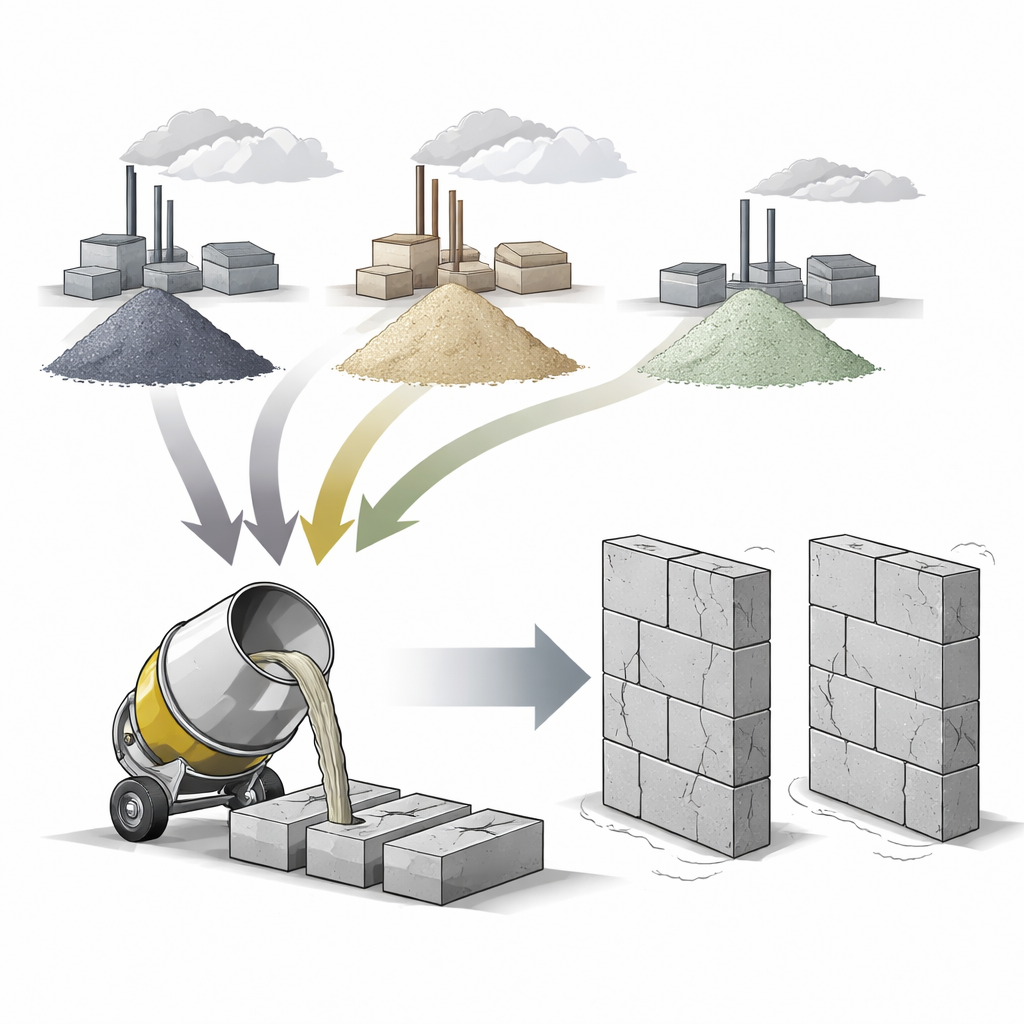
Many eco-friendly cement alternatives, known broadly as alkali-activated materials, have impressive strength and durability. Yet they often suffer from a serious drawback: they shrink more than ordinary Portland cement as they dry. That shrinkage can open up a web of tiny cracks. Over time, these cracks invite water and corrosive chemicals into walls and foundations, undermining the safety and lifespan of buildings. Fixing this problem usually requires special additives or strict curing conditions, which raise costs and limit widespread use.
Giving Steel and Coal Waste a Second Life
The researchers focused on three powdery by-products from heavy industry: steel slag from steelmaking, coal gangue from coal mining, and ground granulated blast furnace slag from iron production. These materials are often piled in vast heaps, taking up land and posing environmental risks. In this work, blast furnace slag was kept at half of the total binder to ensure basic strength, while coal gangue was gradually replaced with steel slag in different amounts. With an alkaline liquid to trigger hardening, these powders were mixed into a mortar, cast into small blocks, and tested for flow, strength, and drying shrinkage, then examined under a suite of microscopes and chemical probes.
Finding the Sweet Spot for Steel Slag
The experiments showed that adding some steel slag improves how the fresh mortar flows, making it easier to place in molds, and significantly boosts its strength over time. When 40% of the coal gangue was replaced by steel slag, the 28-day compressive strength rose by about 42%, reaching over 70 megapascals, while drying shrinkage dropped by nearly 29% compared with mixes without steel slag. Below this level, the gains were smaller; above it, performance began to suffer. With 50% steel slag, the mortar lost strength and no longer shrank less. The authors trace this downturn to a shortage of reactive silicon and aluminum, which are essential building blocks for the binding gels that hold the material together.
What Happens Inside the Hardened Mortar
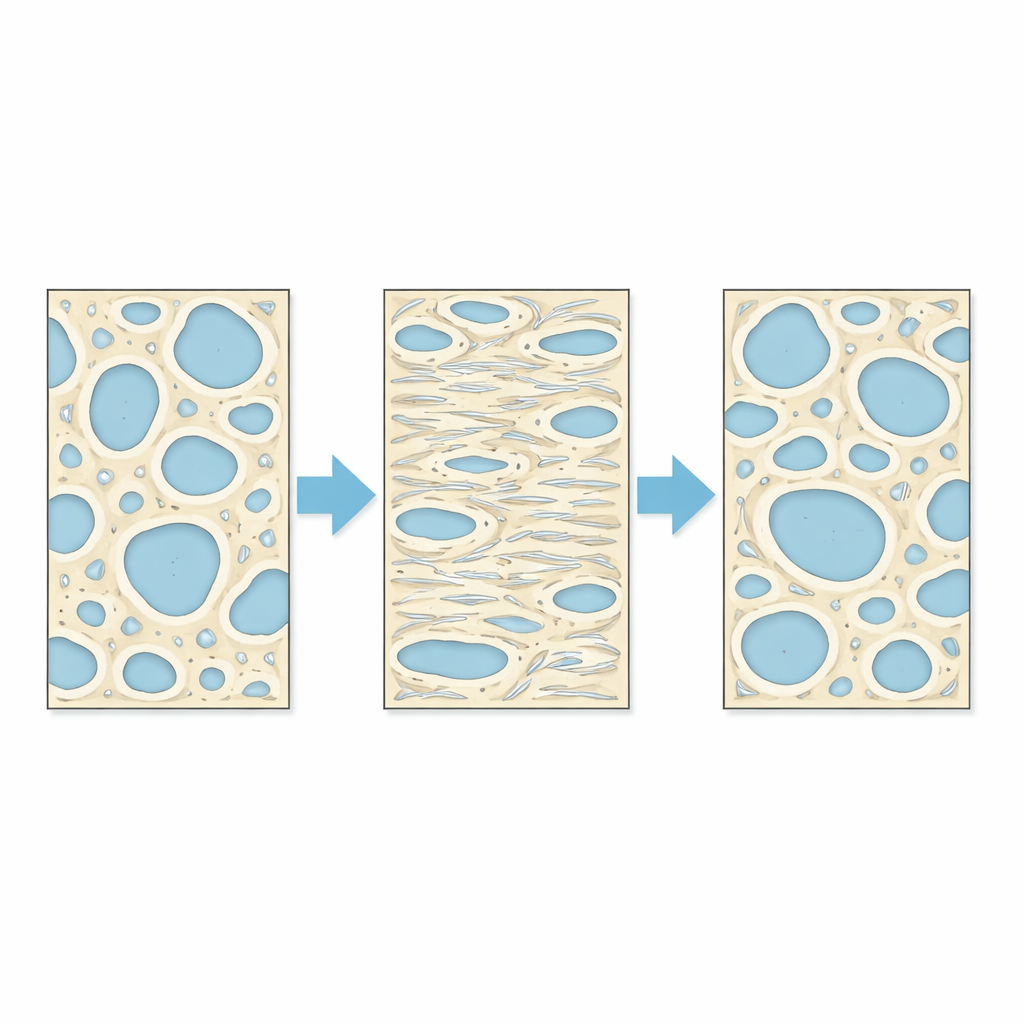
To see why 40% steel slag worked so well, the team looked at the hardened mortar at the microscopic level. They found that steel slag changes how the internal structure develops over time. Early on, it slows the reaction slightly, helping the material hold onto water and reducing rapid drying. Later, however, it reacts more strongly, feeding calcium into the system. This leads to extra gel-like binding phases and abundant needle-shaped crystals called ettringite. Together, these products weave through the material, filling pores, tying particles together, and resisting deformation. Measurements of pore size confirmed that the optimal mix had fewer of the mid-sized pores most responsible for shrinkage, resulting in a denser, more stable network.
From Lab Mortar to Real-World Use
In plain terms, the study shows that carefully balancing steel slag in this waste-based mortar can turn a cracking-prone green material into a tougher, more reliable one. Around 40% steel slag replacement gives a combination of high strength, reduced cracking risk, and better workability, while still consuming large amounts of industrial waste and avoiding the high carbon footprint of conventional cement. Although the work focused on a 28-day window, it points toward practical recipes for greener construction materials that make better use of what industry currently throws away.
Citation: Huang, T., Xie, Q., Deng, J. et al. Effects of steel slag content on the performance of alkali-activated coal gangue-slag mortar. Sci Rep 16, 7993 (2026). https://doi.org/10.1038/s41598-026-38962-1
Keywords: steel slag, green concrete, industrial waste recycling, drying shrinkage, alkali-activated mortar