Clear Sky Science · en
The synergistic effect of grafting and LED light quality on enhancing the mineral nutrition and growth performance of tomato seedlings
Why tomato seedlings and colored light matter
Tomatoes are a cornerstone of modern diets and a major source of income for farmers around the world. Before these plants ever reach a greenhouse or field, they start life in nurseries as young seedlings. How those seedlings are raised strongly shapes their later yield, resilience, and nutritional value. This study explores how two technologies—grafting tomato plants onto strong root systems and using finely tuned red and blue LED lighting—can work together to grow sturdier, better-nourished seedlings for modern agriculture.
Two tools for stronger young plants
Nurseries increasingly graft tomato varieties with desirable fruits onto special rootstocks that are better at withstanding stress and absorbing water and nutrients. At the same time, they are replacing old-fashioned lamps with LED lights that can be adjusted to emit precise colors. Red and blue light are especially important, because plants sense and use these colors differently to shape their form and drive photosynthesis. Until now, most research looked at grafting and light color separately. The authors of this paper asked whether these two tools might interact—whether the light shining on the leaves could actually change how effectively a vigorous rootstock pulls minerals from the growing medium.
Testing red, blue, white, and mixed light
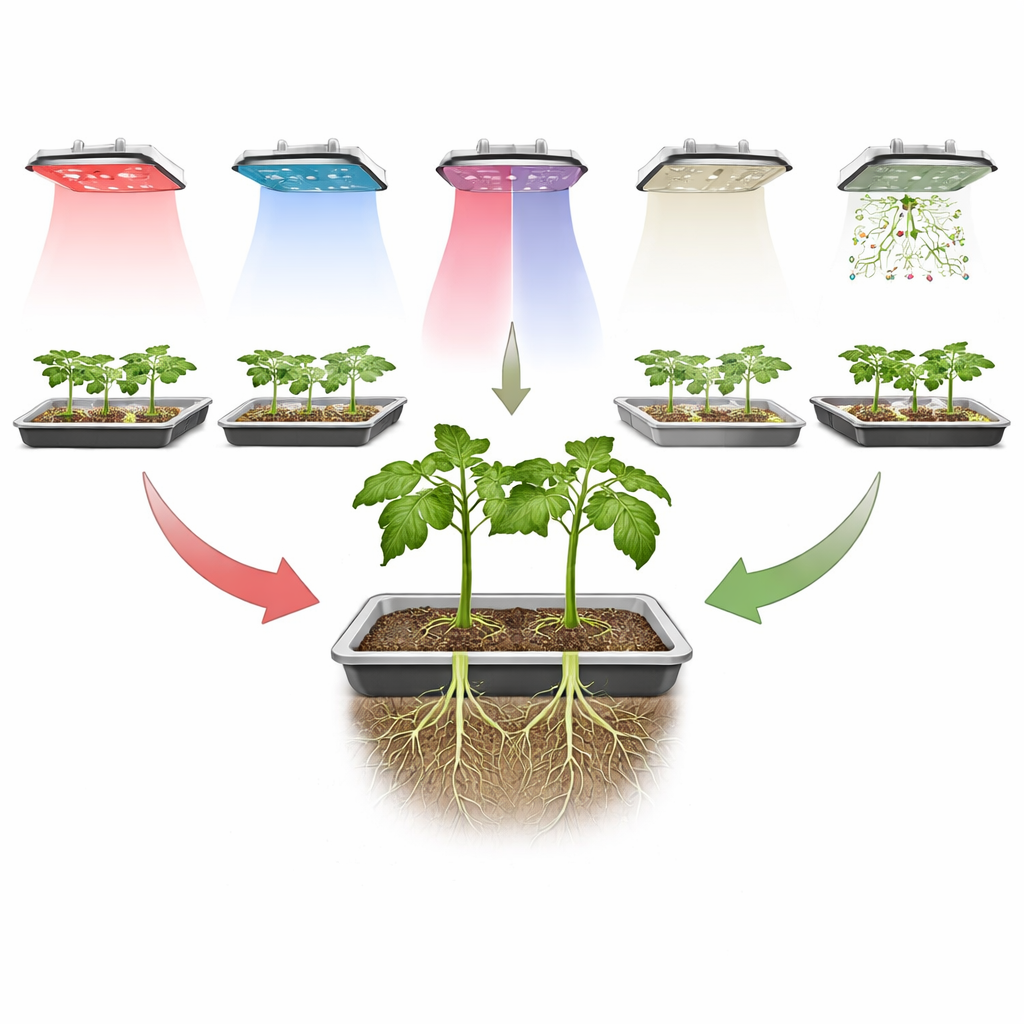
The researchers grew tomato seedlings with and without grafting onto a popular vigorous rootstock called ‘Maxifort.’ After grafting and healing, all plants spent 30 days under one of four LED treatments: pure red, pure blue, white (a broad mix similar to daylight), or a blend of 70% red and 30% blue. They measured how tall the plants grew, how much leaf and root mass they produced, the size of their leaves, and a leaf “greenness” index linked to chlorophyll. They also dried the shoots and analyzed how much of five key mineral nutrients—nitrogen, phosphorus, potassium, calcium, and magnesium—each plant had accumulated.
Mixed red–blue light builds better seedlings
Seedlings raised under pure red light stretched the most, producing tall but less compact plants with relatively low leaf area and mass, especially when they were not grafted. Pure blue light kept stems short and compact but did not maximize overall growth. The standout treatment was the 70:30 red–blue mixture. Under this combination, grafted seedlings developed the greatest total dry mass, the largest leaves, and the highest chlorophyll index, indicating strong photosynthetic potential. Root mass was also highest under this mixed light, and grafted plants generally outperformed non-grafted ones across all light treatments. A heatmap combining all traits showed that grafted seedlings under red–blue light consistently ranked highest, while non-grafted seedlings under pure red light ranked lowest.
Light color reshapes nutrient uptake
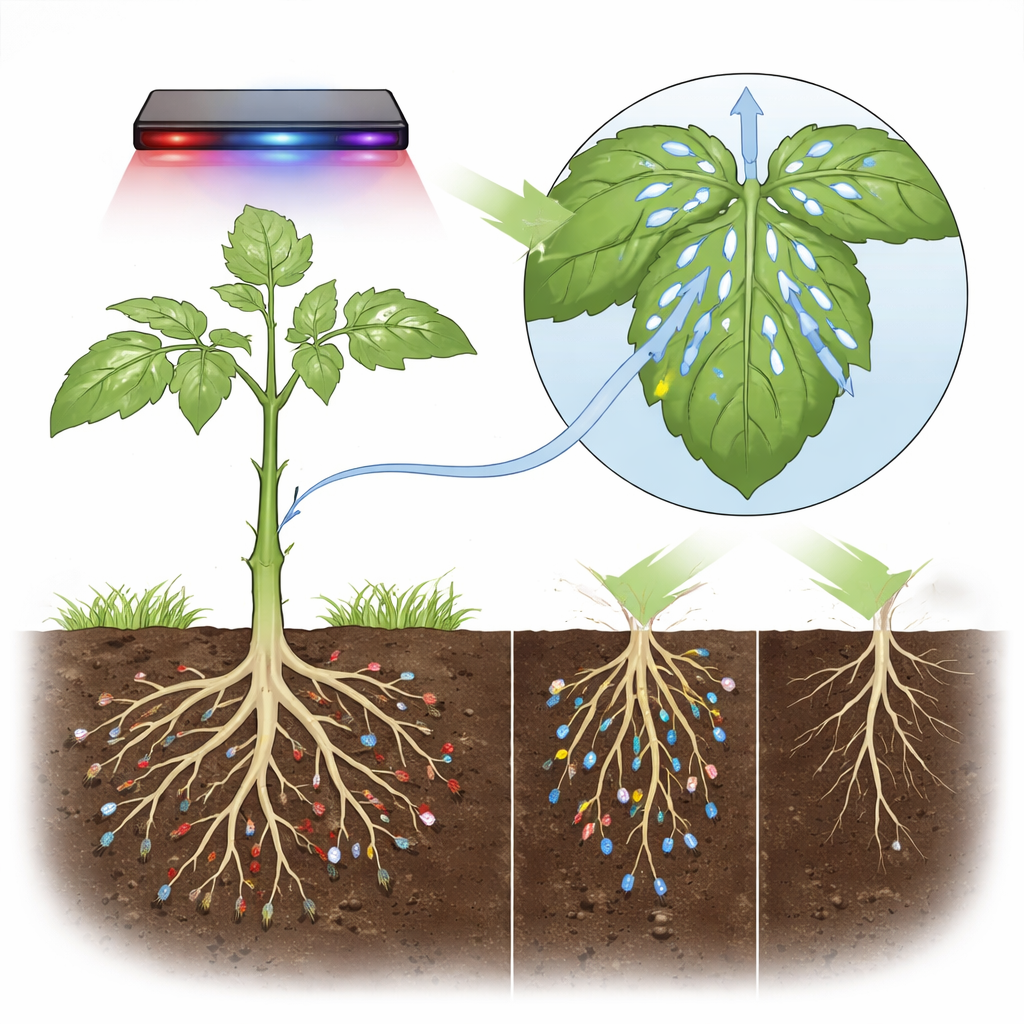
The most striking finding concerned mineral nutrition. Grafted seedlings under mixed red–blue light contained the highest total amounts of all five major nutrients studied. In contrast, non-grafted seedlings under pure red light were poorest in nitrogen, potassium, and magnesium. Grafting alone helped to ease some nutrient shortages under weaker light conditions, but its full advantage emerged only when paired with the 70:30 red–blue spectrum. The authors propose that blue light helps open leaf pores, boosting the flow of water and dissolved minerals from roots to shoots, while red light supports root growth and transport. Together, and in the right ratio, these colors create a more efficient pipeline for nutrient uptake and distribution in grafted plants.
What this means for growers and consumers
For nursery managers, the study offers a clear, practical message: relying on a single light color, whether red or blue, is not enough to grow the best tomato transplants. Instead, combining grafting onto a strong rootstock with a carefully balanced red–blue LED spectrum can produce compact yet vigorous seedlings with rich mineral nutrition and robust root systems. For growers and consumers, this translates into tomato crops that are more resilient, require fewer chemical inputs, and have the potential for better yield and quality. The work also opens a new scientific question: if light perceived by the leaves can “tune” the performance of the roots, uncovering the underlying hormone signals and gene activity could lead to even more precise recipes for growing healthy plants under glass and LEDs.
Citation: Soltani, S., Aroiee, H., Salehi, R. et al. The synergistic effect of grafting and LED light quality on enhancing the mineral nutrition and growth performance of tomato seedlings. Sci Rep 16, 8554 (2026). https://doi.org/10.1038/s41598-026-38960-3
Keywords: tomato seedlings, LED light spectrum, grafting, controlled environment agriculture, plant nutrition