Clear Sky Science · en
Enhancing the mechanical and shear behavior of clay soil using lime, Nano-MgO, and recycled PET fibers: experimental and UPV-based assessment
Building on Soft Ground
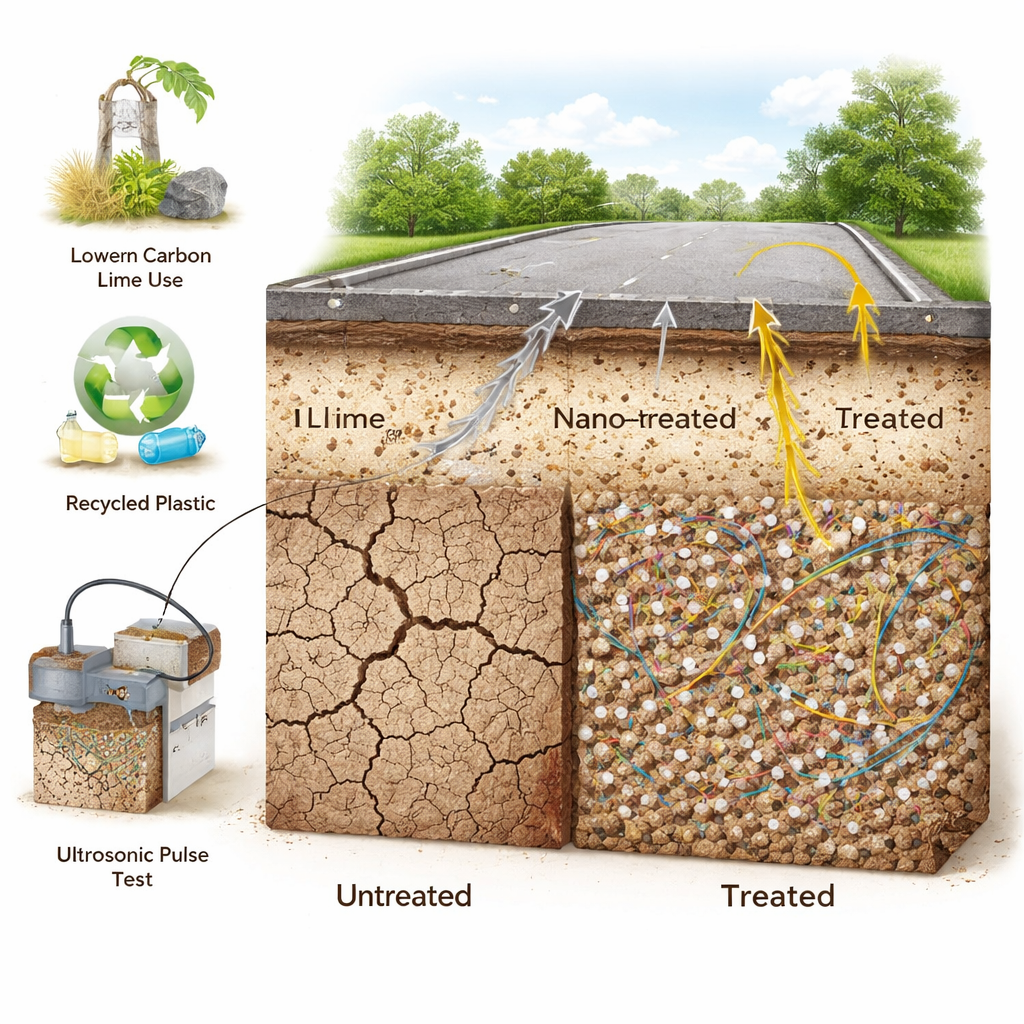
Many cities are expanding onto land underlain by clay soils that are naturally weak and prone to swelling, shrinking, and cracking. These soils can cause roads to rattle apart, pipes to leak, and building foundations to tilt over time. This study explores a cleaner, smarter way to turn troublesome clay into a stronger, more reliable base for construction—while also cutting carbon emissions and reusing waste plastic bottles.
A New Recipe for Stronger Soil
The researchers focused on a high-plasticity clay, a particularly troublesome type that changes volume when it gets wet or dries out. Traditionally, engineers mix such soils with lime to stiffen and stabilize them. Lime works well, but its production releases large amounts of carbon dioxide. To reduce this footprint and boost performance, the team developed a three-part mixture: lime, ultra-fine nano-magnesium oxide (nano-MgO), and short fibers made from recycled polyethylene terephthalate (PET), the plastic used in drink bottles. The idea was that lime and nano-MgO would chemically “cement” the soil grains together, while PET fibers would act like tiny reinforcing threads that hold the mixture together when it cracks or deforms.
How the Soil Was Tested
Clay samples were mixed with different amounts of lime, nano-MgO, and PET fibers, then compacted and left to cure for up to 90 days. The team measured how well each mixture resisted squeezing (unconfined compressive strength), pulling apart (indirect tensile strength), and sliding (direct shear tests that reveal friction and cohesion). They also used ultrasonic pulse velocity (UPV): sound waves were sent through the samples, and the travel speed was recorded. Faster waves mean a denser, more continuous internal structure. Unlike traditional strength tests, UPV is non-destructive, raising the possibility of quickly checking soil quality in the field without breaking samples.
Finding the Sweet Spot
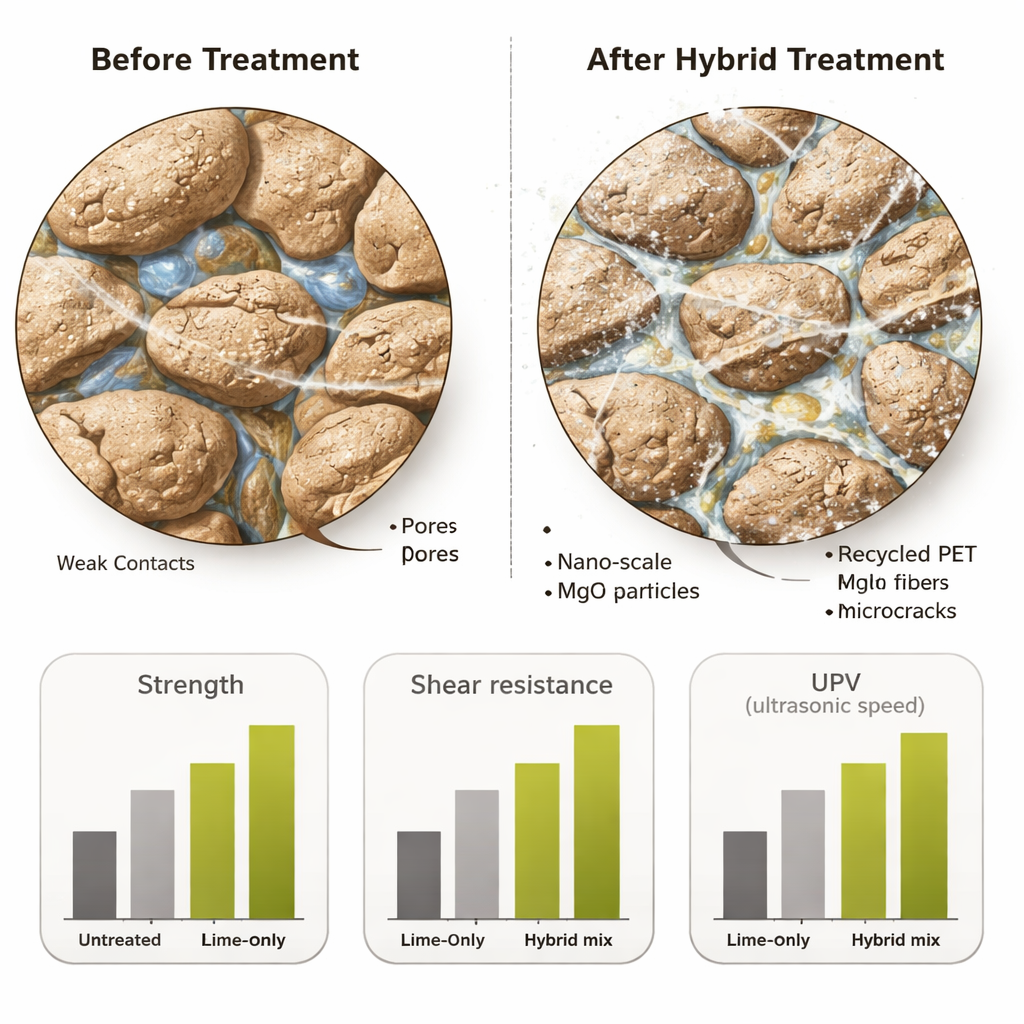
The experiments showed there is a clear “sweet spot” in the mix proportions. Raising the lime content improved strength up to about 10 percent by dry weight of soil; beyond that, extra lime created weak crystals that actually made the soil less robust. Replacing a small share of that lime—about 2 percent of the lime’s weight—with nano-MgO further boosted strength and stiffness. After 90 days, this lime-plus-nano mix increased compressive strength by more than eightfold compared with untreated clay and by roughly 40 to 50 percent over lime alone. Adding 0.9 percent PET fibers by soil weight then provided an extra lift, especially in resistance to cracking and tensile failure, though adding more fiber than that offered little additional benefit and could even create weak zones if the fibers clumped.
Seeing Inside the Soil
Microscope and surface imaging confirmed what the mechanical tests suggested. Untreated clay looked loose and porous, with plate-like particles and many voids. In contrast, samples with 10 percent lime and 2 percent nano-MgO showed a dense fabric: the clay grains were coated and bound by gel-like reaction products that filled pores and tied particles together. PET fibers were seen threading through this matrix, with cemented soil stuck to their surfaces, forming a three-dimensional network that helped spread loads and stop cracks from spreading. UPV measurements closely tracked these internal changes. As the soil became denser and better bonded, ultrasonic waves traveled faster. The study found strong mathematical links between wave speed and key properties such as strength, cohesion, and friction angle, suggesting UPV can be used to estimate how well the soil has been stabilized without destroying samples.
Why This Matters for Real-World Projects
For engineers and planners, the optimized mixture—10 percent lime, 2 percent nano-MgO, and 0.9 percent recycled PET fibers—offers a promising balance of performance, cost, and sustainability. It significantly increases strength and shear resistance, helping foundations and earth structures rest more safely on clay, while cutting back on the amount of lime needed and giving discarded plastic a useful second life. The ability to monitor soil quality using simple ultrasonic tests could also make quality control faster and cheaper on construction sites. Although the study was done under controlled laboratory conditions and still needs field-scale validation under real weather and loading cycles, it points toward more durable and environmentally conscious ways to build on challenging ground.
Citation: Amiri, A.A., Ranjbar Malidarreh, N., Soleimani Kutanaei, S. et al. Enhancing the mechanical and shear behavior of clay soil using lime, Nano-MgO, and recycled PET fibers: experimental and UPV-based assessment. Sci Rep 16, 7548 (2026). https://doi.org/10.1038/s41598-026-38956-z
Keywords: clay soil stabilization, nano-MgO, recycled PET fibers, ultrasonic testing, geotechnical engineering