Clear Sky Science · en
Design and performance evaluation of a novel cutter-ring material based on TBM rock-breaking mechanisms
Why better tunnel cutters matter
Modern cities depend on tunnels for subways, utilities, and roadways. Deep underground, these tunnels are carved by massive tunnel boring machines (TBMs) that push spinning steel discs into rock. In mixed ground made of alternating hard sandstone and softer mudstone, these cutting discs can wear out quickly, forcing crews to stop frequently for replacements. This study explains how and why those discs fail and introduces a new cutter-ring material that lasts longer and keeps tunneling safer, faster, and cheaper.
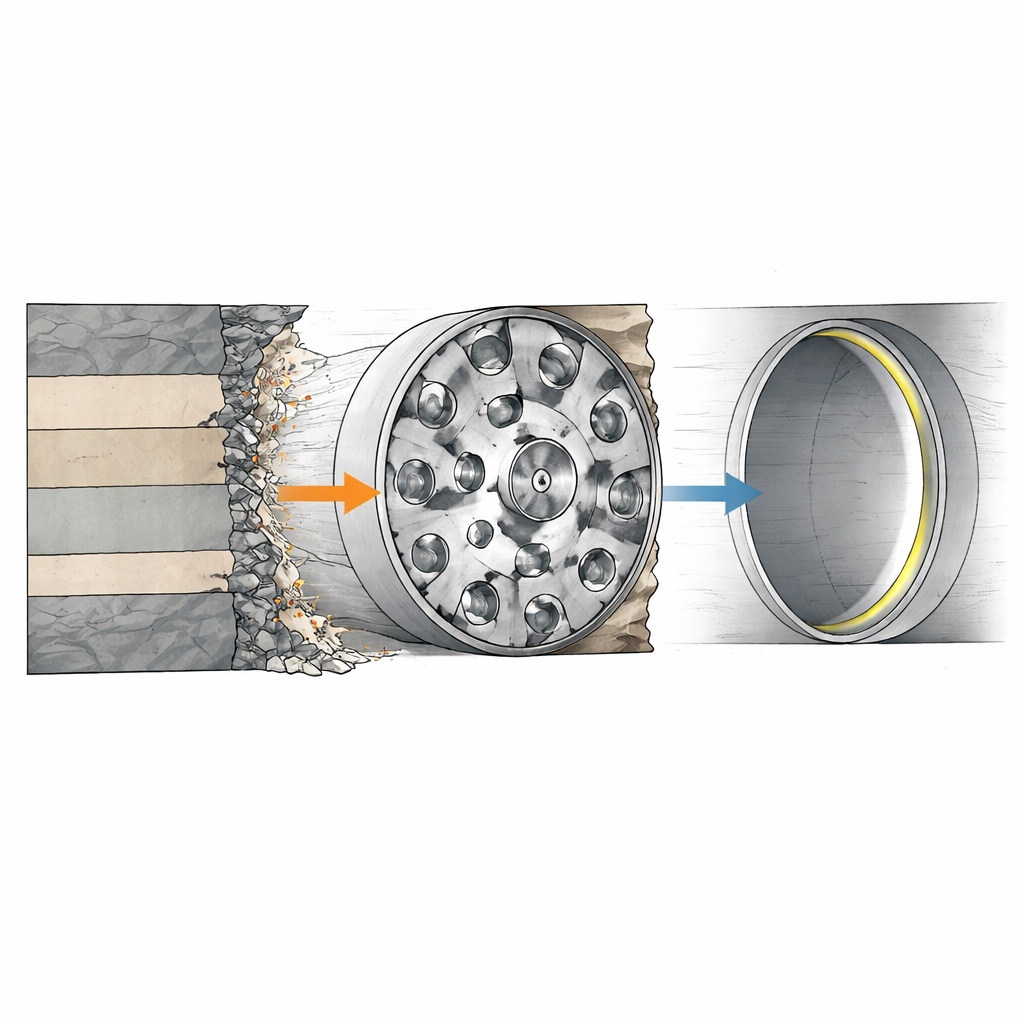
How tunnels are carved through layered rock
The authors focus on a subway section in Chongqing, China, where the tunnel passes through thick, irregular layers of sandstone and mudstone. The TBM uses circular steel discs, called cutter rings, pressed with huge force against the rock face. As the machine advances, each disc both presses in and rolls, crushing and chipping away the rock. In the studied region, the sandstone is especially strong and abrasive, leading to rapid cutter wear, frequent geometry changes at the disc edge, and more downtime for maintenance and replacement.
Watching rock break in the computer
To understand what happens where steel meets stone, the researchers built a detailed virtual model of a TBM disc pressing and rolling across blocks of sandstone and mudstone. Using advanced finite element software, they simulated how stresses build up, how cracks start at the contact point, and how they spread through the rock. The simulations showed strong stress concentration right under the cutter edge, with internal cracks forming a V-shaped damage zone that grows and eventually causes chunks of rock to detach. In both rock types, the downward, or normal, force proved to be the main driver of rock breakage, while the rolling force played a smaller but still important supporting role.
Comparing different cutter shapes
The team then compared three common disc designs: smooth-edge rings, single-edge insert cutters with one row of hard teeth, and double-edge insert cutters with two rows. Smooth discs, which spread contact more evenly, produced steadier forces and slower crack growth, especially in softer mudstone. Insert cutters, designed for very hard, abrasive rock, focused the load into small contact areas. This created intense local stress, faster crack propagation, and more abrupt, jump-like rock fragmentation. Single-edge inserts showed strong, highly fluctuating forces as each tooth repeatedly bit into and left the rock. Double-edge inserts amplified this effect, generating even higher peak forces and more complex crack networks, but also greater rock-breaking power in hard sandstone.
Designing tougher steel from the inside out
Armed with these insights, the researchers turned to the cutter material itself. They started from a commonly used hot-work tool steel and adjusted its chemistry to better balance hardness (for wear resistance) and toughness (to avoid brittle fracture). By slightly increasing carbon and carefully tuning alloy elements such as chromium, molybdenum, and vanadium, they produced several candidate steels, then forged and heat-treated them into full-size cutter rings. Laboratory tests showed that two of these variants combined high hardness with superior impact toughness, making them promising base materials for heavy-duty cutters.
Armoring the surface against grinding rock
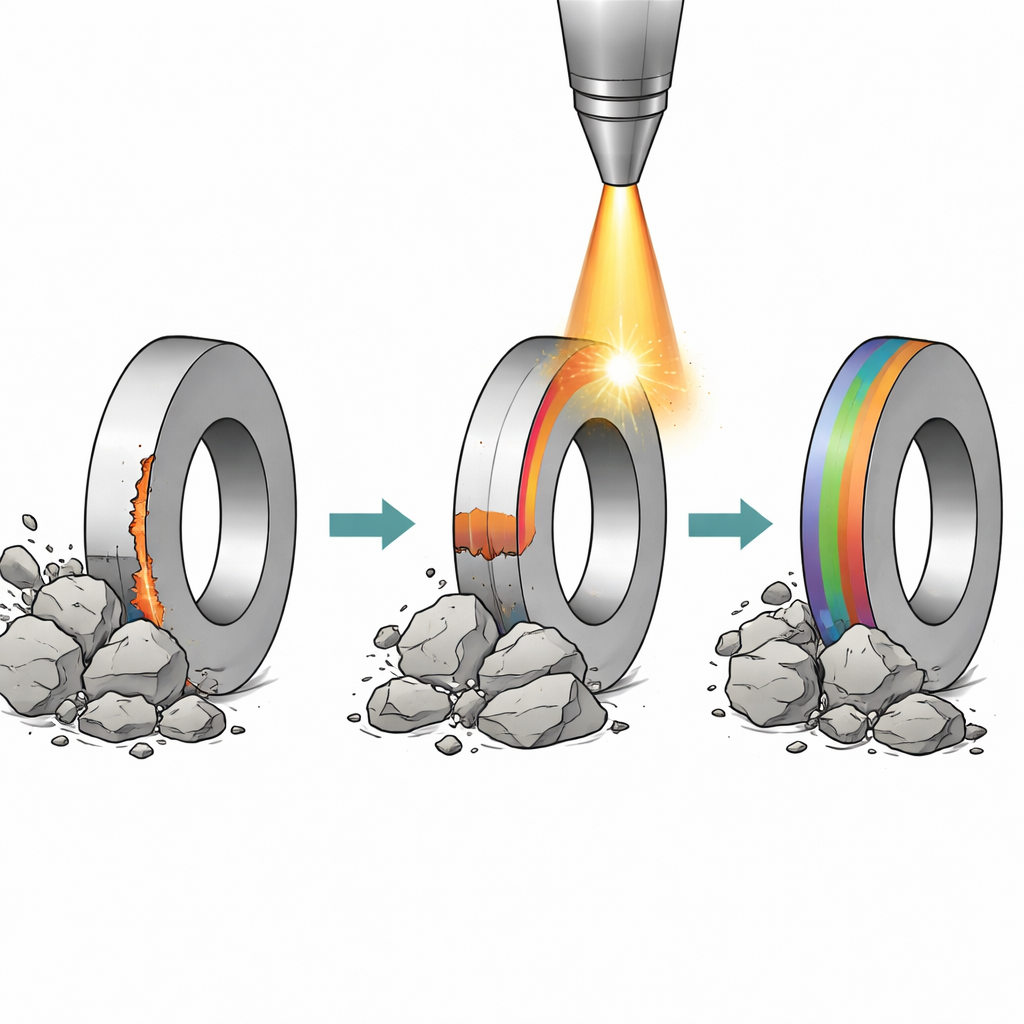
Because the outer edge of the ring faces the harshest conditions, the team further reinforced it with a special coating. They used plasma cladding to melt and bond a nickel-based alloy mixed with very hard ceramic particles onto the ring surface, creating a thick, wear-resistant skin. In rotary wear tests, short cylindrical samples cut from these coated rings were pressed against sandstone and granite under load. The newly developed material consistently lost the least mass and showed the smoothest, least damaged surfaces under both optical inspection and electron microscopy. Profilometer measurements confirmed that its wear grooves were about half as deep as those in conventional materials, indicating much higher resistance to grinding by rock particles.
Proving the new cutters in real tunnels
Finally, the new cutters were installed on a working TBM in another Chongqing subway project that also crossed strong sandstone and sandy mudstone. Over hundreds of meters of excavation, the improved discs showed no abnormal cracking or uneven wear. Compared with standard cutters used under similar ground conditions, the new design reduced wear rates by roughly one-fifth and cut the number of cutter replacements by about 28%. Fewer tool changes meant fewer stoppages, smoother tunneling progress, and lower maintenance costs.
What this means for future underground projects
This work links detailed rock-breaking physics to practical tool design. By showing exactly how stress builds and cracks spread under different cutter shapes, and by tailoring steel chemistry and surface coatings to those conditions, the authors created cutter rings that last longer in demanding layered rock. For non-specialists, the takeaway is simple: smarter design at the tiny contact zone between steel and stone can translate into safer, more reliable, and more economical tunnel construction beneath our cities.
Citation: Zhong, Z., Yang, Z., Li, X. et al. Design and performance evaluation of a novel cutter-ring material based on TBM rock-breaking mechanisms. Sci Rep 16, 8110 (2026). https://doi.org/10.1038/s41598-026-38954-1
Keywords: tunnel boring machine, rock cutting, tool wear, sandstone mudstone, advanced steel