Clear Sky Science · en
Experimental study of microbial enhanced oil recovery in fractured porous media using the halophilic bacterium Haloferax mediterranei
Why tiny salt-loving microbes matter for our energy future
Much of the world’s remaining oil is locked away in hard-to-access rock, especially in reservoirs crisscrossed by natural cracks. Conventional methods already squeeze out most of the easy oil, but a huge fraction stays behind underground. This study explores an unconventional helper: a salt-loving microbe called Haloferax mediterranei that thrives where few organisms can survive. By carefully tuning how many of these microbes are injected into fractured rocks, the researchers show it is possible to redirect water flows, unlock some of that trapped oil, and do so with a biodegradable, potentially lower-impact approach than many synthetic chemicals.
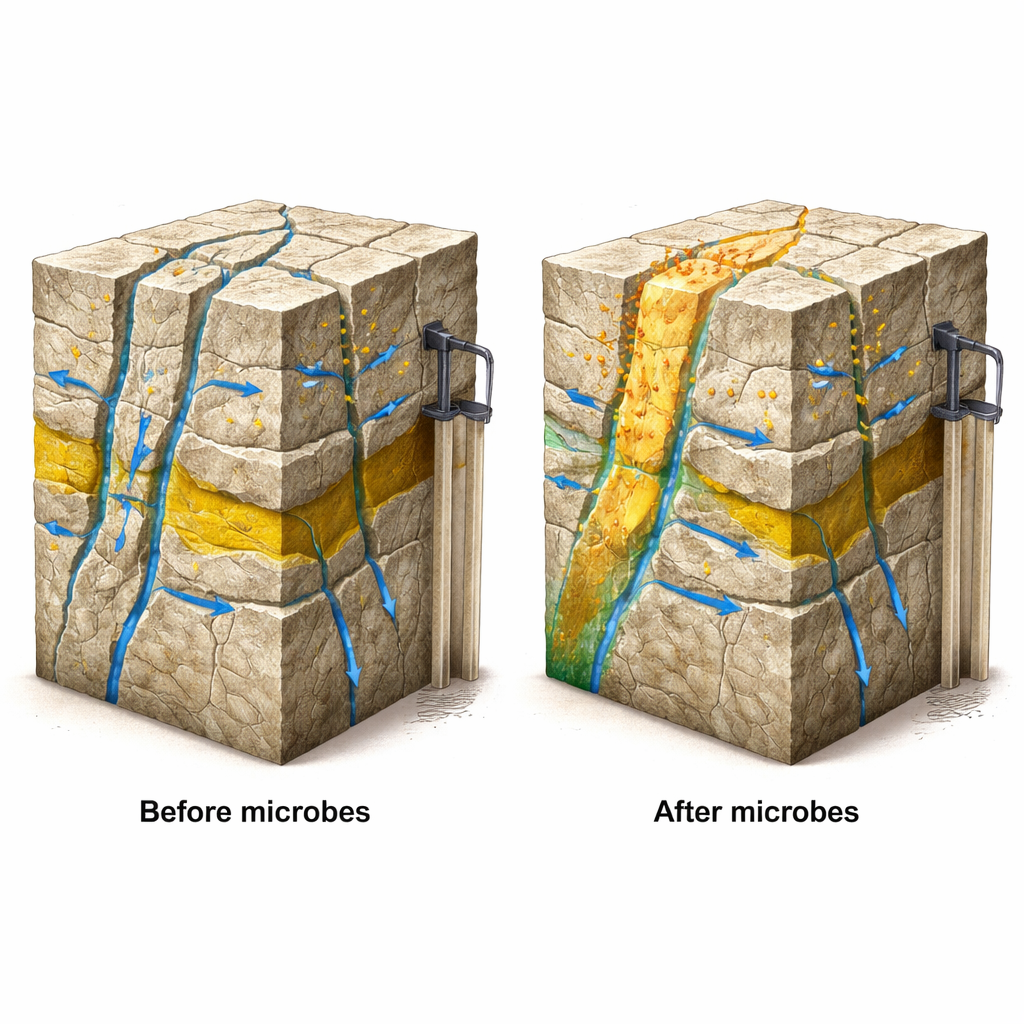
Cracked rocks and missed oil
Oil reservoirs made of carbonate rocks, such as limestone and dolomite, often contain a tangled web of fractures. When engineers push water into these formations to drive oil toward production wells, the water races through the open cracks and largely bypasses the tighter rock matrix, where much of the oil is stuck. As a result, 35–55% of the original oil can remain behind even after primary and secondary recovery. Chemical methods can help, but high salinity, high temperatures, and the cost and persistence of man-made polymers and surfactants limit their usefulness. The idea behind microbial enhanced oil recovery is different: let microbes grow in the most open flow channels so they partially clog those “shortcuts” and force the injected water to sweep through the surrounding rock instead.
A microbe built for extreme oil fields
Haloferax mediterranei is a member of a group of microorganisms that flourish in extraordinarily salty environments, even at salinities over ten times that of seawater and at elevated temperatures. Unlike many standard oilfield bacteria, it continues to grow and to produce a natural plastic-like substance under these harsh conditions. That substance, a biodegradable biopolymer called polyhydroxybutyrate, helps the microbes form sticky films along rock surfaces and within fractures. These biofilms are strong enough to narrow flow paths but can still leave small channels open, creating the possibility of a “just right” level of plugging: enough to steer water into oil-filled regions of the rock without sealing it off entirely.
Glass rock models and real rock tests
To see how this plays out in practice, the team built transparent glass “micromodels” that mimic fractured porous rock. They first flooded the models with crude oil from an Iranian field, then injected salty water, then microbial solutions with three different biomass levels, and finally water again. The clearest results came at a moderate microbe concentration of 5.07 grams per liter. In that case, the biofilm grew mainly in the fractures, narrowed them, and redirected the follow-up water into the rock matrix. This extra sweep increased oil recovery in the micromodel by 23 percentage points of the original oil in place compared with water flooding alone. When the researchers doubled the biomass, however, recovery fell sharply: thicker, denser biofilms clogged not only fractures but also the entrances to the rock matrix, leaving less room for water to move oil.
From the lab bench to real fractured cores
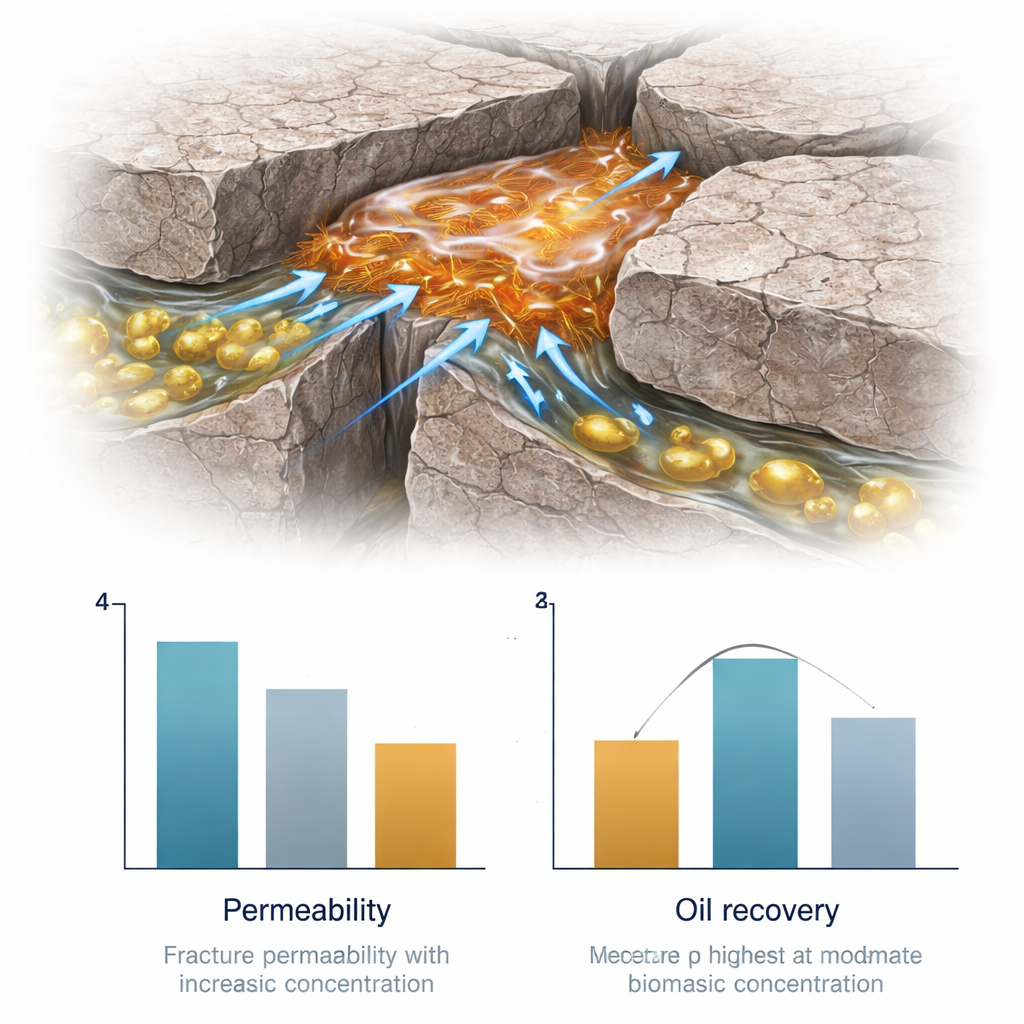
The scientists then repeated the concept in actual carbonate and dolomite rock cores that had been artificially fractured. Before adding microbes, water flowed very easily through these fractures. After microbial injection, the permeability of the fractures dropped by roughly 50–75%, showing that the biofilms were successfully restricting the main flow paths. When the team ran oilflood experiments with the optimised biomass level, the additional oil recovered during the post-microbe water flood was 14% and 12.6% of the original oil in place for two separate cores. These gains were smaller than in the idealised glass models—real rocks are rougher and more complex—but still substantial, and comparable to improvements reported for other microbial methods that cannot tolerate such extreme salinity.
Finding the sweet spot
A key lesson from the experiments is that more microbes are not always better. At low biomass, fractures remain too open and water continues to bypass the matrix. At very high biomass, biofilms grow so aggressively that they choke off communication between fractures and the surrounding rock, leaving oil stranded. The best results appeared at an intermediate concentration: enough microbial growth to narrow the largest cracks and reroute flow, but not enough to block access to the oil-bearing rock. This “selective plugging” behavior—targeting the easiest flow paths first—emerged naturally from how the microbes grow and deposit their polymer in the fractures.
What this means for future oil production
For a general reader, the takeaway is that certain extremophile microbes can act as smart, self-organizing flow regulators deep underground. By choosing the right amount of Haloferax mediterranei, operators could make injected water work harder, sweeping more oil from stubborn fractured reservoirs while relying on biodegradable materials that function under brutal salinity and temperature. The study does not solve all the challenges of late-stage oil production, nor does it replace the need to transition away from fossil fuels. But it shows how biology can be harnessed to make existing reservoirs more efficient, potentially reducing the need for new drilling and squeezing more energy out of already developed fields.
Citation: Eslam, B.Z., Hashemi, R., Khaz’ali, A.R. et al. Experimental study of microbial enhanced oil recovery in fractured porous media using the halophilic bacterium Haloferax mediterranei. Sci Rep 16, 7452 (2026). https://doi.org/10.1038/s41598-026-38949-y
Keywords: microbial enhanced oil recovery, fractured reservoirs, Haloferax mediterranei, biofilm plugging, high-salinity oilfields