Clear Sky Science · en
Effects of pre-fracturing fluids on pore-fracture structure and mechanical properties of deep coal
Why the hidden cracks in coal matter
Deep underground, coal seams hold large amounts of natural gas that could help power homes and industries with lower emissions than traditional coal burning. Getting that gas out, however, depends on how easily it can move through tiny pores and cracks inside the coal. This study asks a practical question with big economic and environmental stakes: when engineers soak deep coal with different preparation fluids before hydraulic fracturing, which ones actually open up flow paths for gas, and which ones quietly damage the rock or even make things worse?
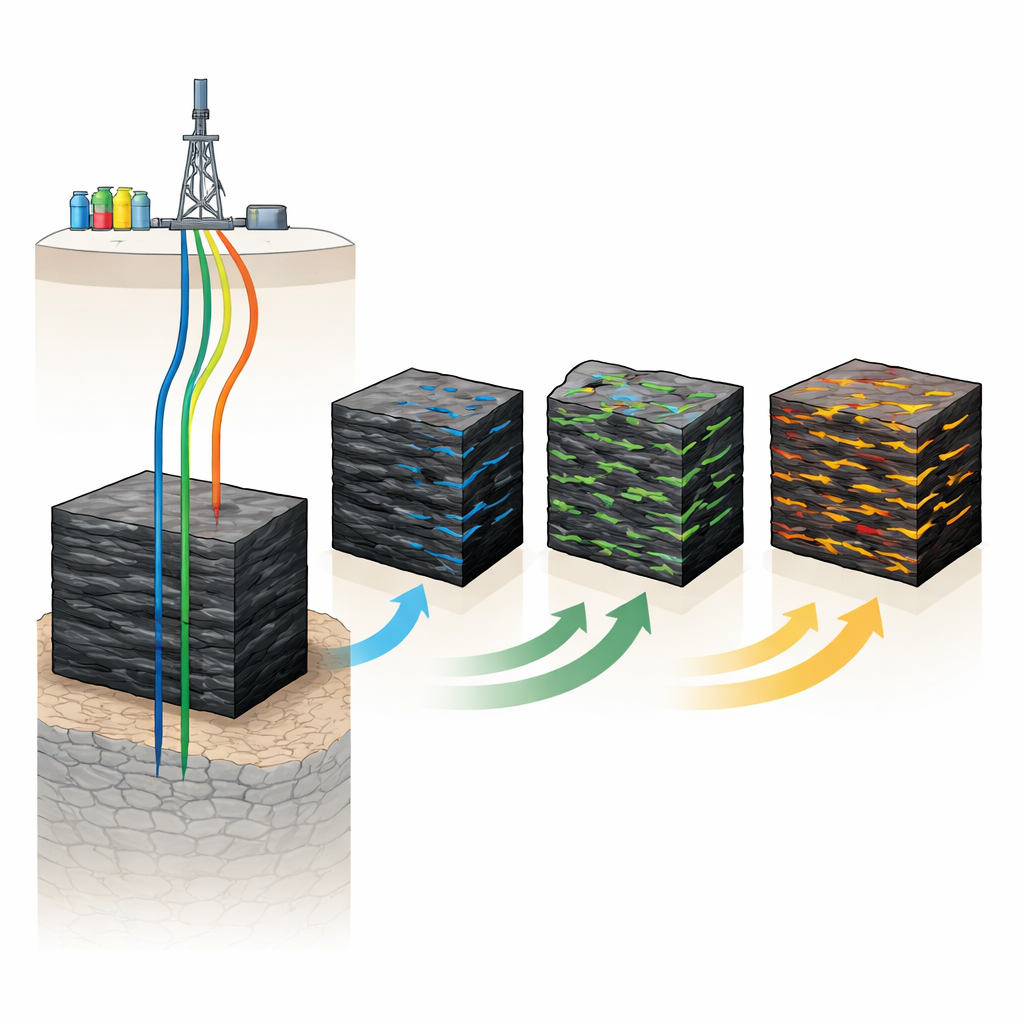
How engineers "pre-treat" deep coal
Before a coal seam is fractured to release gas, workers often pump in special liquids designed to clean out minerals, widen tiny passages, or gently weaken the rock so fractures form more easily. The researchers tested five such pre-fracturing fluids on coal taken from about 2,700 meters below ground in China. One was a common slick-water mixture similar to those used in many gas wells. Two were acid blends based on hydrochloric acid, one of them strengthened with hydrofluoric acid. The other two were oxidizing fluids, based on household-style chemicals related to bleach and hydrogen peroxide. By starting with cores from a single deep well, the team could compare how each fluid changed the same type of coal.
Looking inside coal without breaking it apart
To see how these cocktails reshaped the coal’s inner architecture, the scientists used several imaging tools. Nuclear magnetic resonance, a cousin of the technology used in medical MRI, measured how much void space existed and how that space was divided between very small, medium, and larger pores. Scanning electron microscopes gave close-up views of the coal surface, revealing pits, dissolved grains, and new cracks. Atomic force microscopy traced tiny hills and valleys on the surface to calculate how rough it became after treatment. Finally, compression and tension tests squeezed and pulled on treated samples to find how much weaker or more flexible the coal had become.
Which fluids open pathways—and which clog them
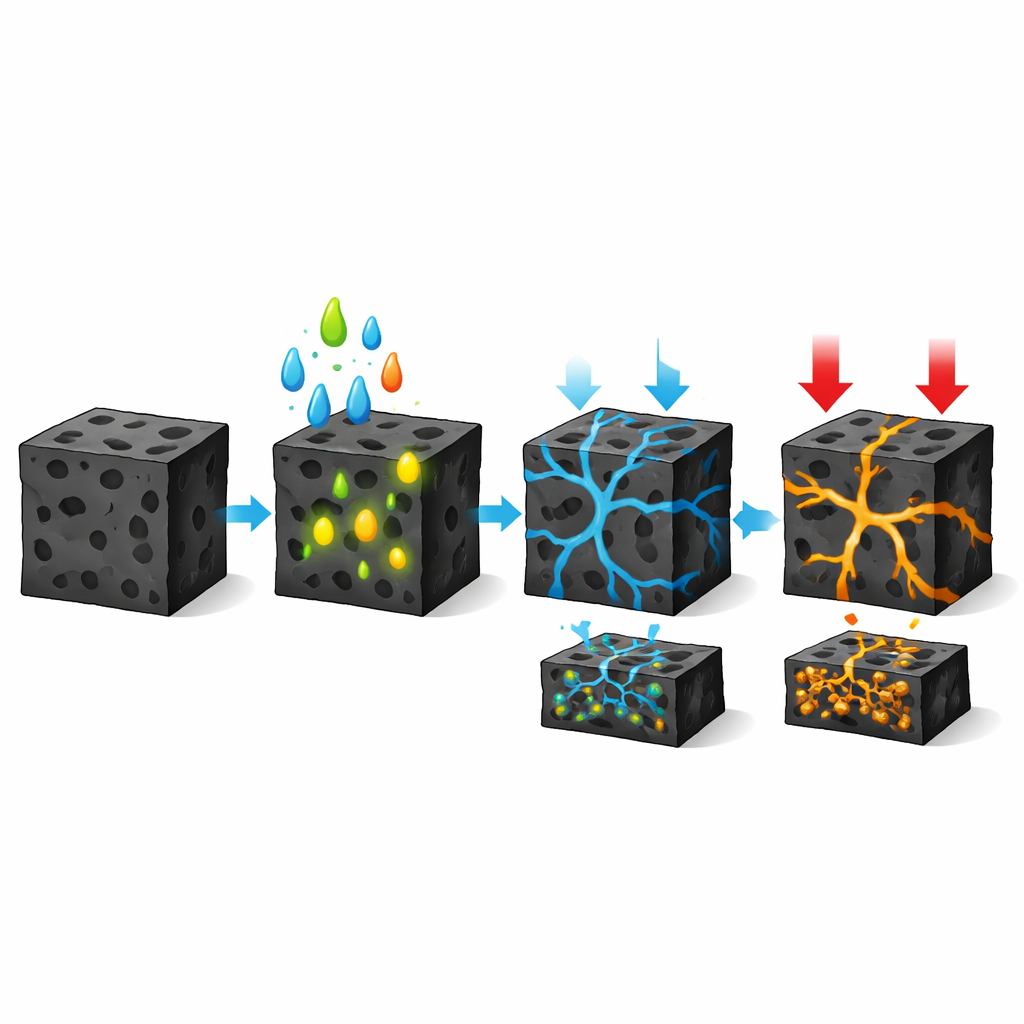
All five fluids increased the total amount of pore space, but they did not behave equally. The acid blend that combined hydrochloric and hydrofluoric acids was the star in terms of gas flow: it boosted calculated permeability by more than a hundredfold by dissolving stubborn minerals such as quartz and silicates and stitching small pores into larger, connected channels. The bleach-like oxidant also greatly improved flow by swelling and dissolving parts of the organic coal, while slick water and hydrogen peroxide had more modest effects. Surprisingly, plain hydrochloric acid alone actually made flow worse despite enlarging some pores. Microscopy and porosity measurements suggest that loosened mineral grains migrated and plugged narrow throats, converting some formerly open space into trapped, non-flowing pockets.
Trading strength for productivity
The same chemical reactions that sculpt pores and cracks also change how the rock responds to stress. The strongest flow enhancer, the mixed acid, left the coal much softer and easier to deform, with the lowest compressive and tensile strength and the highest tendency to bulge sideways when squeezed. Bleach and plain hydrochloric acid also weakened the coal substantially, while slick water and especially hydrogen peroxide preserved more of the original strength. When the team compared mechanical behavior with microstructure, clear patterns emerged: samples with more overall pore space and rougher surfaces became less stiff, and rougher surfaces also made the coal easier to tear apart in tension. In contrast, how strong the coal was in compression did not track neatly with any single pore or crack measure, hinting at more complex failure modes.
Choosing the right tool for the job
For operators planning deep coalbed methane projects, the message is that pre-fracturing fluids are not interchangeable. Mixed acid or strong oxidants can dramatically boost the ease with which gas moves through the seam, but they also carve the coal into a weaker, more ductile material. That weakness can be helpful for starting and spreading fractures, yet it may also affect long-term stability. Gentler fluids keep the rock stronger but deliver smaller flow gains, while plain hydrochloric acid risks clogging the very pathways it is meant to clear. By linking specific fluid recipes to measurable changes in pore structure and strength, this work offers a roadmap for picking treatments that match the goal—whether it is maximum permeability, targeted weakening, or a balanced compromise between the two.
Citation: Wang, X., Sun, Z., Li, M. et al. Effects of pre-fracturing fluids on pore-fracture structure and mechanical properties of deep coal. Sci Rep 16, 9359 (2026). https://doi.org/10.1038/s41598-026-38943-4
Keywords: coalbed methane, hydraulic fracturing, acidizing, oxidation treatment, rock mechanics