Clear Sky Science · en
Stable isotope insights into water use sources and adaptation strategies of Tamarix Chinensis in desert ecotone of arid regions
Why desert shrubs and hidden water matter
In many of the world’s drylands, the survival of entire ecosystems hinges on how a few hardy plants find and use water. This study looks at Tamarix chinensis, a tough shrub growing where desert and steppe meet in northwestern China. By tracking the “fingerprints” of water molecules, the researchers reveal how this shrub switches among rainwater, soil moisture, and underground water to stay alive as conditions grow hotter, drier, and saltier. The findings offer clues for restoring vegetation and managing scarce water in arid regions facing climate change.
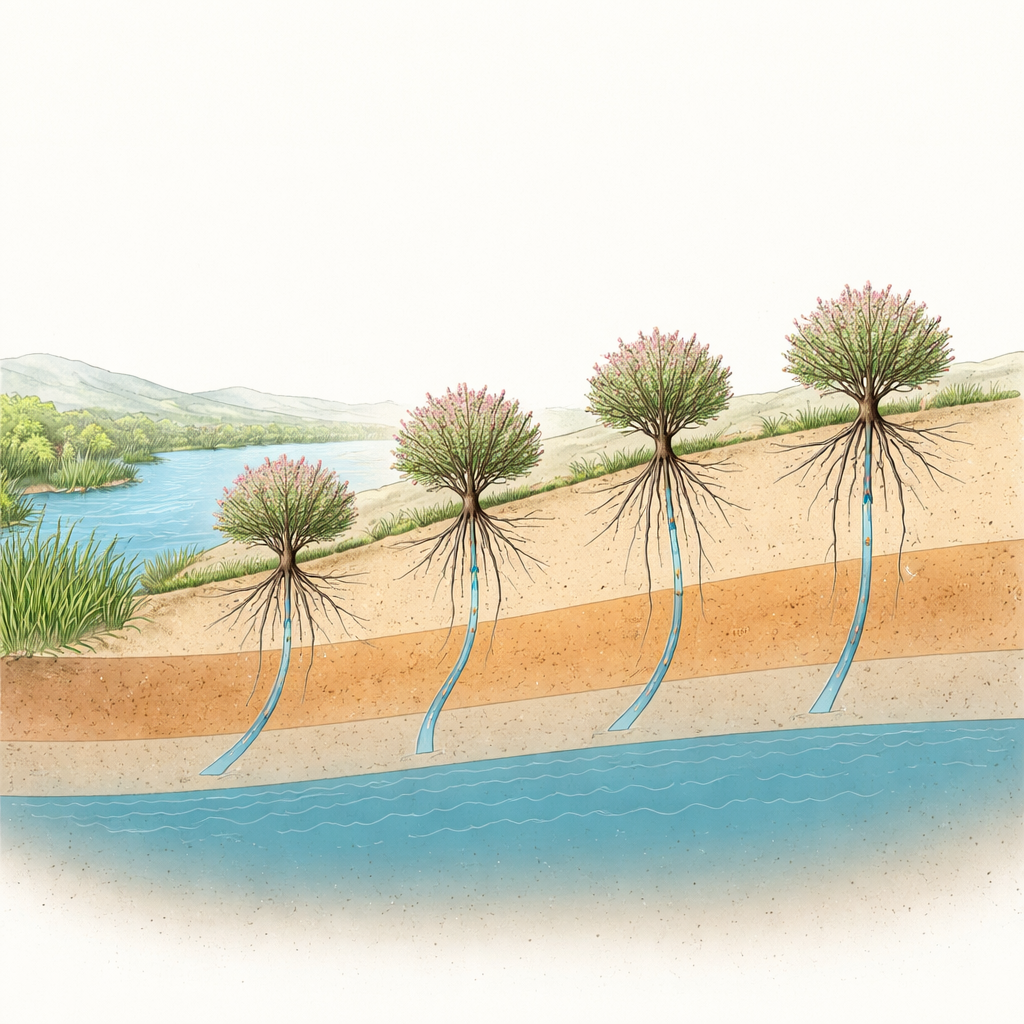
A harsh landscape on the desert’s edge
The research took place in the Tailan River Basin of Xinjiang, a typical arid region with very little rainfall, intense evaporation, frequent dust storms, and groundwater lying a few to several meters below the surface. Here, small desert oases sit beside wide areas of salty, sparsely vegetated land. Tamarix chinensis dominates these transition zones because it tolerates both drought and salt. Yet many dead Tamarix roots in the area suggest that rising salinity and falling groundwater are pushing this hardy species to its limits. Understanding exactly where these shrubs obtain water, and how that changes as groundwater drops, is critical for predicting whether the desert will continue to spread.
Following water by its invisible signature
To untangle the shrubs’ water sources, the team combined detailed field measurements with a powerful tracing technique. They sampled rainfall, soil water at different depths, groundwater, and water inside plant stems, then measured the natural ratios of heavy and light forms of hydrogen and oxygen in each. Because plants generally move water without altering these isotope ratios, the patterns in stem water can be matched back to likely sources. The researchers then used a Bayesian mixing model, called MixSIAR, to estimate how much of the plant’s water came from rain, shallow soil, deeper soil, or groundwater, while also mapping root structures and soil salt levels along a gradient of groundwater depths.
Flexible rooting and shifting water sources
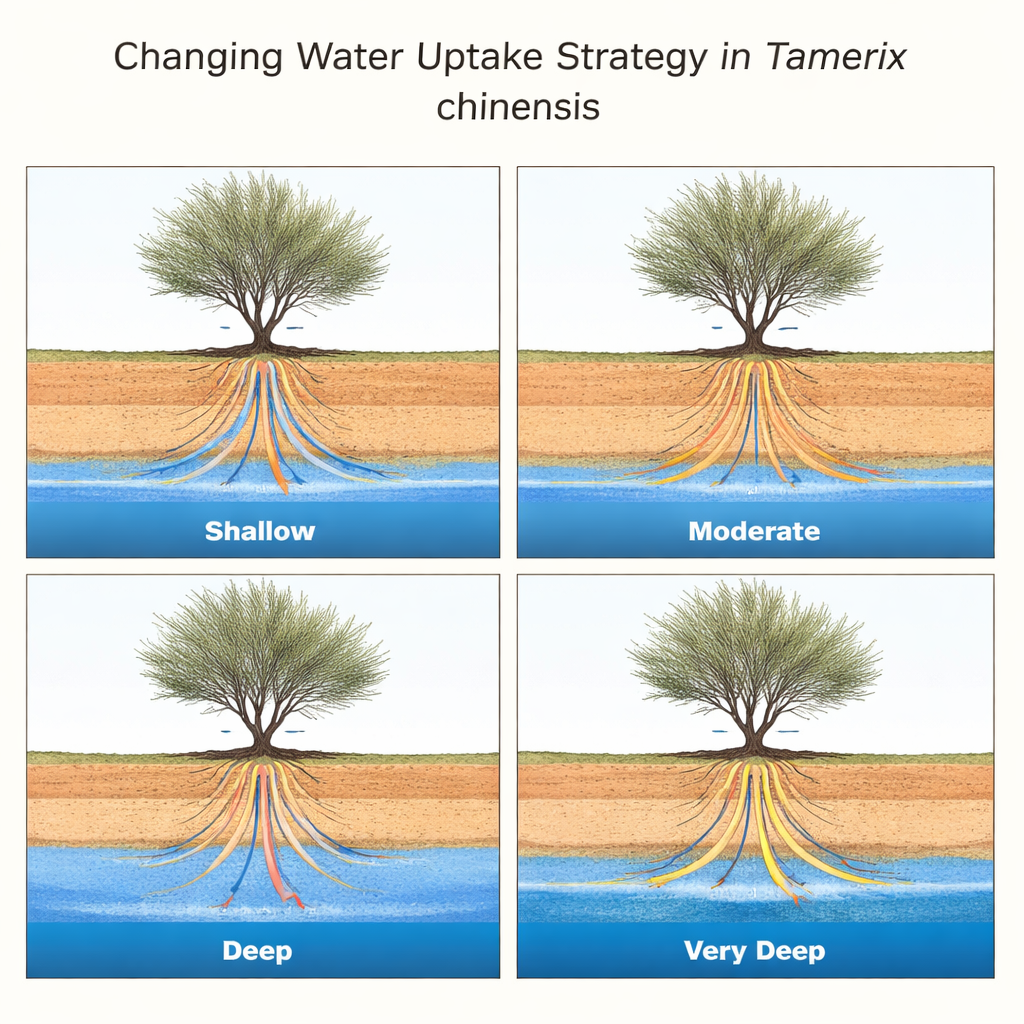
The picture that emerged is of a shrub that is remarkably flexible, but not invincible. On average, direct rainfall supplied only about one tenth of Tamarix’s water. Most came from groundwater and from middle and deep soil layers, which together accounted for roughly two thirds of uptake. When groundwater was relatively shallow and not too salty, Tamarix tapped it directly and also drew from deep soil moisture. As the water table fell, the plants reduced their dependence on groundwater and instead increased use of mid- and deep-soil water. In some places with poorer plant diversity, they also made greater use of shallow soil water, especially where soil texture allowed more moisture to be stored near the surface.
Roots that remodel to chase water
The shrub’s root systems changed shape as groundwater retreated. Where water lay close to the surface, coarse roots and fine, absorbing roots were spread more evenly through the soil profile. At intermediate depths, thick structural roots concentrated in the middle soil layer, while fine roots reached both upward and downward, allowing the shrub to combine rainfall-driven shallow moisture with deeper reserves. Under the deepest groundwater conditions, coarse and fine roots shifted downward, forming a dense absorbing network in mid-to-deep soil. This reorganization helps Tamarix track the slowly moving underground water and bypass the highly salty, drier upper layers, but it also indicates that the plant must invest more energy simply to secure enough water.
Implications for restoring dryland vegetation
For land managers, the study delivers a clear message: Tamarix chinensis can adjust its water-use strategy across a wide range of conditions, but it relies heavily on stable access to mid- and deep-soil moisture and moderately deep groundwater. If groundwater sinks too far or becomes too salty, even this resilient shrub struggles, and surface greening efforts may fail. By mapping how water sources shift with groundwater depth, soil type, and plant community structure, the work provides a scientific basis for setting safe limits on groundwater extraction and for selecting planting sites and species mixes that are most likely to survive in an increasingly water-stressed world.
Citation: Liu, L., Yin, L., Yang, Z. et al. Stable isotope insights into water use sources and adaptation strategies of Tamarix Chinensis in desert ecotone of arid regions. Sci Rep 16, 7218 (2026). https://doi.org/10.1038/s41598-026-38933-6
Keywords: desert shrub water use, groundwater and vegetation, stable isotope tracing, arid ecosystem restoration, Tamarix chinensis adaptation