Clear Sky Science · en
Estimation of the apparent anisotropic water diffusivity on spruce evaluated with a simplified derivative approach and as a function of the flow rate
Why the way wood drinks water matters
Anyone who has watched a wooden deck swell after rain or a musical instrument go out of tune on a humid day has seen how strongly wood responds to moisture. Builders, conservators, and designers all need to know how quickly water moves into wood to predict swelling, cracking, or loss of performance. This study looks at spruce, a common softwood, and asks two practical questions: how fast does water vapor work its way inside along different grain directions, and is there a simpler way to measure that speed without heavy mathematics and long experiments?
Watching wood gain weight in moist air
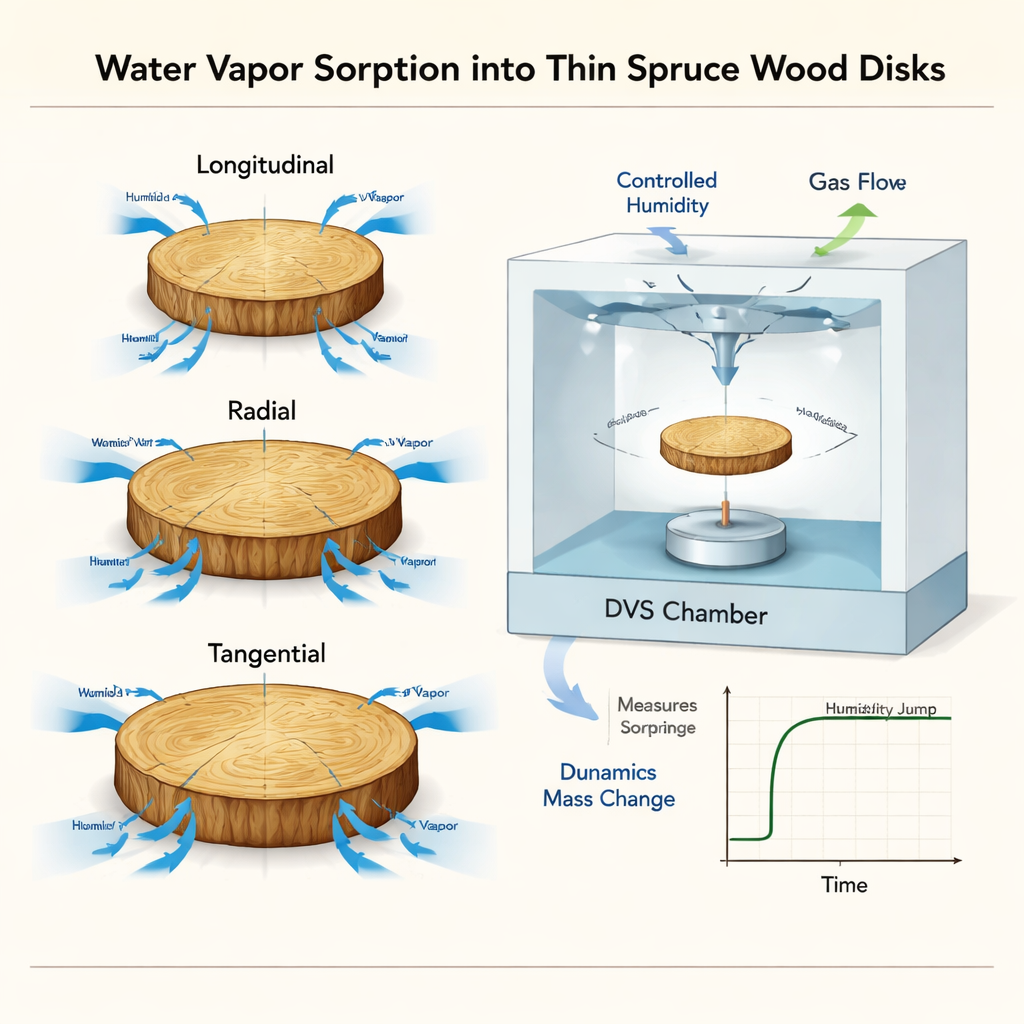
The researchers used a highly sensitive device called a Dynamic Vapor Sorption (DVS) system, which can weigh tiny samples continuously while controlling humidity and gas flow. They prepared thin, coin‑like spruce disks cut in three directions relative to the tree: along the grain (longitudinal), across the radius of the trunk (radial), and around the trunk (tangential). The curved edges of each disk were sealed so that water vapor could only enter through the flat faces. Each sample was first dried to a moderate humidity of 30%, then suddenly exposed to a much damper atmosphere of 80%, while nitrogen gas flowed past at different speeds. As the wood absorbed water, its mass increased in a smooth, S‑shaped way over about two days.
Old formulas versus new shortcuts
Traditionally, scientists describe this water uptake with elaborate mathematical formulas derived from diffusion theory. The team compared several of these: classic power‑law expressions (such as the Ritger–Peppas model), series solutions of the basic diffusion equation (single and double Fickian models), and a more flexible “double‑stretched exponential” fit that can handle two simultaneous diffusion processes inside the wood. All these methods require adjusting many parameters to match the entire 48‑hour curve, a procedure that is time‑consuming and sensitive to the analyst’s choices. Despite this effort, some of the popular models did not reproduce the data well and gave diffusion values that were clearly off.
A simpler way: follow the steepest climb
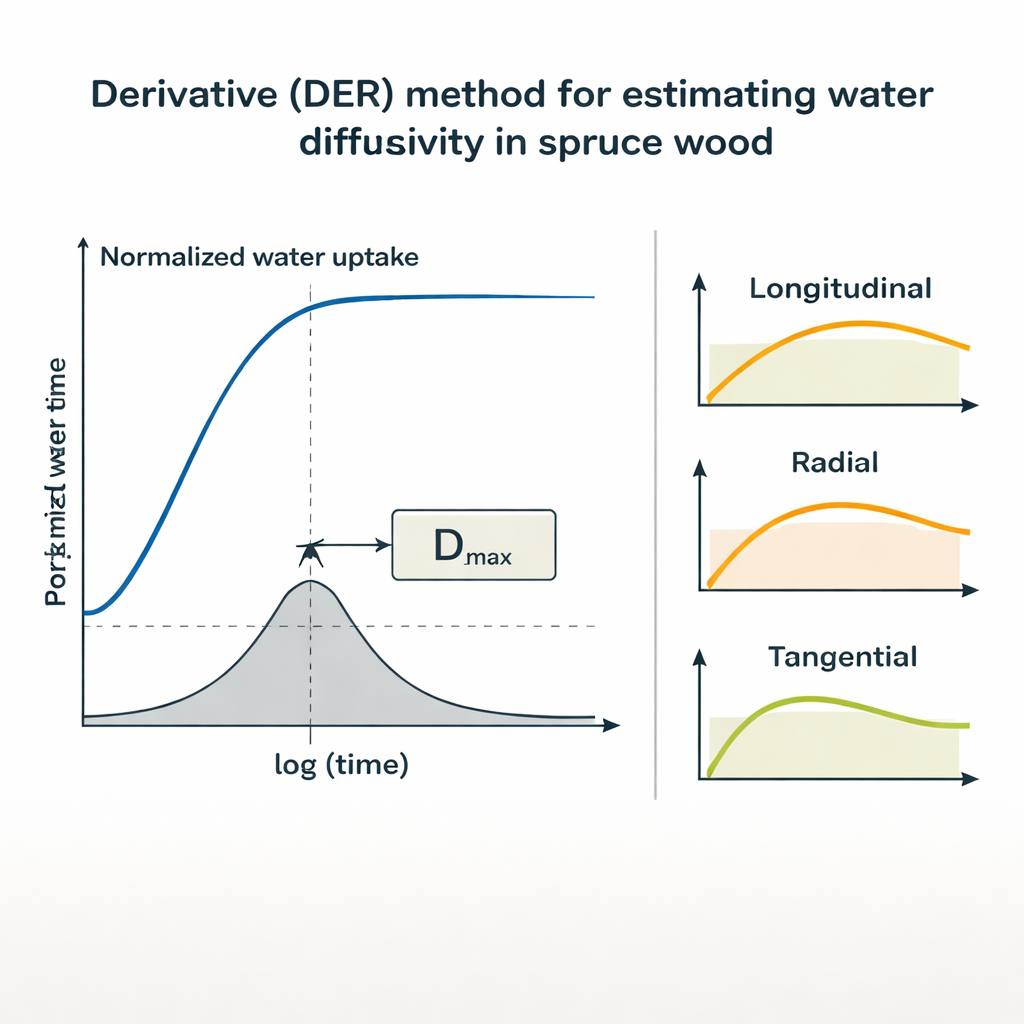
The core of this work is a simplified “derivative method,” or DER. Instead of fitting a full equation, the authors transform the time axis to a logarithmic scale and look at the relative mass gain versus log(time). This curve has an S shape, rising slowly at first, then rapidly, then leveling off. They then compute the slope of this curve at every point. The slope itself forms a single peak: the time of this peak marks when the wood is absorbing water fastest. By reading off this peak time and combining it with the known thickness of the disk, they estimate an effective diffusion coefficient. The width of the peak also hints at how “sharp” or “spread out” the diffusion process is inside the material. Crucially, this approach avoids complex curve fitting and focuses on one clearly defined feature of the data.
What the wood revealed about direction and airflow
Comparing results across models and directions, the derivative method produced diffusion values that closely matched those from the most sophisticated double‑exponential fit, differing by at most about 10%. Both approaches agreed that water vapor travels fastest along the grain of spruce and more slowly across it, reflecting the internal structure of cells and the glue‑like middle layer that hinders movement. The team also showed that the apparent diffusion increases with the gas flow rate over the sample and levels off toward a maximum value. At very low flow, there simply are not enough water molecules near the surface, so the wood cannot take up moisture as quickly. Importantly, widely used power‑law and simple diffusion series methods underestimated diffusivity by factors of roughly 1.5 to 3 compared with the derivative method.
What this means for using and modeling wood
In everyday terms, the study shows that there is a quick and reliable way to measure how fast wood “drinks” water vapor that does not require specialized fitting skills or very long tests. By focusing on when the uptake curve is steepest, the derivative method captures almost the same information as complex models while being easier to automate and less prone to user bias. For engineers and scientists who design wood structures, packaging, or humidity‑powered devices, having trustworthy values for how fast water moves along and across the grain helps predict swelling, durability, and performance under changing weather. This streamlined method could therefore become a practical tool for characterizing other porous materials where moisture transport plays a central role.
Citation: Sánchez-Ferrer, A., Engelhardt, M. Estimation of the apparent anisotropic water diffusivity on spruce evaluated with a simplified derivative approach and as a function of the flow rate. Sci Rep 16, 5876 (2026). https://doi.org/10.1038/s41598-026-38932-7
Keywords: wood moisture diffusion, spruce humidity sorption, dynamic vapor sorption, anisotropic transport, derivative analysis