Clear Sky Science · en
Posterior reversible encephalopathy syndrome in Colombia a case series
When Sudden Headaches Signal a Hidden Brain Problem
Most of us think of high blood pressure as a slow, silent threat to the heart. But in some people, a sudden surge in blood pressure or certain illnesses can briefly overwhelm the brain, causing seizures, vision loss, and confusion. This condition, called posterior reversible encephalopathy syndrome, or PRES, can look frightening—yet with timely care it is often treatable. A new study from two hospitals in Bogotá, Colombia, offers one of the largest looks at PRES in Latin America, showing who is at risk, how it appears on brain scans, and why quick recognition can mean the difference between a short stay and weeks in the hospital. 
What This Rare Brain Syndrome Looks Like
PRES is a cluster of symptoms that usually comes on over hours to days. In this Colombian series of 60 adults, nearly three out of four patients had seizures, and more than half arrived with confusion or reduced alertness. Many reported headaches, often tension‑like rather than the explosive "thunderclap" pain associated with bleeding in the brain. About one third had visual problems such as blurred vision or partial loss of the visual field. Despite these alarming symptoms, none of the patients in this study died, underscoring that PRES is often reversible when it is recognized and treated promptly.
Who Is Most at Risk
The patients in Bogotá were mostly women, with a median age of 55. Many had long‑standing health problems: over half had high blood pressure and nearly half had chronic kidney disease. Autoimmune illnesses, such as lupus, were also common, and a few patients developed PRES during pregnancy or after organ transplantation. In about half of all cases, a severe spike in blood pressure—sometimes called a hypertensive emergency—was identified as a key trigger. In others, infections, liver disease, cancer treatments, or COVID‑19 appeared to play a role. Taken together, the findings highlight that PRES tends to strike people whose blood vessels are already stressed by chronic disease or strong medications.
What Brain Scans and Brain Waves Reveal
To diagnose PRES, doctors rely heavily on MRI, which can show swelling in the back parts of the brain where vision is processed. In this study, almost all patients had MRI scans, and roughly one third showed the classic pattern of edema in the occipital and parietal lobes, with some also involving the temporal and infratentorial regions. Electroencephalograms (EEGs), which record the brain’s electrical activity, were abnormal in most patients who were tested: they often showed signs of generalized brain slowing, and in some cases epileptic activity, reflecting the brain’s irritation from swelling. These tools not only confirmed the diagnosis but also helped rule out look‑alike conditions such as stroke, infection, and metabolic encephalopathy. 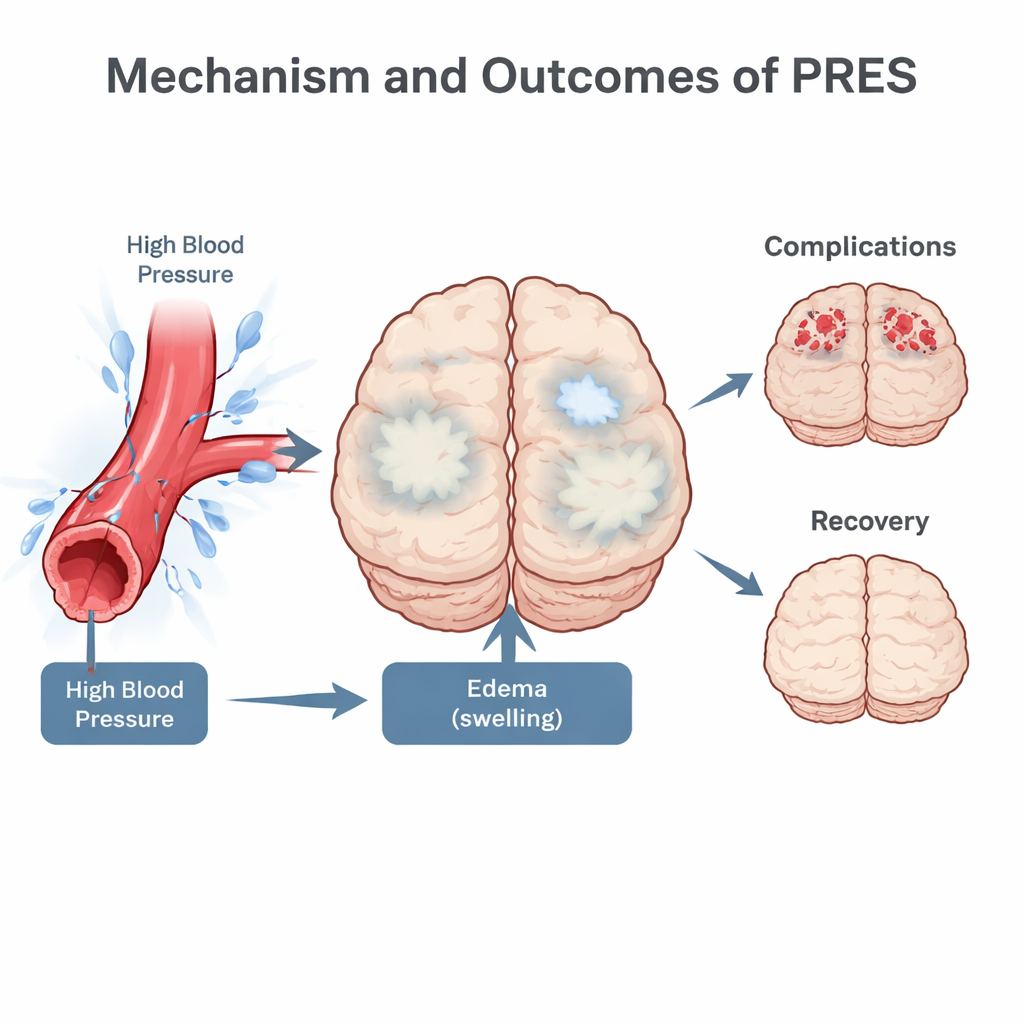
Complications, Surprises, and Recovery
Although PRES is described as "reversible," it can leave a heavy mark. In this case series, about half of the patients developed neurological complications, especially bleeding in or around the brain and small, often silent strokes. Those with such problems stayed in the hospital more than twice as long as those without them. Men were more likely than women to have lasting disability at discharge. An unexpected finding was that people who already had a history of stroke or transient ischemic attack—or who arrived with clear loss of vision—seemed less likely to develop serious complications from PRES. The authors suggest these patients may be monitored more closely or diagnosed earlier, though the study design cannot prove cause and effect.
Why These Findings Matter for Patients
For lay readers, the key message is that PRES is a dramatic but often treatable reaction of the brain to sudden stress on blood vessels—most commonly from uncontrolled blood pressure, kidney failure, pregnancy‑related problems, autoimmune disease, or powerful drugs. In the Colombian hospitals studied, careful blood pressure control, removal or treatment of triggers, and close neurological monitoring led to zero in‑hospital deaths, and most patients left with good function. The work also shows that PRES is not limited to wealthier countries and that understanding it in different populations can guide quicker diagnosis and better care. For people living with high blood pressure or chronic illnesses, it is a reminder that severe headache, seizures, sudden confusion, or vision changes are reasons to seek urgent medical attention, because timely treatment can allow the brain to recover.
Citation: Ortiz-Pereira, M., Gaviria-Carrillo, M., Mendoza-Rodelo, I.E. et al. Posterior reversible encephalopathy syndrome in Colombia a case series. Sci Rep 16, 7708 (2026). https://doi.org/10.1038/s41598-026-38921-w
Keywords: posterior reversible encephalopathy syndrome, high blood pressure and brain, seizures and vision loss, neurology case series, Colombia hospital study