Clear Sky Science · en
Longitudinal behavioral and ERP evidence for domain-general working memory deficits in children with mathematical difficulties
Why Some Kids Struggle With Numbers
Many children find math hard, but for a sizeable minority the struggle is so deep that it affects school, confidence, and everyday life. This study followed hundreds of children from preschool into early school years to ask a simple but important question: are math problems mainly about numbers themselves, or about broader thinking skills that help us hold and use information in mind—what psychologists call working memory?
Looking Beyond Just Math Skills
The researchers began by recruiting 500 preschoolers in Iran and giving them a broad set of tests. These included puzzles that measure general intelligence, attention checks, and brain recordings while children performed memory tasks. Families and teachers also reported on the children’s learning and behavior. After about nine months of schooling, the team tested the children’s early math skills and used careful criteria to identify those with serious, specific difficulties in learning math, while ruling out problems in reading, general intelligence, or major psychological issues. In the end, they compared 27 children with marked math difficulties to 27 closely matched classmates with typical math performance. 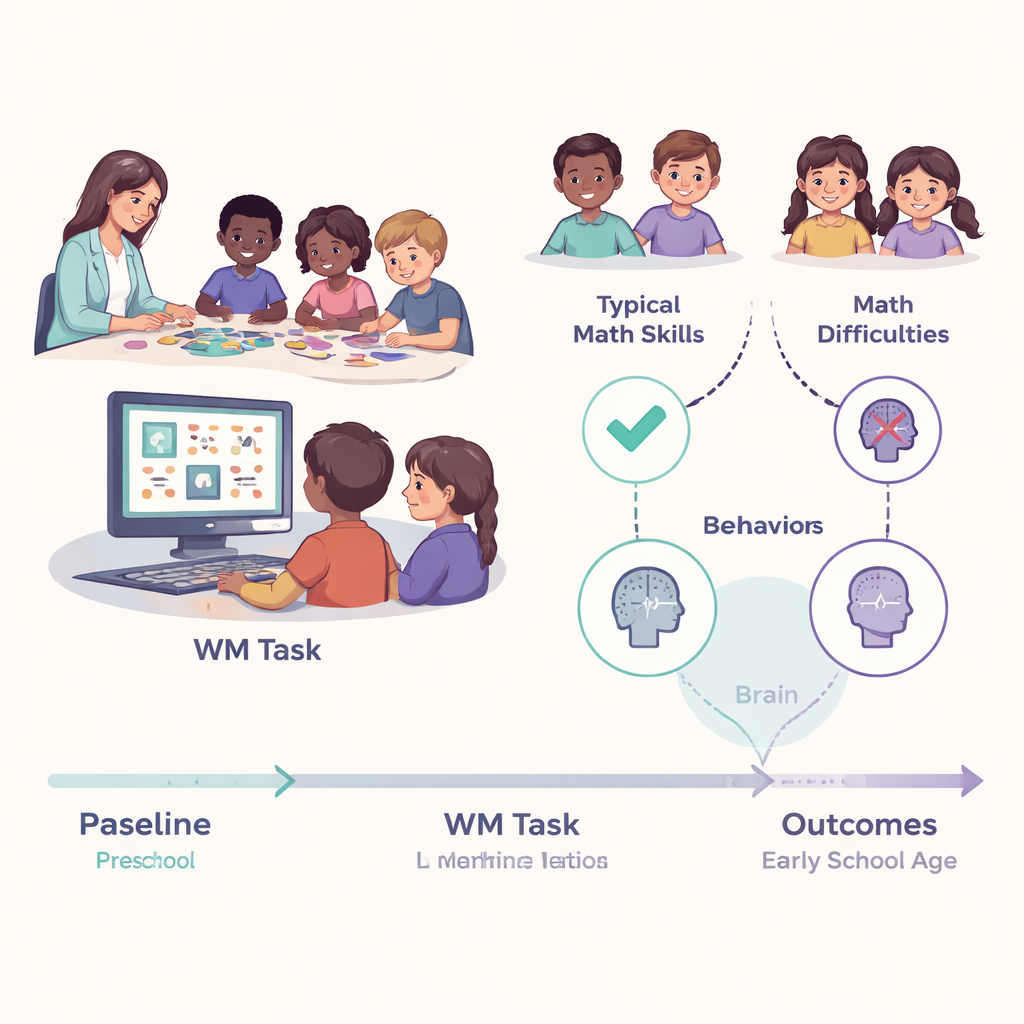
A Memory Test With and Without Numbers
To probe working memory, the scientists designed a game-like task with two versions: one using everyday objects and one using small numbers of dots. In each round, children saw two items in a four-square grid and had to remember both what they saw and where it appeared. After a brief visual and sound “noise” meant to wipe out short-term traces, they were shown a new pair of items and asked whether this final pair exactly matched the original in both content and location. Sometimes the items were the same (a “positive” set), and sometimes one or both items, or their positions, were changed (a “negative” set). The number-based block worked the same way, but with dot patterns instead of pictures, letting the team compare memory for numbers and for non-number information using the same structure.
Behavioral Clues From Hits and False Alarms
Performance on the task revealed clear differences. Children with math difficulties gave fewer correct answers when the final display truly matched the original and made more “false alarms,” incorrectly saying that changed displays were the same. A combined score called sensitivity (d′), which captures how well someone can separate signal from noise, was also lower in the math-difficulties group. Interestingly, these weaknesses appeared in both the picture-based and number-based versions of the task, and did not depend on whether the final display matched or differed. Reaction times tended to be slower in children with math difficulties, but not enough to reach strict statistical significance. Together, the patterns point to broadly less efficient working memory and decision processes, not just trouble handling numbers.
What the Brain Signals Revealed
While children performed the task, their brain activity was recorded using electrodes on the scalp, allowing the researchers to examine event-related potentials—brief electrical patterns linked to thinking steps. They focused on a signal called Late Posterior Negativity (LPN), which appears over the back of the head several hundred milliseconds after a stimulus and is thought to reflect the effort of retrieving and checking information in memory. Across both the picture and number blocks, children with math difficulties showed a clearly reduced LPN compared with their peers, suggesting that their brains devoted fewer or less effective resources to this retrieval-and-checking phase. A statistical model combining the behavior measure (d′ from the number task) and the brain measure (LPN size from the non-number task) could correctly classify about 70% of children as having math difficulties or not, hinting at a useful early warning tool. 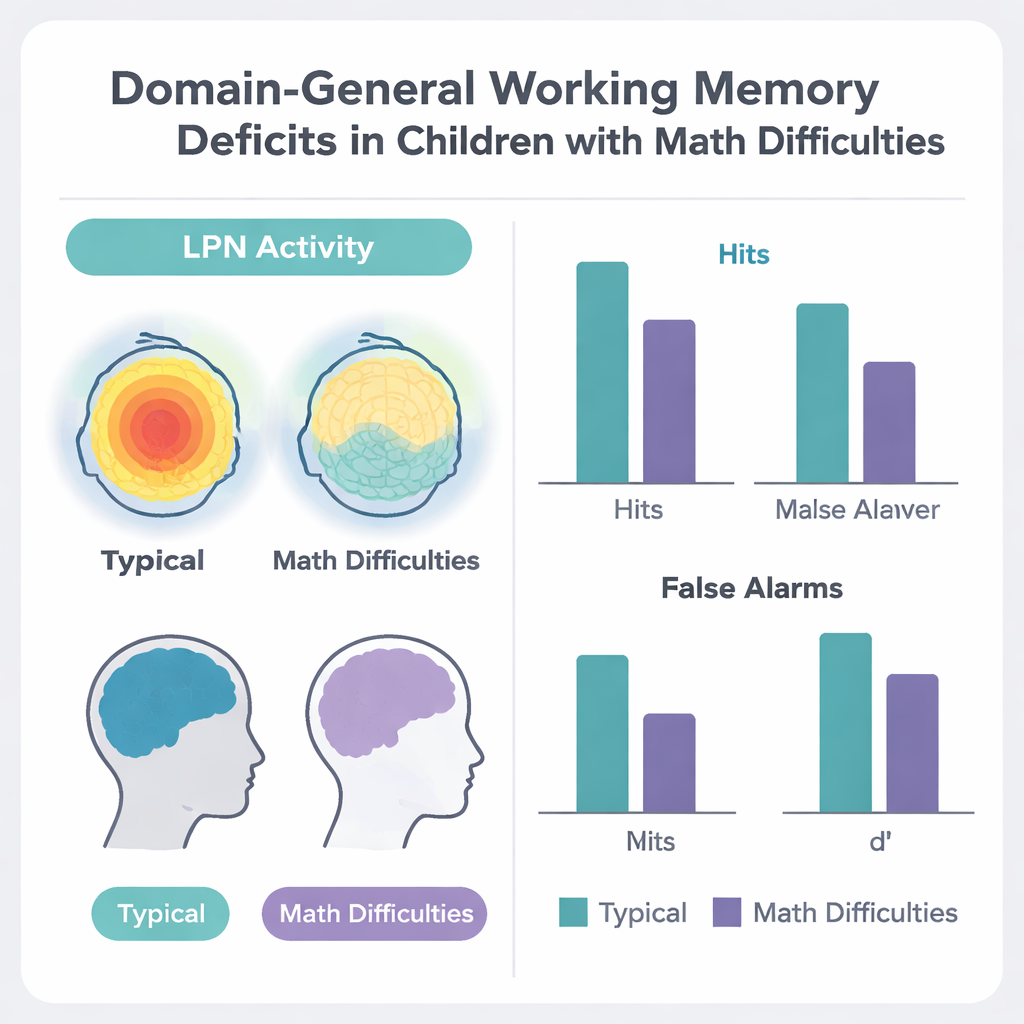
Why This Matters for Helping Children
The overall picture that emerges is that serious math problems in young children are not only about weak number sense or counting skills. Instead, many of these children seem to have a broader working-memory weakness that affects how well they can hold, update, and check information, whether it involves numbers or everyday objects. This domain-general view helps explain why some students rely on slow, error-prone counting strategies and struggle to memorize basic facts. It also suggests that effective support should not focus solely on extra math drills, but may need to strengthen general memory and attention processes as well. By combining brain measures with carefully designed tasks, studies like this one may eventually allow earlier and more precise identification of children at risk, opening the door to targeted interventions before math difficulties become entrenched.
Citation: Safakheil, H., Nazari, M.A., Rezaeian, M. et al. Longitudinal behavioral and ERP evidence for domain-general working memory deficits in children with mathematical difficulties. Sci Rep 16, 7516 (2026). https://doi.org/10.1038/s41598-026-38919-4
Keywords: mathematical difficulties, working memory, children, EEG, learning disorders