Clear Sky Science · en
Synergistic and distinct effects of expansive posture and nasal breathing on psychological and physiological self-regulation in adolescents
Simple Body Tricks for Stressed Teens
Many teenagers feel overwhelmed by exams, social pressure, and worries about the future. This study asks a surprisingly practical question: can simple changes in how you stand and how you breathe quickly boost confidence and calm nerves—without apps, drugs, or long therapy sessions? By testing powerful body poses and slow nasal breathing in stressed high-school students, the researchers explored whether tiny “tweaks” to the body can help teenagers feel more in control.
Stress in the Teenage Years
Mid-to-late adolescence is a stormy period for the brain. Emotional centers mature faster than the regions that help with planning and self-control. As a result, teenagers are especially prone to anxiety and to doubting their own abilities. This mix of high stress and low confidence can become a vicious cycle: worry hurts performance, poor performance damages self-belief, and the spiral continues. The authors wanted to find realistic tools that teachers, parents, and teens themselves can use to break this cycle in everyday school life.
Using the Body to Steady the Mind
The study is based on the idea that the mind and body constantly talk to each other. An upright, open posture can send the brain a message of strength and safety, while controlled nasal breathing can nudge the body into a calmer mode. To test these ideas, 138 students aged 15–18 first went through a well-established stress test involving an impromptu speech and a hard mental arithmetic task in front of unsmiling adults. This reliably raised their anxiety and lowered their sense of capability, putting everyone into a similar “stressed-out” state. 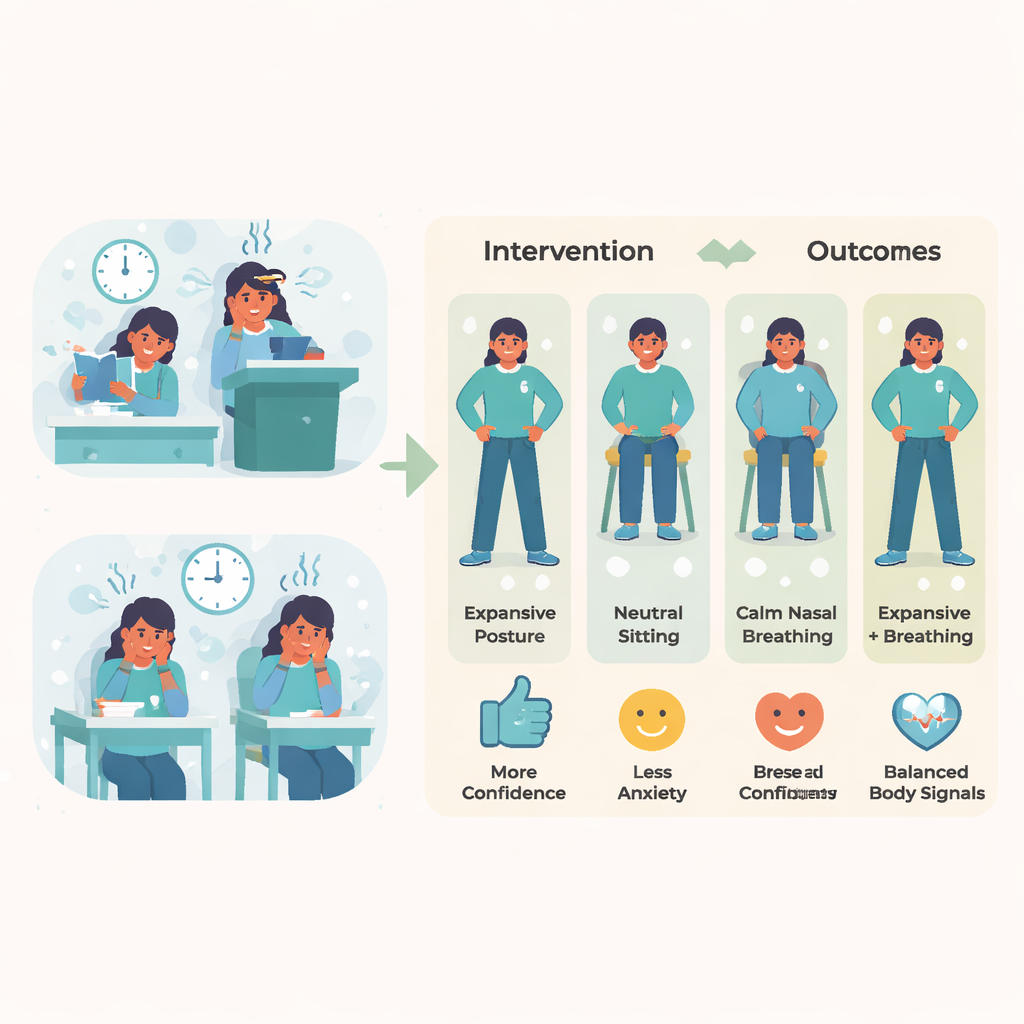
Four Short Exercises After Stress
Right after this stress challenge, students were randomly assigned to one of four brief interventions. One group stood in a wide, upright “expansive” pose for two minutes, with chest open and hands on hips. A second group sat neutrally in a chair as a control condition. A third group sat comfortably with eyes closed and practiced slow nasal breathing for about nine and a half minutes, focusing on long, complete exhales through the nose. A fourth group combined the expansive standing posture with the same nasal breathing. Before and after these exercises, all students rated their anxiety and general self-confidence, and a subset wore wristbands that tracked tiny changes in skin sweat, a sensitive marker of how activated the body’s stress system is.
What Changed in Feelings and Body Signals
All three active exercises helped students feel less anxious than those who simply sat neutrally. But only the groups that included the expansive posture showed a strong boost in general self-efficacy—the belief that “I can handle challenges.” In other words, standing big seemed to lift inner confidence, while breathing slowly mainly soothed anxiety. The body data told a more detailed story. Expansive posture briefly revved up the stress system and then allowed it to settle, a pattern of strong activation followed by adaptation. Pure nasal breathing produced the steadiest, most flexible body responses: skin conductance stayed stable with small, well-timed bursts during a later attention test, suggesting a calm body that can still react quickly when needed. The combined posture-plus-breathing group showed the largest swings in bodily arousal, hinting at a more intense, possibly “rebound” style of regulation.
A Stepwise Strategy for Everyday Life
Putting these findings together, the authors suggest a simple “activate–then–stabilize” approach for teens. Before a big exam or nerve-racking presentation, briefly adopting a strong, open posture—possibly paired with deep nasal breathing—may quickly lift confidence and readiness. After that, or for everyday stress management, slower nasal breathing on its own seems ideal for keeping the body balanced and responsive without overreacting. 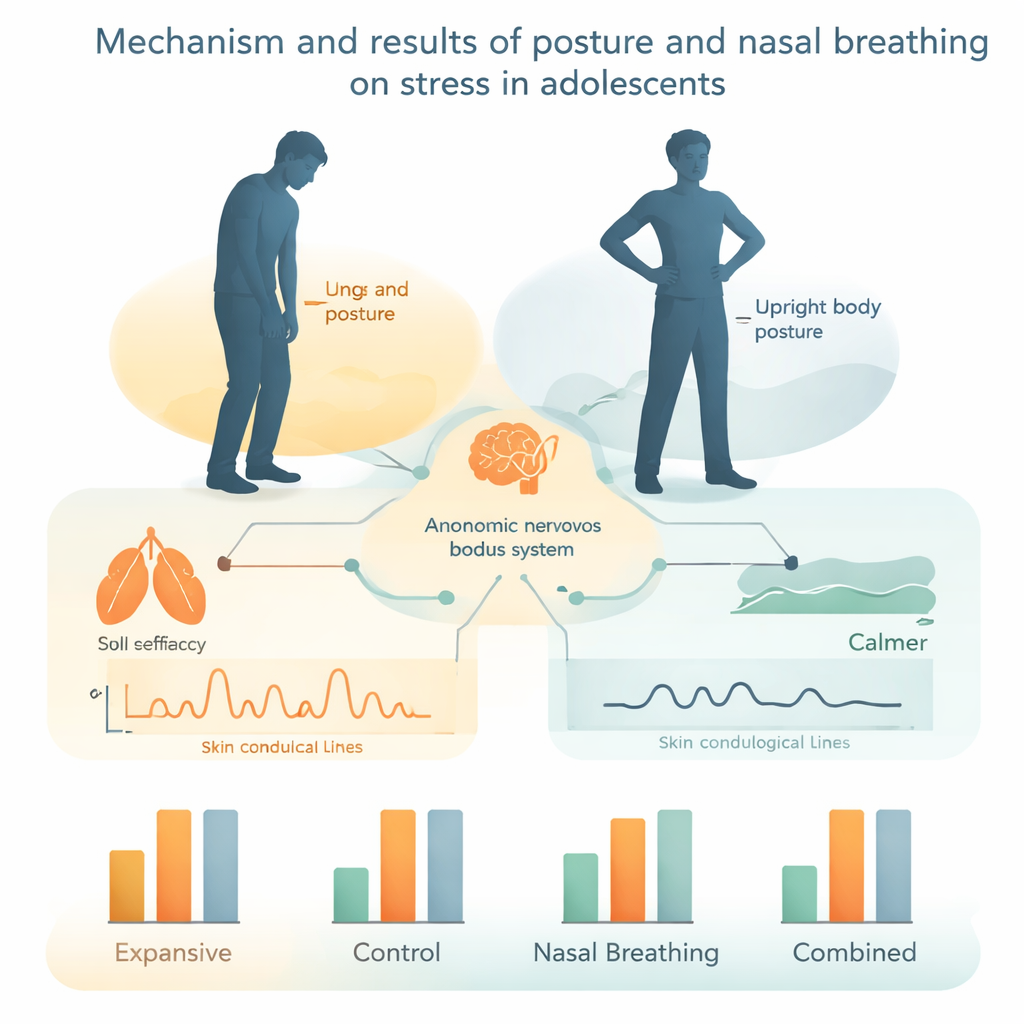
Citation: Yang, X., Liu, Z., Li, Z. et al. Synergistic and distinct effects of expansive posture and nasal breathing on psychological and physiological self-regulation in adolescents. Sci Rep 16, 7699 (2026). https://doi.org/10.1038/s41598-026-38917-6
Keywords: adolescent anxiety, self-efficacy, posture, nasal breathing, stress regulation