Clear Sky Science · en
Part-level 3D shape generation driven by user intention inference with preferential Bayesian optimization
Why smarter 3D design tools matter
Anyone who has tried to build something in 3D—whether a piece of furniture in a home-design app or a character in a game—knows how quickly options become overwhelming. Modern AI can generate stunning 3D shapes from simple prompts, but it rarely understands what, exactly, a person likes about a design. This paper presents BOgen, a new system that helps designers create chairs by mixing and matching parts, while the AI quietly learns their tastes and steers them toward better options.
From text prompts to meaningful 3D choices
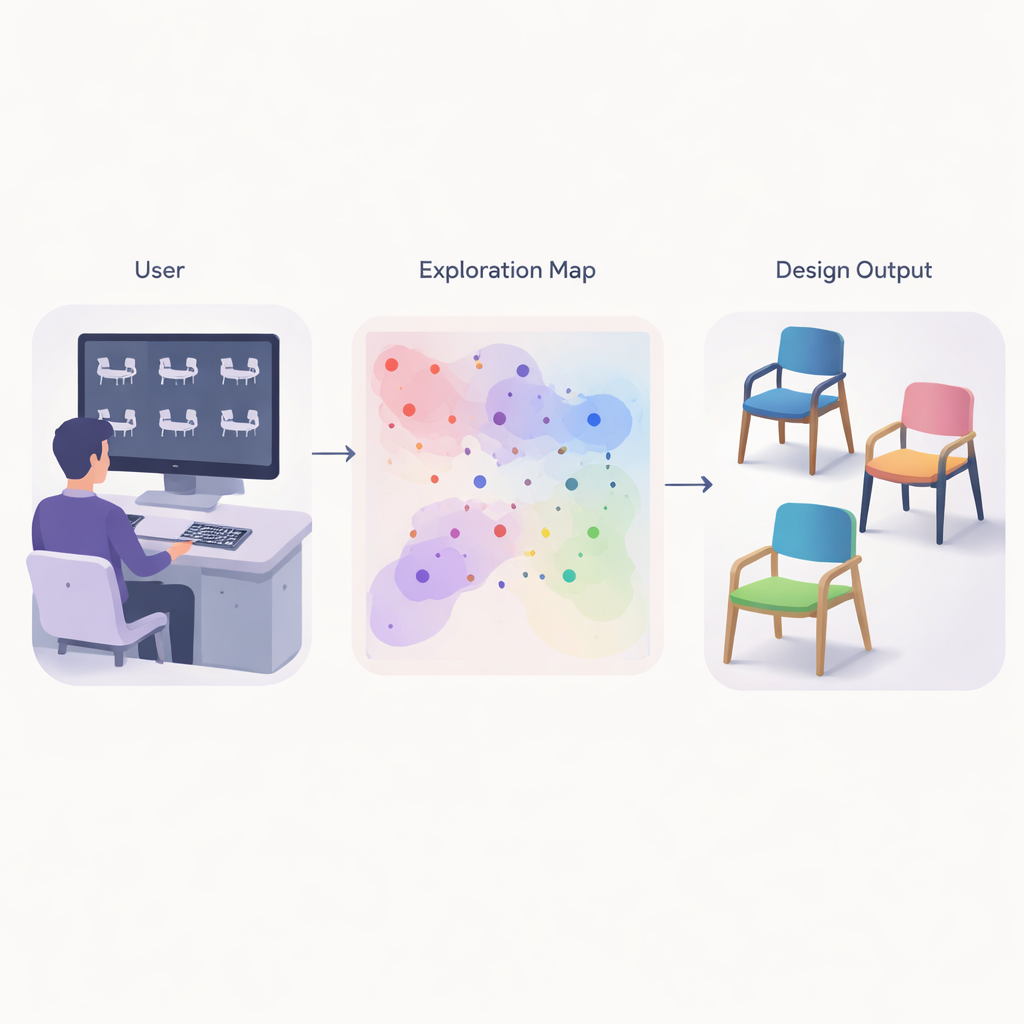
Recent advances in generative AI can turn text descriptions like “wooden dining chair with curved backrest” into detailed 3D models. Yet these tools mainly chase visual wow factor. They do little to support the messy, iterative decisions designers actually make, especially when they want to swap specific parts—such as combining the legs of one chair with the backrest of another. The authors argue that a helpful system must prioritize the designer’s intent over eye candy and must work at the part level, not only the whole object. BOgen tackles this by combining a powerful 3D shape generator with an interface that lets users select, compare, and recombine chair parts while the system tracks what they prefer.
Turning a complex shape universe into a simple map
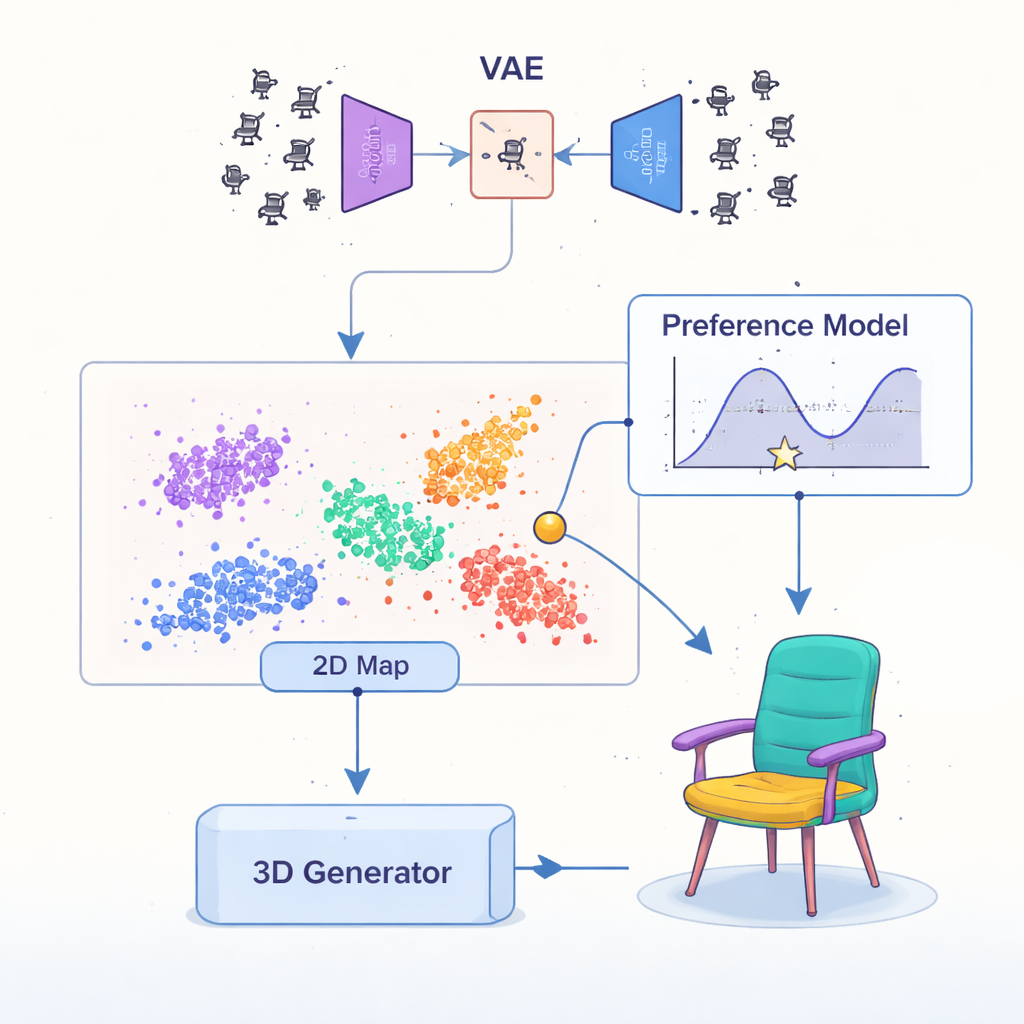
Behind every generated 3D chair lies a high-dimensional code that describes its overall structure and its parts. Directly searching this massive space would be far too slow for an interactive tool. To solve this, the authors train a variational autoencoder (VAE) to compress each chair’s structural information—especially the arrangement of parts—down to just two numbers. These two numbers place every possible chair on a flat “exploration map.” Nearby points correspond to chairs with similar overall forms, while distant points represent very different types, from simple dining chairs to decorative or unusual pieces. This map lets designers roam a complex design universe as if they were browsing a 2D atlas of chair possibilities.
Letting the AI infer preference from simple actions
BOgen does more than display options; it learns from what users do. When a designer marks a favorite chair, hovers over examples on the map, or requests more designs “like this one,” the system treats that choice as a clue about what matters—perhaps a rounded backrest, slender legs, or a compact footprint. A technique called preferential Bayesian optimization models these signals as relative preferences rather than rigid scores. It estimates which regions of the exploration map are likely to contain designs the user will like and which areas remain uncertain. Using this estimate, the system chooses new points on the map to sample, balancing safe bets that match the current taste with riskier suggestions that may reveal new interests.
Designing by swapping and blending parts
Within BOgen’s interface, users can select a “main” chair and a “sub” chair and directly synthesize a new design by interpolating their parts—for example, merging the backrest of one chair with the legs of another. The underlying part-aware 3D generator rebuilds a complete 3D model from these blended components. Each new design is placed back onto the exploration map, so designers can see where it sits relative to other options. Over time, as users repeat this cycle of exploration and part swapping, the system refines its understanding of which combinations are promising and offers more targeted suggestions, effectively co-creating with the designer rather than merely responding to isolated prompts.
Putting BOgen to the test with real designers
To evaluate BOgen, the researchers asked 30 trained or practicing designers to complete early-stage chair-design tasks using two tools: a basic “UIonly” interface and the full BOgen system. Both could generate and recombine chairs from text prompts, but only BOgen included the exploration map and preference-guided recommendations. Quantitative measures showed that BOgen became more confident about user preferences, identified liked designs more reliably, and encouraged users to explore a larger and more varied area of the design space. Survey responses and interviews echoed these findings: designers felt BOgen better clarified their goals, surfaced useful suggestions, and enabled discoveries they would not have reached with text prompts alone.
What this means for everyday design tools
In plain terms, the study shows that it is not enough for AI to be a talented 3D sculptor; it must also act as a thoughtful assistant. BOgen demonstrates how compressing complex 3D options into a simple map and modeling user choices statistically can turn open-ended AI generation into a guided search tailored to each person’s taste. While this work focuses on chairs and optimizes only for visual appeal, the same recipe—map the space, watch what users choose, and suggest new options accordingly—could be adapted to many kinds of 3D assets, from vehicles to characters. As such systems mature and begin to account for real-world constraints like strength and manufacturability, they could make advanced 3D design more accessible, efficient, and creatively rewarding for professionals and non-experts alike.
Citation: Lee, S.W., Choi, J. & Hyun, K.H. Part-level 3D shape generation driven by user intention inference with preferential Bayesian optimization. Sci Rep 16, 7715 (2026). https://doi.org/10.1038/s41598-026-38916-7
Keywords: 3D generative design, Bayesian optimization, design exploration, user-centered AI, part-based modeling