Clear Sky Science · en
Examining speakers’ subjective and bio-behavioral responses to audience-induced social-evaluative threat via immersive VR
Why audiences matter for your nerves
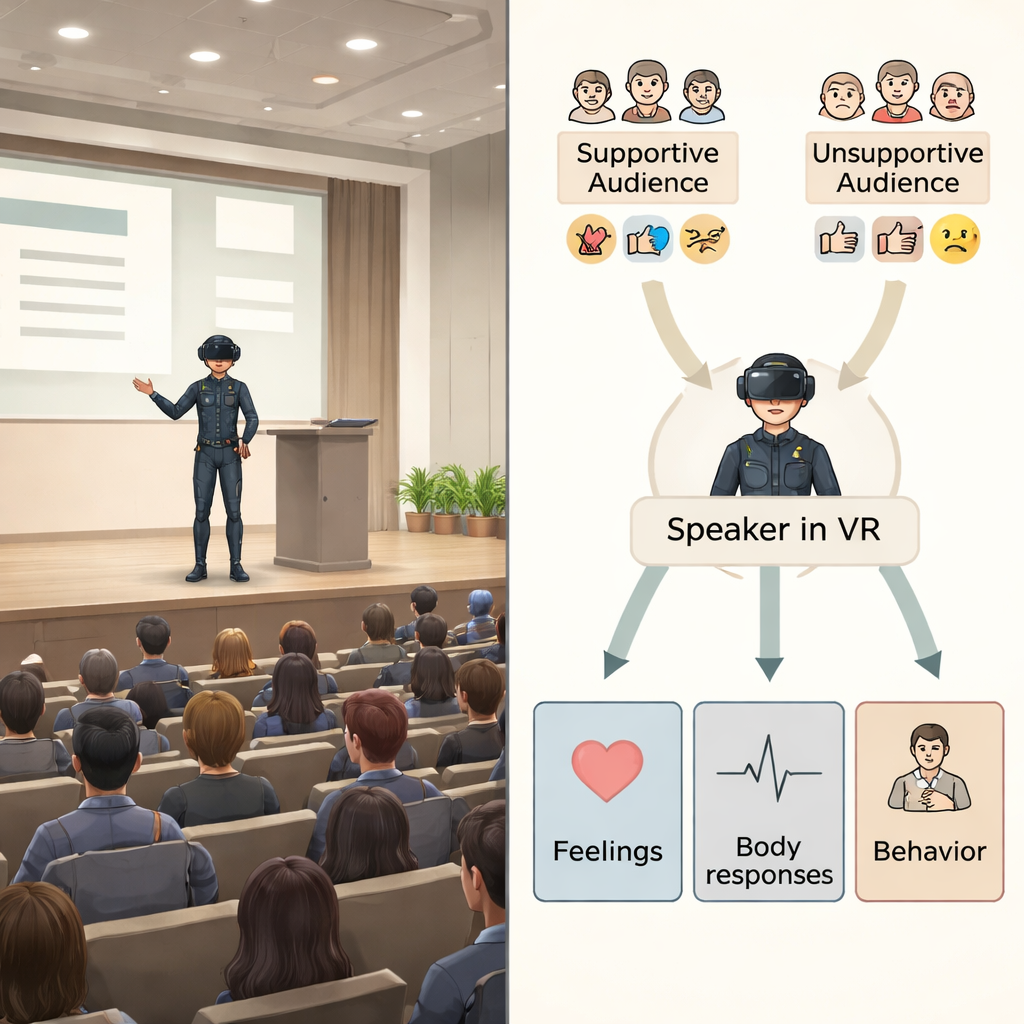
Standing up to give a talk can feel exhilarating or terrifying—and the audience often makes the difference. This study used immersive virtual reality (VR) to ask a simple question with big everyday implications: how do friendly versus bored, distracted listeners change what a speaker feels, how their body reacts, and how they actually behave on stage? By recreating high-stakes scientific talks in VR, the researchers could safely dial audience reactions from warmly supportive to actively unsupportive and watch what happened inside and outside the speaker in real time.
Stepping onto a virtual stage
Participants—researchers and graduate students used to giving scientific talks—prepared two short research presentations. In the lab, they put on a VR headset and motion-capture suit and stepped into a realistic virtual conference room. There they delivered one talk to a supportive audience that looked attentive, faced the speaker, and stayed quiet. In another session, the same speaker confronted an unsupportive crowd: audience members slouched, checked phones, chatted, or even dozed off, with background noises adding to the distraction. Because VR let the team control every detail, each person experienced both kinds of audiences while the researchers recorded their feelings, body signals, and nonverbal behavior.
Listening to feelings, voice, and body
After each talk, speakers filled out questionnaires about how hard they had to work mentally, physically, and socially, and how anxious, tense, or in control they felt. At the same time, sensors tracked heart rate, breathing, pupil size, and brain activity, while microphones captured subtle changes in the voice, and motion sensors measured gestures and posture. This “multi-channel” approach let the team compare what people said they felt with what their bodies and behavior were actually doing, giving a fuller picture than self-reports or lab observations alone.
When the crowd turns cold
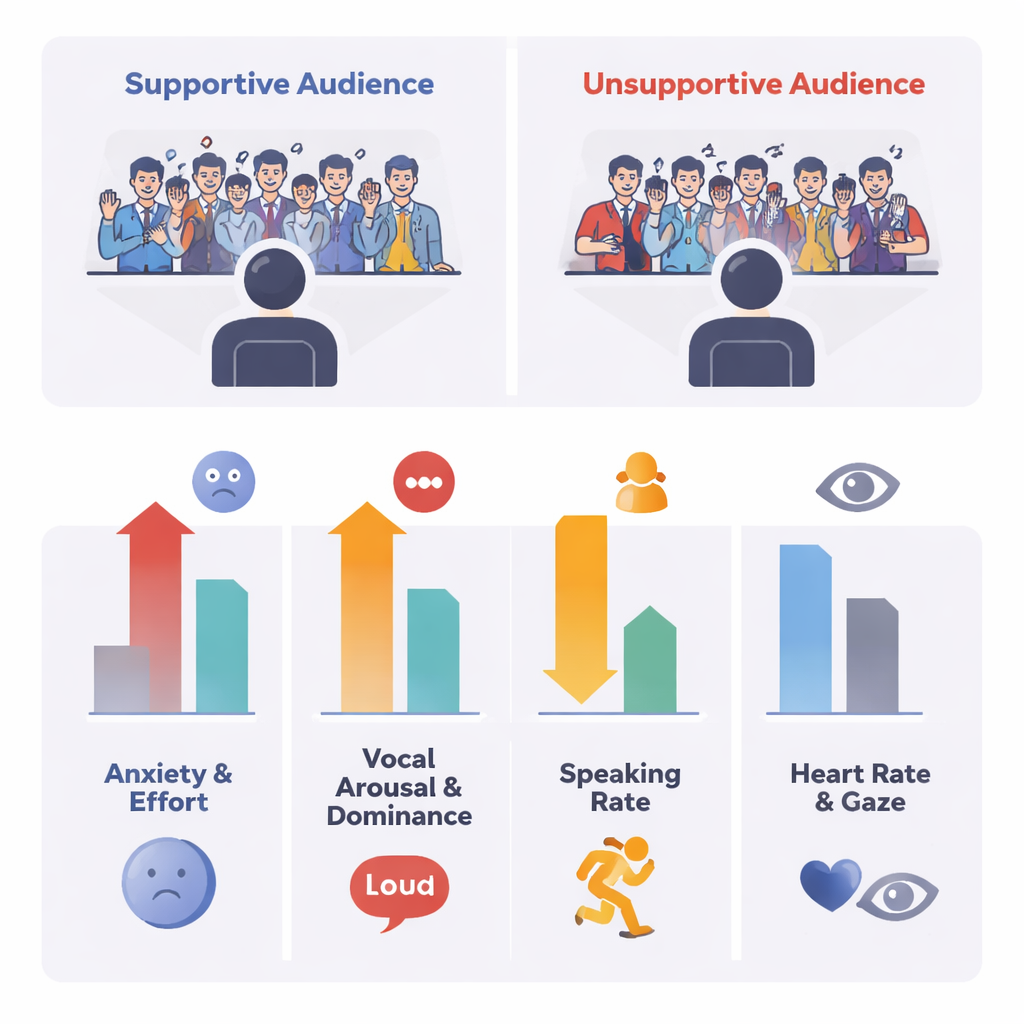
The unsupportive audience clearly got under speakers’ skin. Participants said they had to exert more mental effort to stay on track, felt more negative emotions, and reported more anxiety-related thoughts and language slip-ups. They also felt more worked up overall. Interestingly, their voices betrayed this pressure: vocal patterns showed higher arousal and a stronger, more forceful sound, suggesting that speakers may instinctively “turn up the volume” or assertiveness to try to win back a disengaged crowd. At the same time, their speaking rate slowed slightly, hinting that they might be choosing words more carefully under stress. Yet not every body signal shifted: heart rate, breathing, and pupil size did not differ reliably between friendly and unfriendly audiences, and eye contact patterns remained similar across conditions.
Training nerves, not just slides
Beyond comparing audiences, the researchers asked whether just doing these VR talks could help people’s nerves. Across the board, state anxiety levels were lower after the VR sessions than before, especially for those who started out more fearful of public speaking. Participants also said they would recommend the VR simulation to others. This suggests that immersive practice, even with computer-generated listeners, may be a promising tool for building public speaking confidence and resilience without the risks of bombing in front of a real crowd.
What this means for everyday speakers
For anyone who has ever worried about a bored or hostile audience, the study offers both validation and hope. It confirms that audiences’ nonverbal reactions—leaning in or tuning out—do more than bruise pride; they measurably color how speakers feel and how they sound. At the same time, VR proves to be a powerful “flight simulator” for public speaking: it can recreate the social pressure of the stage, capture detailed body and brain responses, and potentially deliver tailored feedback and training. As VR headsets and built-in sensors become more common, this kind of science-guided practice could help students, professionals, and leaders turn one of the most feared job skills into a more manageable—and even rewarding—part of modern life.
Citation: Lim, S., Schmälzle, R. & Bente, G. Examining speakers’ subjective and bio-behavioral responses to audience-induced social-evaluative threat via immersive VR. Sci Rep 16, 7633 (2026). https://doi.org/10.1038/s41598-026-38915-8
Keywords: public speaking anxiety, virtual reality training, audience feedback, social stress, science communication