Clear Sky Science · en
Growth differentiation factor-15 improves long-term mortality risk prediction beyond the GRACE 2.0 score after acute coronary syndrome
Why a new heart risk test matters
Surviving a heart attack is only the beginning. Doctors then need to estimate who is at higher risk of dying in the coming years so that care can be tailored and follow-up intensified. This study asked whether a modern blood marker, called growth differentiation factor‑15 (GDF‑15), and heart ultrasound measurements can improve on today’s standard risk calculator, the GRACE 2.0 score, for people treated after an acute coronary syndrome (a recent heart attack or severe chest pain).
Current tools to judge danger after a heart attack
Hospitals around the world commonly use the GRACE 2.0 score to estimate the chance that a patient will die within three years after an acute coronary event. GRACE 2.0 combines age, blood pressure, heart rate, kidney function, signs of heart failure and heart‑damage blood tests into a single number. Although powerful, this score was designed years ago, before newer blood markers and imaging methods became widely available. Researchers suspected that adding such modern tests might sharpen the picture of long‑term risk.
A stress signal from the heart and body
GDF‑15 is a protein released into the blood when cells are under stress, including heart muscle cells injured during a heart attack. Earlier work suggested that higher GDF‑15 levels are strongly linked to worse outcomes in heart patients, but it was unclear how this marker compared directly with GRACE 2.0 over many years of follow‑up. At the same time, heart ultrasound can measure how well the main pumping chamber squeezes, using ejection fraction (the percentage of blood pushed out with each beat) and a more sensitive measure called global longitudinal strain, which can pick up subtle weakness before ejection fraction falls.

How the study was done
The research team followed 751 people hospitalized for acute coronary syndrome at three Swedish hospitals between 2008 and 2014. Most had a heart attack, the average age was about 64 years, and more than four out of five underwent procedures to open blocked arteries. Everyone had a GRACE 2.0 score calculated at admission, blood drawn for GDF‑15, and an ultrasound of the heart within three days. The investigators then tracked who died from any cause over three years and over a longer period of about six and a half years, comparing how well different combinations of tests distinguished higher‑ from lower‑risk patients.
What the researchers found
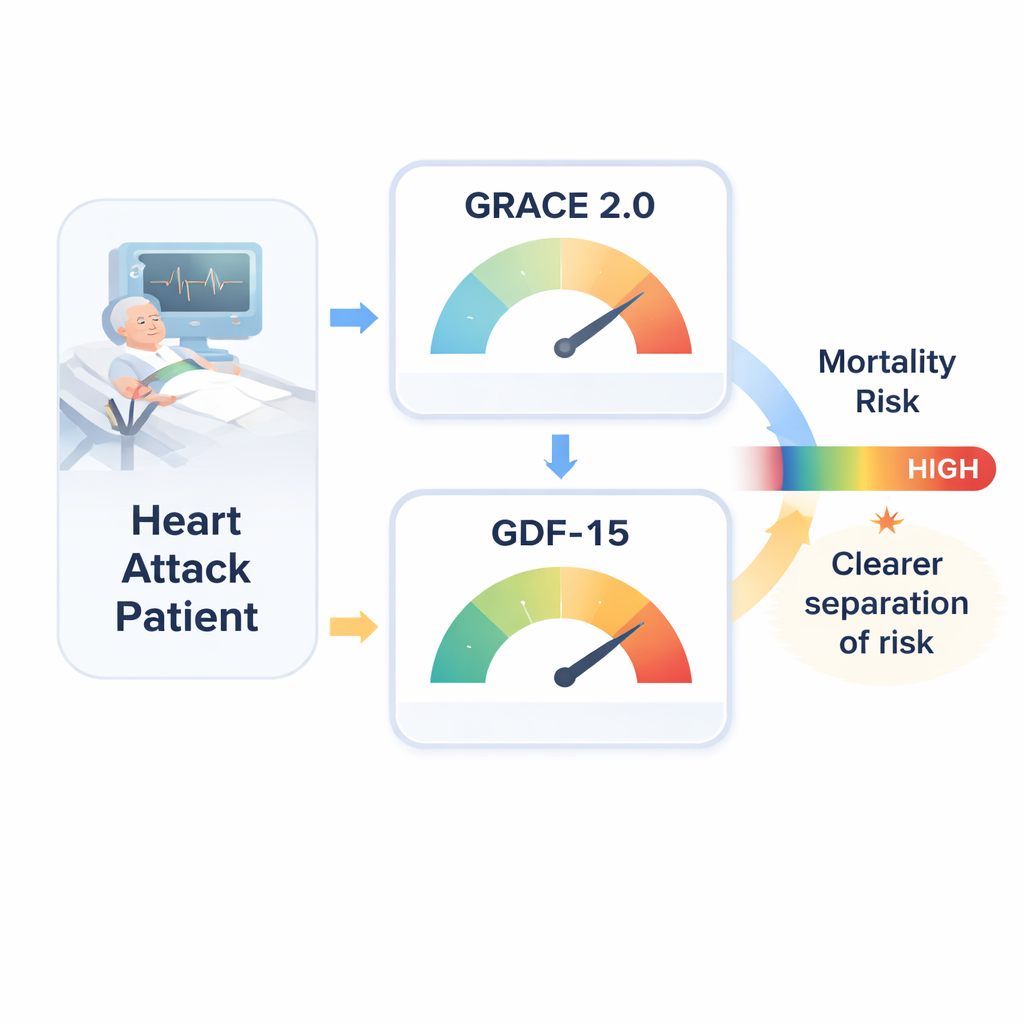
During the first three years, 40 patients died; by the end of follow‑up, 104 deaths had occurred. As expected, people who died tended to be older, had more other illnesses, and had weaker heart pumping function. When the researchers compared prediction tools, GDF‑15 alone gave a clearer separation between survivors and non‑survivors at three years than GRACE 2.0 did. Adding GDF‑15 on top of GRACE 2.0 further improved the ability to sort patients by long‑term risk, even up to six or more years after the heart event. In contrast, heart ultrasound measures—ejection fraction and strain—added only small gains in prediction when combined with GRACE 2.0, likely because most patients already had nearly normal pumping strength and GRACE partly reflects heart failure severity.
What this could mean for patients and doctors
For someone who has just had a heart attack, these results suggest that a single blood test for GDF‑15, taken soon after hospital arrival, might give doctors a surprisingly strong signal about their long‑term survival chances. In everyday terms, high GDF‑15 levels flagged patients who were much more likely to die in the years that followed, while low levels identified people with a relatively good outlook. While ultrasound still has many roles in heart care, this study shows that for forecasting long‑term death risk after acute coronary syndrome, this stress‑related blood marker appears more informative than small refinements in measuring how forcefully the heart squeezes.
Looking ahead
The authors conclude that incorporating GDF‑15 into routine risk assessment, alongside or even ahead of scores like GRACE 2.0, could meaningfully improve how clinicians identify which heart attack survivors need the most intensive follow‑up and treatment. Before this can become standard practice, however, GDF‑15 testing needs to be more widely available, and the findings must be confirmed in larger and more diverse patient groups. Still, the work points toward a future in which a simple blood sample may help personalize care long after a person leaves the hospital.
Citation: Lenell, J., Lindahl, B., Erlinge, D. et al. Growth differentiation factor-15 improves long-term mortality risk prediction beyond the GRACE 2.0 score after acute coronary syndrome. Sci Rep 16, 5241 (2026). https://doi.org/10.1038/s41598-026-38905-w
Keywords: acute coronary syndrome, heart attack, risk prediction, GDF-15 biomarker, mortality