Clear Sky Science · en
Effect of fabrication error on the sensitivity of a one-dimensional photonic crystal sensor for cancer detection
A new way to spot cancer earlier
Catching cancer at its earliest stages can dramatically improve survival, but many current tests are slow, expensive, or invasive. This study explores a tiny optical device called a photonic crystal biosensor that could one day help doctors detect cancer cells quickly by shining light through a carefully designed stack of transparent layers. The twist is that the researchers looked not just at how sensitive this sensor can be in theory, but how well it holds up to the real-world imperfections that inevitably arise when you try to build it in the lab.
How light and layers can reveal sick cells
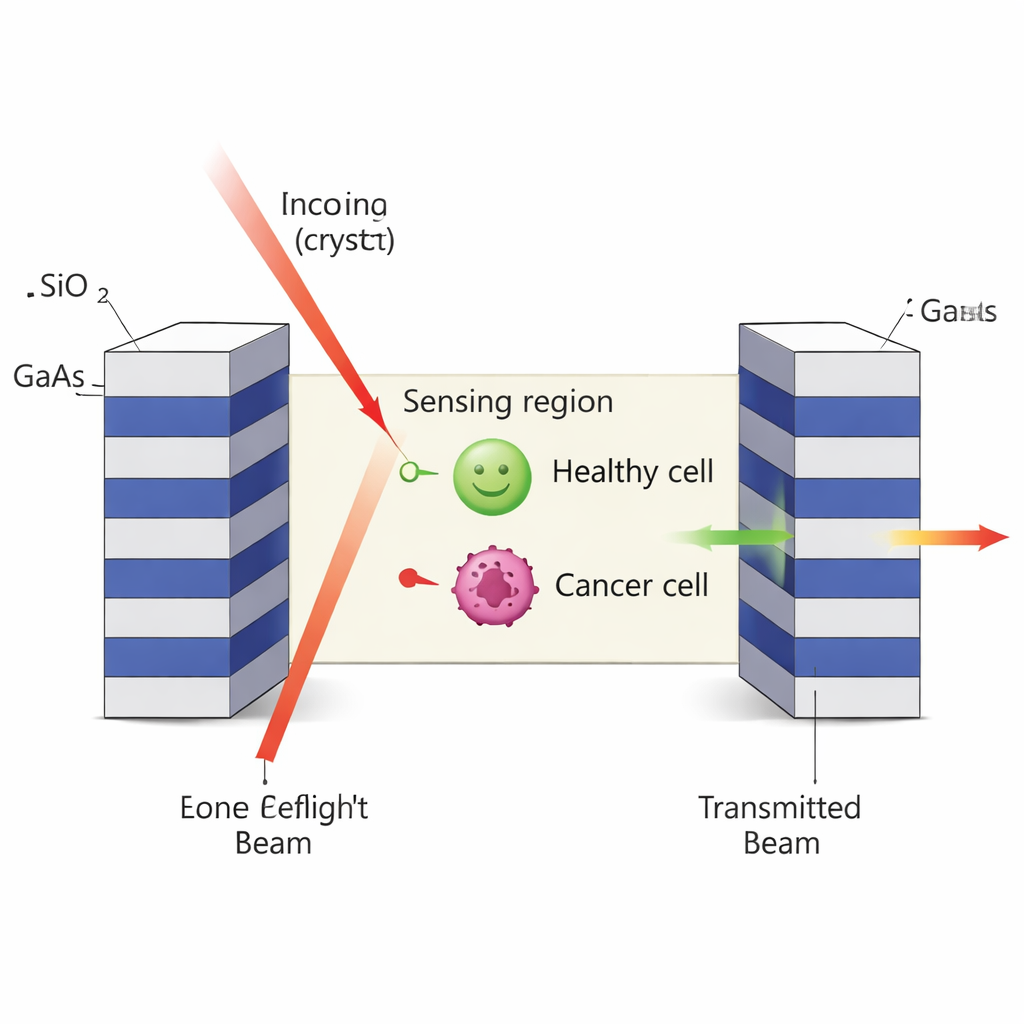
A one‑dimensional photonic crystal is essentially a sandwich of ultra-thin transparent films, each with a different ability to bend light. When stacked in a repeating pattern, these layers act like a very selective mirror, blocking most colors of light while letting only a few pass. The researchers introduce a special “defect” layer in the middle that serves as a slot for a biological sample, such as healthy or cancerous cells from blood or tissue. When light hits this structure, one razor‑sharp peak appears in the transmitted spectrum at a particular color. If the cells inside the cavity change—because cancer cells bend light slightly differently than healthy ones—that peak shifts position, providing an optical fingerprint of disease.
Why tiny building mistakes matter
In computer models, this sort of sensor can look nearly perfect, but real devices are never built exactly to plan. Each of the nanometer-thin layers ends up a little thicker or thinner than intended. Earlier studies typically ignored these imperfections or only discussed them qualitatively. Here, the team treats manufacturing errors as random variations drawn from a statistical distribution, much like measuring the natural spread in heights across a large group of people. They then repeatedly “build” virtual versions of the sensor with different small thickness errors and calculate how these affect crucial performance measures: where the transmission peak appears, how sharp it is, and how strongly it responds to changes between healthy and cancerous cells.
Putting the sensor through a stress test
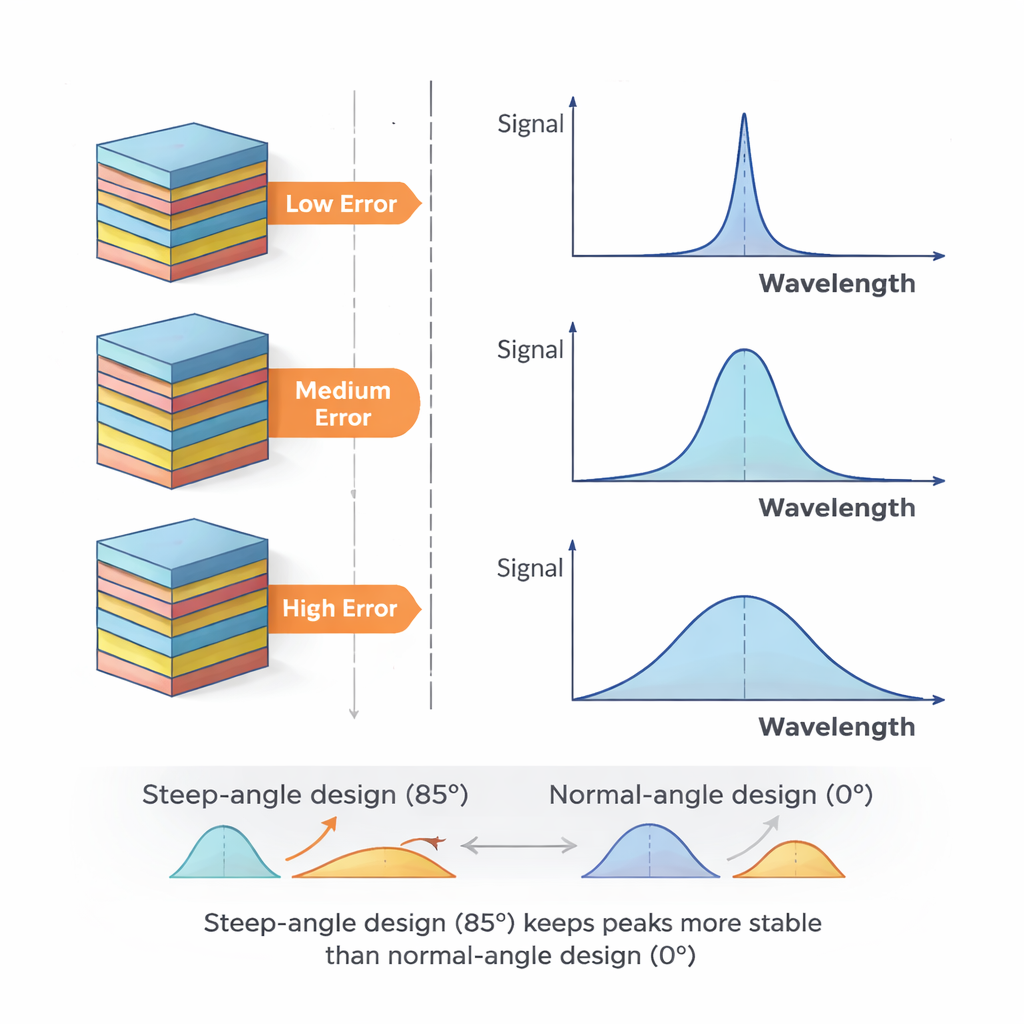
The researchers based their work on a previously published design that, in ideal conditions, is extremely sensitive when light hits it at a very steep angle—about 85 degrees to the surface. They simulated six levels of fabrication error, from extremely precise (half a percent deviation) to relatively rough (10 percent), and repeated the simulation 100 times at each level. As the error increased, the wavelength of the sensor’s peak wandered further away from its ideal value, and the peak became broader and less pronounced. This broadening corresponds to a drop in the device’s ability to cleanly distinguish small changes, much like a blurry line on a graph is harder to read accurately than a razor‑thin one.
A surprisingly robust sweet spot
Despite this general degradation, one encouraging pattern emerged. When the sensor was used at the steep 85‑degree angle, its performance proved much more stable than at normal, straight‑on illumination. For the same level of fabrication error, the spread in sensitivity—the degree to which the peak shifts when switching from healthy to cancerous cells—was noticeably smaller at the steep angle. On average, the sensitivity stayed essentially equal to the ideal value predicted for a perfectly built structure, even when the simulated manufacturing errors were fairly large. Interestingly, a few individual sensor instances in the simulations even outperformed the error‑free design, achieving slightly higher sensitivity by chance.
What this means for future cancer tests
For non-experts, the main message is that the way you shine light on this type of layered optical sensor can make it not only more responsive to cancer cells but also more forgiving of tiny flaws in how it is fabricated. Using a steep incidence angle turns out to be a smart design choice: it keeps the sensor highly sensitive while reducing how much its readings are distorted by unavoidable manufacturing variations. Although the work is based on simulations rather than experiments, it offers a practical roadmap for engineers who want to translate photonic crystal biosensors from theory into robust, real-world tools for early cancer detection.
Citation: Mohammadi, A., Mohammadi, S.A. & Hosseini, M. Effect of fabrication error on the sensitivity of a one-dimensional photonic crystal sensor for cancer detection. Sci Rep 16, 7709 (2026). https://doi.org/10.1038/s41598-026-38903-y
Keywords: cancer detection, photonic crystal sensor, biosensor, nanophotonics, fabrication error