Clear Sky Science · en
Influence of dairy farms’ characteristics and technological level on attitude towards augmented reality
High-Tech Glasses in the Cow Barn
Feeding a growing population while caring for animal welfare and the environment is pushing farms to become more high-tech. This study asks a simple but important question: how ready are dairy farmers to wear smart glasses that project digital information into their field of view, a technology known as augmented reality? By looking at real farms in Italy, the researchers explore whether this kind of tool could genuinely help farmers manage their cows more efficiently and what might stand in the way of adoption.
Why Cows and Computers Now Go Together
Modern dairy farms increasingly rely on electronic sensors and software to track how much cows eat, how much milk they produce, and how healthy they are. This movement, often called precision livestock farming, treats each animal as an individual whose data can guide daily decisions. On farms with automatic milking systems, robots milk cows several times a day and collect large amounts of information. Farmers must then interpret that information, usually on a computer in the office or on a phone. Turning those numbers into clear, timely guidance is challenging, and many tools are still not user friendly. Augmented reality offers a fresh way to put key facts directly in front of a farmer’s eyes while he is standing next to a cow.
The Farms Behind the Numbers
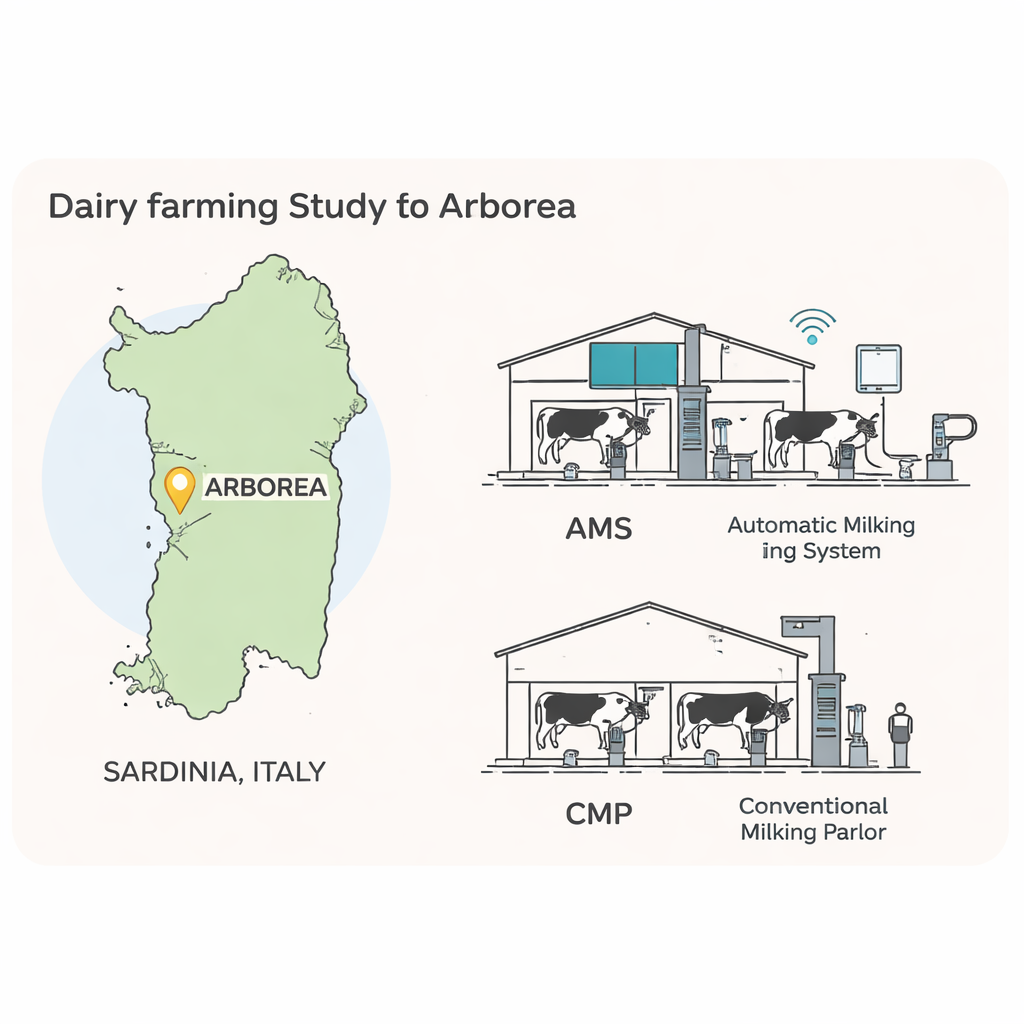
The researchers visited 18 intensive dairy farms in Arborea, a coastal area of Sardinia, Italy. All farms kept cows indoors year-round, but they differed in how they milked them: nine used milking robots, known as automatic milking systems (AMS), and nine used conventional milking parlors (CMP). The two groups were similar in herd size and general layout, though the AMS farms tended to have slightly younger and more highly educated owners and produced more milk per cow. A detailed inventory showed that AMS farms also had more automated equipment overall, such as electronic identification collars, automatic calf feeders, and climate control systems that respond to heat and humidity.
Asking Farmers About Smart Glasses
To capture farmers’ attitudes toward augmented reality, the team conducted face-to-face interviews using a structured questionnaire. Before answering, each farmer tried out Microsoft HoloLens 2 smart glasses running a prototype app that displayed livestock data in their field of view. The survey probed three aspects: how positive they felt about the idea of using smart glasses, whether they intended to use them in future, and what benefits they expected. Farmers rated statements on a five-point scale from strong disagreement to strong agreement, and the answers were then analyzed statistically to compare AMS and CMP farms and to look for patterns across all 18 farms.
What Farmers See as the Payoff
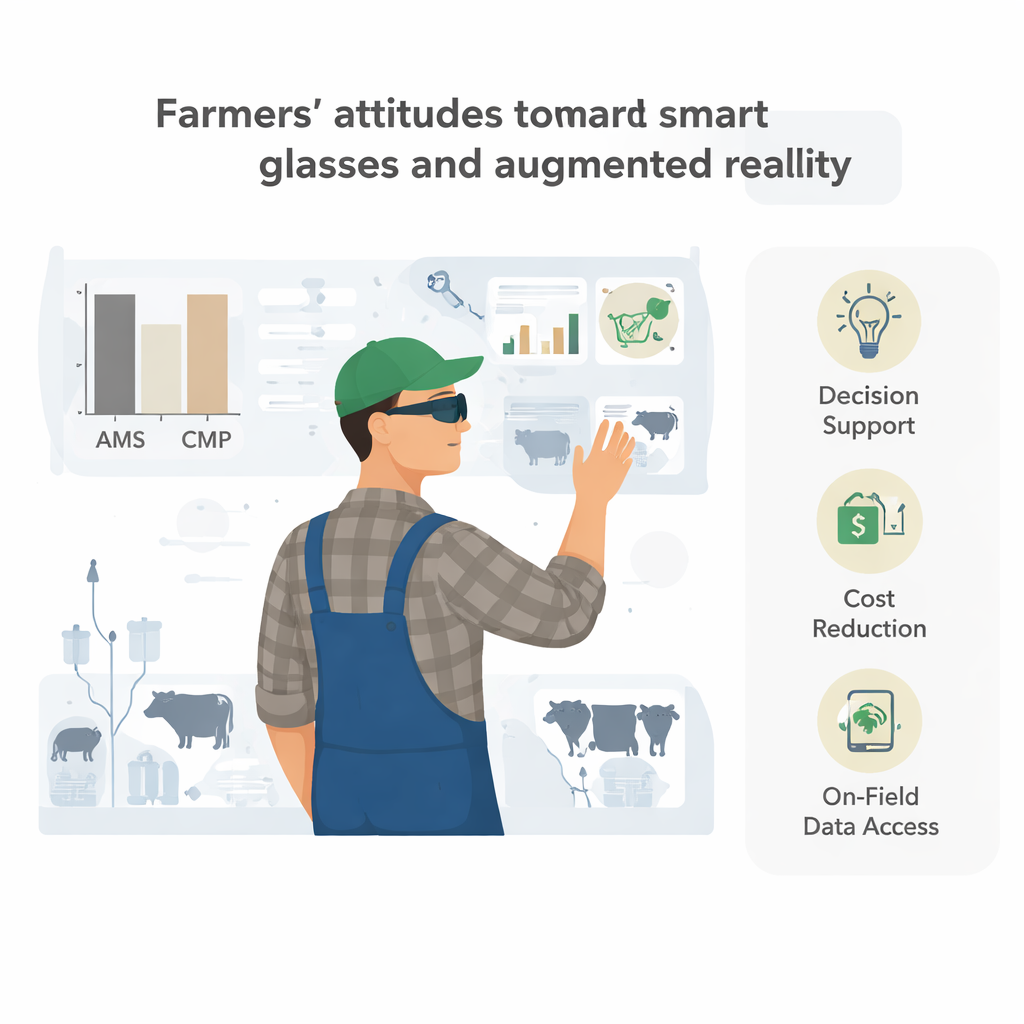
Both groups of farmers reacted favorably to smart glasses. They agreed that using them would be a good idea, advantageous, and even enjoyable, giving high scores for overall attitude and intention to use. The biggest difference emerged in perceived benefits: CMP farmers, who usually access animal data only from a desktop computer, expected smart glasses to improve their decision-making, reduce costs, and justify their price more than AMS farmers did. Those with robots already use phone apps and on-machine screens, so the jump to augmented reality seemed less transformative. Across all farms, interest in reading about new livestock technologies was strongly linked to a positive view of smart glasses, while age and formal education were not. Farmers most wanted to see, in real time, information about milk yield, milk quality, health treatments, and reproductive status for each cow.
Looking Ahead on the Digital Dairy
For non-specialists, the main message is that dairy farmers are open to wearing smart glasses if the technology truly helps them manage cows and simplifies the flood of data modern farms generate. Conventional farms, which currently have less on-the-spot access to digital information, could gain the most: augmented reality could let a farmer glance at a cow and instantly see her milk history or health alerts without leaving the barn. However, smart glasses will only be useful if they connect smoothly to existing sensors, remain comfortable in tough barn conditions, and are affordable and easy to learn. With these hurdles addressed, augmented reality could become a practical everyday tool in barns, turning invisible data into visible guidance right where work happens.
Citation: Pinna, D., Sara, G., Cresci, R. et al. Influence of dairy farms’ characteristics and technological level on attitude towards augmented reality. Sci Rep 16, 7437 (2026). https://doi.org/10.1038/s41598-026-38898-6
Keywords: augmented reality, dairy farming, smart glasses, precision livestock, farm technology adoption