Clear Sky Science · en
Study on energy evolution and damage constitutive model of coal fractured by dual-frequency ultrasonic cracking
Breaking Coal with Sound
Coal seams deep underground often hold large amounts of gas, but the rock is so tight that the gas barely moves. Engineers need ways to open up that rock safely and efficiently, both to prevent explosions in mines and to tap coalbed methane as a cleaner energy source. This study explores a new twist on an old idea: using powerful sound waves, at two different pitches at once, to pre-crack coal so it fails more easily and lets gas escape with much less effort.
Why Coal Needs Help to Breathe
In many Chinese coalfields and elsewhere, coal seams have low permeability, meaning gas is trapped in tiny pores and cannot flow to wells or drainage holes. Traditional methods like high-pressure water fracturing can work but are costly, water-intensive, and not always effective in deep, stressed rock. Ultrasonic cracking offers a cleaner option: sound waves create tiny bubbles, vibrations, and heating inside the coal, which can grow into small cracks. However, using only a single tone of ultrasound has drawbacks; its energy fades quickly with distance and affects only a limited volume of rock. The authors set out to see whether combining two ultrasonic frequencies could shake the coal more effectively than any single tone alone.
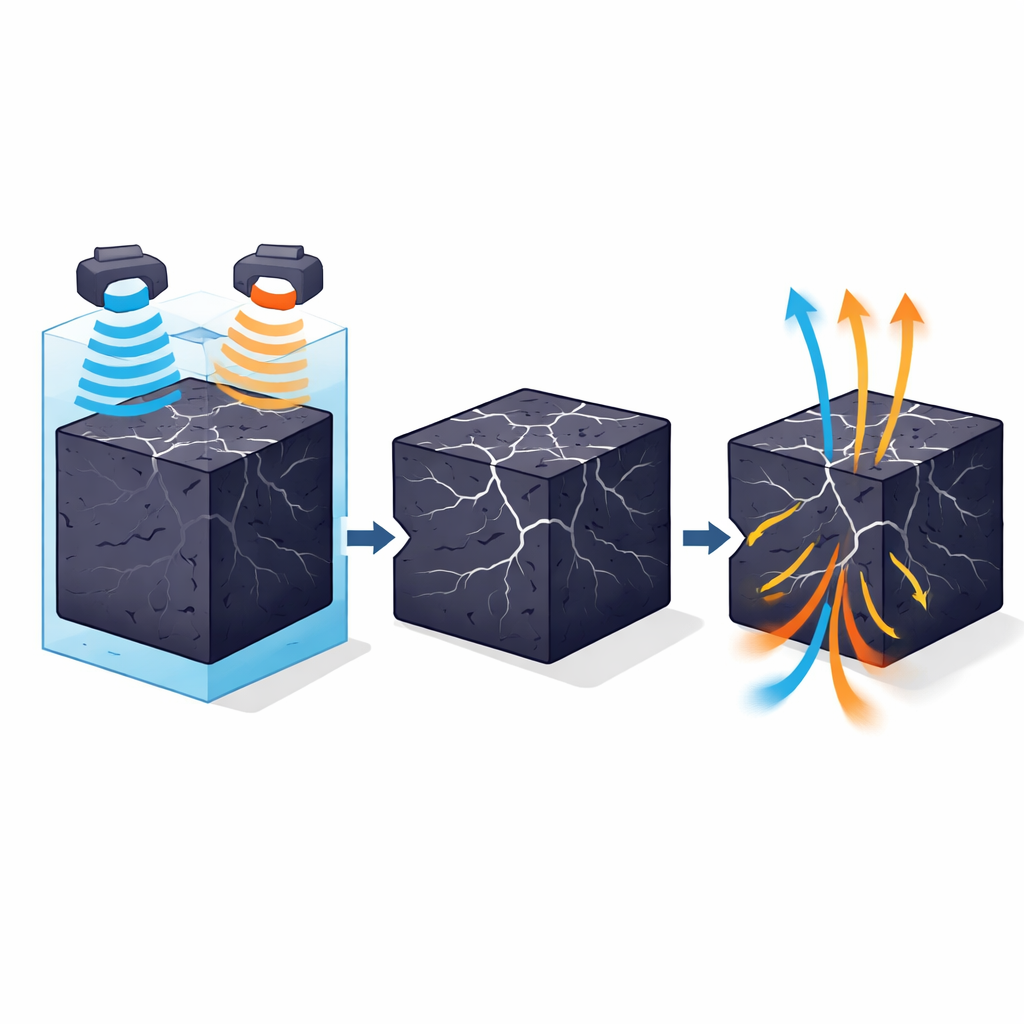
How Dual-Tone Sound Shakes Coal Apart
To test this, the team made uniform cylindrical coal briquettes from powdered coal and divided them into several groups. Some samples received no sound, some were treated with a single ultrasonic frequency, and others were exposed to two frequencies at once in a water tank, with one fixed at 20 kilohertz and the other varied. After treatment, each sample was slowly squeezed in a press until it failed, while sensors recorded its deformation and the tiny acoustic "pings" that signal internal cracking. The researchers then photographed the broken surfaces and used image-processing software to measure the total crack length and how intricate the crack networks were. This allowed them to compare how different sound combinations changed both the inside structure and overall strength of the coal.
From Straight Cracks to Fracture Webs
The dual-frequency treatment turned out to be far more disruptive than either no sound or a single tone. Under single-frequency ultrasound, coal tended to form a few simple, mostly straight cracks. When two frequencies were combined, especially when the second pitch was 1.5 to 2 times higher than the first, the crack patterns shifted to dense, branching networks that wove through the sample in many directions. In one of the strongest cases, the total visible crack length grew by about one quarter compared with untreated coal, and the complexity of the pattern—measured using a fractal index—rose steadily as the frequency gap widened. These elaborate networks act like a pre-cut lattice in the material, so that once loading begins, the coal has many ready-made paths along which to fail.
Making Coal Brittle with Less Energy
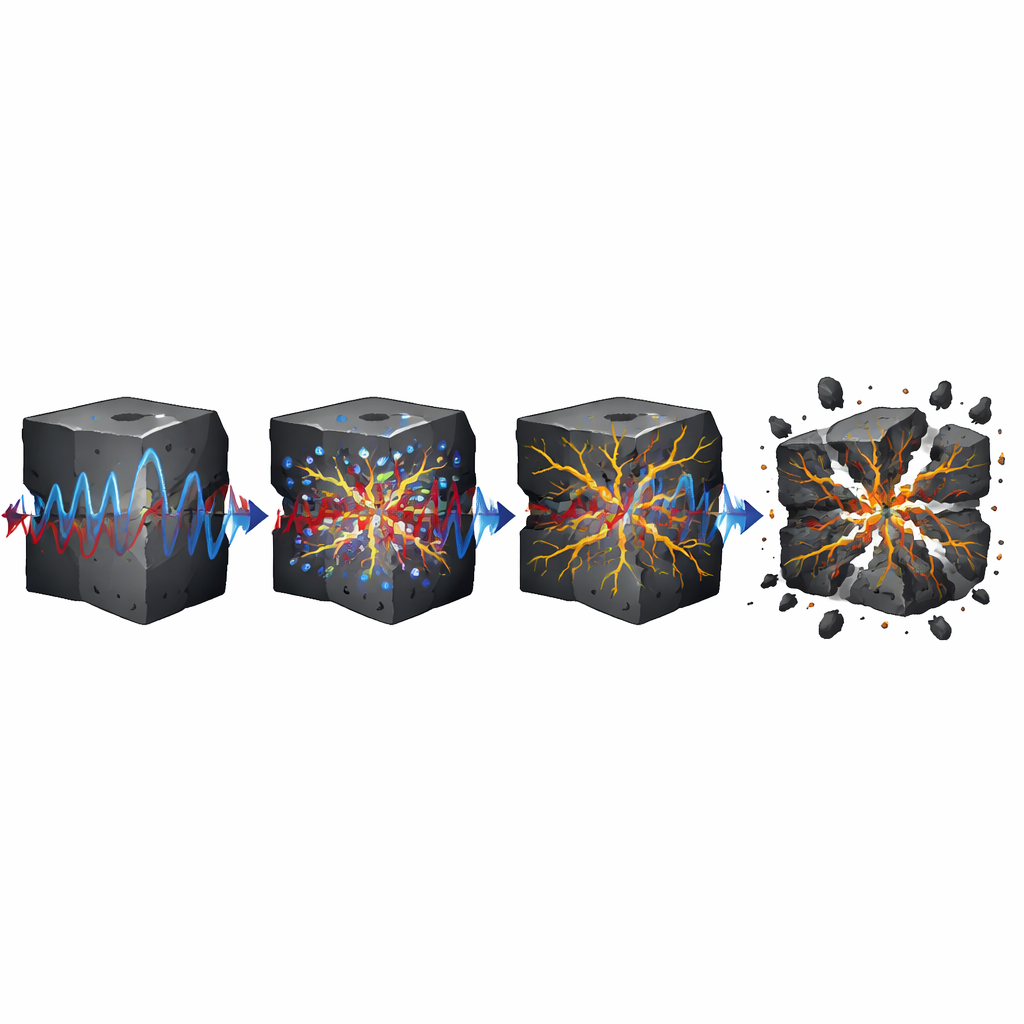
Mechanical tests confirmed how powerful this pre-cracking was. As the dual frequencies were tuned farther apart, the coal’s compressive strength plunged, by up to roughly 87 percent in the most extreme case. At the same time, the energy absorbed before failure dropped by more than 80 percent. Yet, at the moment of peak stress, most of the input energy was still stored elastically, meaning the coal behaved like a spring that suddenly snaps. The authors describe this as an "energy pre-dissipation" effect: much of the internal damage has already been done by ultrasound, so the external press only needs to supply a small extra push to trigger a sharp, brittle collapse. Acoustic emission data backed this up, showing that pretreated samples produced many more internal crack events even though they failed at lower stress.
Finding the Sweet Spot and Predicting Behavior
Interestingly, more sound is not always better in terms of efficiency. By defining a measure of how much extra damage is produced per unit change in frequency ratio, the researchers found that coupling efficiency peaks when the higher frequency is about 1.5 to 2 times the lower one. Beyond that, damage continues to grow, but each extra step in frequency buys smaller gains. To make the results useful for design, the team built a mathematical model that links the evolving damage in coal to both the measured crack complexity and the cumulative acoustic emission signals. This model, rooted in statistical damage theory, predicted stress–strain behavior within about 6 percent of laboratory measurements across different frequency pairs.
What This Means for Safer, Cleaner Coal Use
In simple terms, the study shows that carefully tuned dual-frequency ultrasound can "soften" coal in advance, carving out a fine crack network that makes the rock much easier to break and its gas easier to drain. With an optimal ratio between the two sound pitches, engineers could lower the pressures and energy needed for underground stimulation, improving methane recovery while enhancing mine safety. The new damage model also offers a practical tool for forecasting how coal will respond under different ultrasonic settings, helping move this promising technique closer to real-world application.
Citation: Bao, R., Zhang, Y. & Cheng, R. Study on energy evolution and damage constitutive model of coal fractured by dual-frequency ultrasonic cracking. Sci Rep 16, 9128 (2026). https://doi.org/10.1038/s41598-026-38893-x
Keywords: coalbed methane, ultrasonic fracturing, dual-frequency ultrasound, rock damage mechanics, energy evolution