Clear Sky Science · en
A frequency restoration control scheme of series-parallel-type microgrids with local low bandwidth communication
Keeping the Lights Steady in a Renewable World
As more homes and businesses are powered by solar panels and wind turbines, keeping the electricity system stable becomes harder. The grid must always run at a very precise frequency (like 50 or 60 cycles per second); if it drifts, lights can flicker and equipment can fail. This paper explores a new way to keep that frequency steady in a promising kind of small-scale power network called a microgrid, while using far less communication and computing than existing methods. 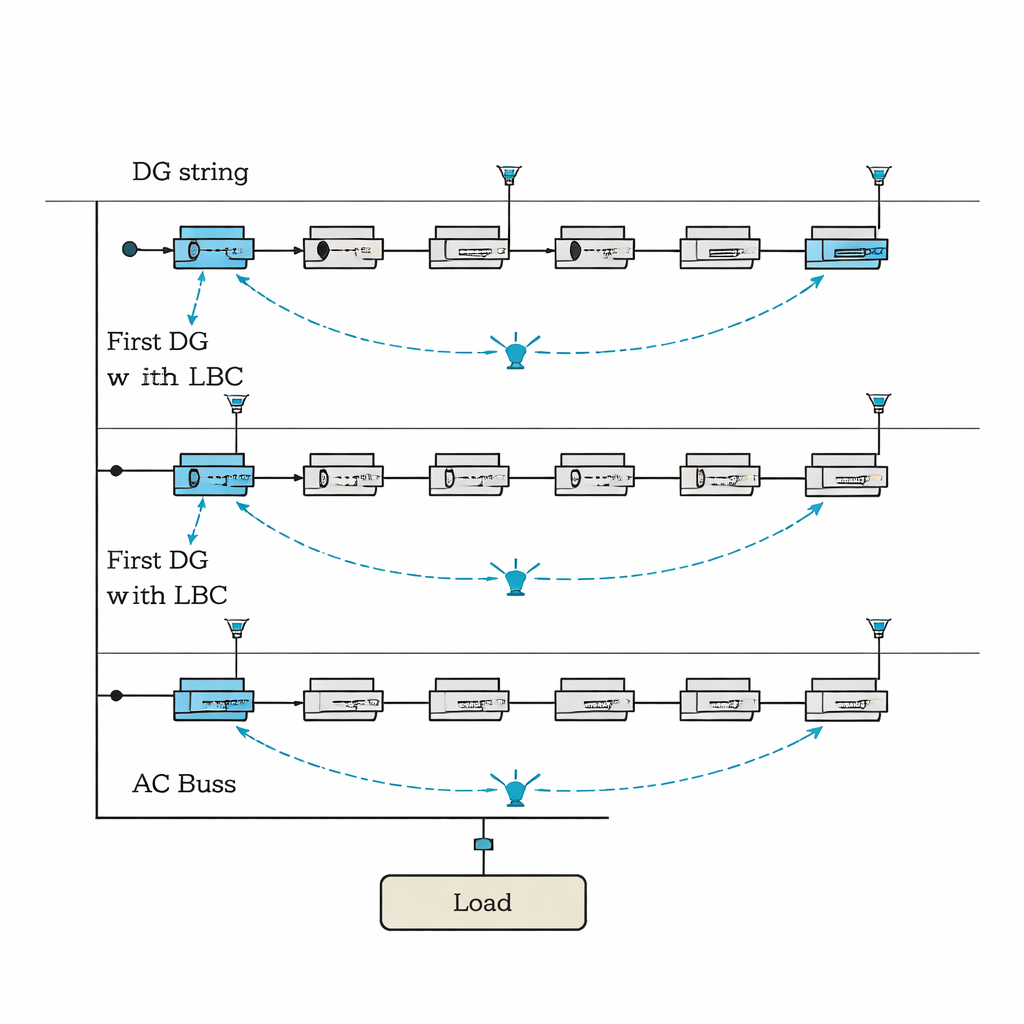
A New Shape for Small Power Networks
Microgrids are self-contained power systems that can host many small generators, such as rooftop solar, batteries, and wind. The study focuses on a particular layout called a “series-parallel” microgrid. In this design, several small generator units are linked together in a chain (series) to form a “string,” and several such strings are then joined side by side (in parallel) to feed shared electrical loads. This structure can make good use of low‑voltage equipment and offers flexibility and modular growth, but it also complicates how power and frequency are shared among all the units.
Why Frequency Drifts and Why That Matters
Modern renewable-based generators are electronic devices rather than spinning machines, so they have very little natural inertia. To cooperate, they often use simple “droop” rules: as power demand rises, their output frequency naturally shifts slightly. This helps them share the load but leaves a small error—the operating frequency no longer matches the ideal reference. Existing ways to pull the frequency back into line typically rely on a central controller or on all units constantly talking to each other over a communication network. That much data exchange can be costly, vulnerable to failures, and hard to scale up.
Let the First in Line Do the Talking
The core idea of the paper is to exploit a special feature of series-connected generators: every unit in a string carries exactly the same current. That common current can act as a shared signal. The authors design a control scheme where only the first generator in each string needs a low‑bandwidth communication link to its peers in other strings. These “first in line” units exchange just enough information about their power output to agree on a common target, while a built‑in correction term uses the measured line current to nudge the whole string’s frequency back to the reference. All the remaining generators in each string rely only on their own local measurements and this shared current, requiring no communication at all. 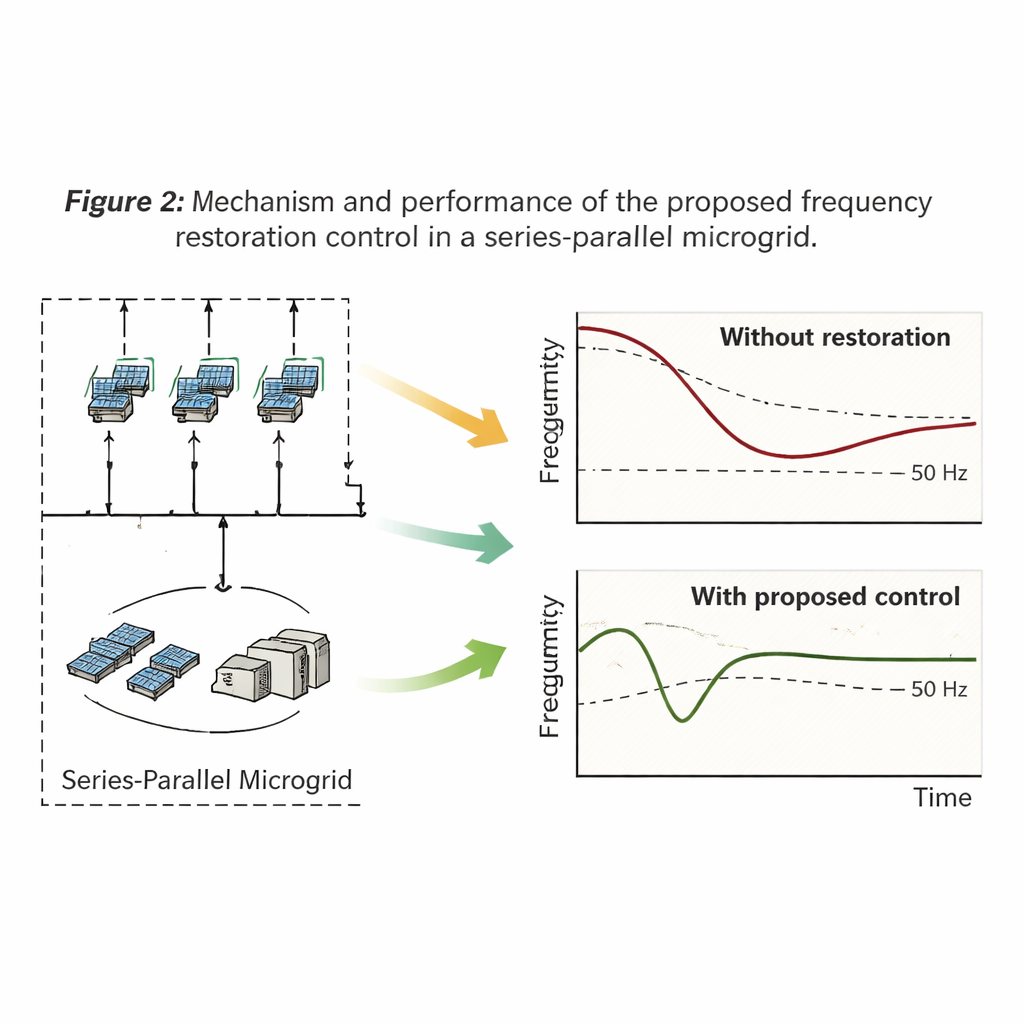
Testing Stability and Realistic Scenarios
To ensure this leaner control scheme would not destabilize the microgrid, the authors build a mathematical “small‑signal” model and apply a root‑locus analysis, a standard tool in control engineering. They identify safe ranges for key settings so that any small disturbance decays rather than grows. They then simulate a nine‑generator, three‑string microgrid under a variety of conditions: sudden load increases, switches between different types of electrical loads, loss of communication links, deliberate changes in how power is shared, and even the failure of one generator. In each case, the proposed method keeps the frequency locked at its nominal value, shares active (real) power in a controlled way, and maintains smooth waveforms, all while using far fewer communication links than older approaches.
What This Means for Future Microgrids
In everyday terms, the paper shows how a cleverly organized “whisper network” among just a few key devices can keep a complex renewable‑rich microgrid humming at the right rhythm, even when parts of the system fail or loads suddenly change. By cutting communication and computing needs, the method can lower costs and improve reliability—important advantages for remote communities, industrial parks, or campuses that want resilient, low‑carbon power. The work also highlights remaining challenges, such as sensitivity to single‑point failures and real‑world uncertainties, and points toward future extensions that include batteries, motor loads, and more varied microgrid layouts.
Citation: Li, L., Shen, S., Tian, P. et al. A frequency restoration control scheme of series-parallel-type microgrids with local low bandwidth communication. Sci Rep 16, 7618 (2026). https://doi.org/10.1038/s41598-026-38888-8
Keywords: microgrid frequency control, distributed generators, low bandwidth communication, renewable energy stability, series-parallel microgrid