Clear Sky Science · en
Bending behavior of concrete-filled FRP wound tubular arches with internal FRP bars
Stronger Tunnel Supports for Tough Underground Conditions
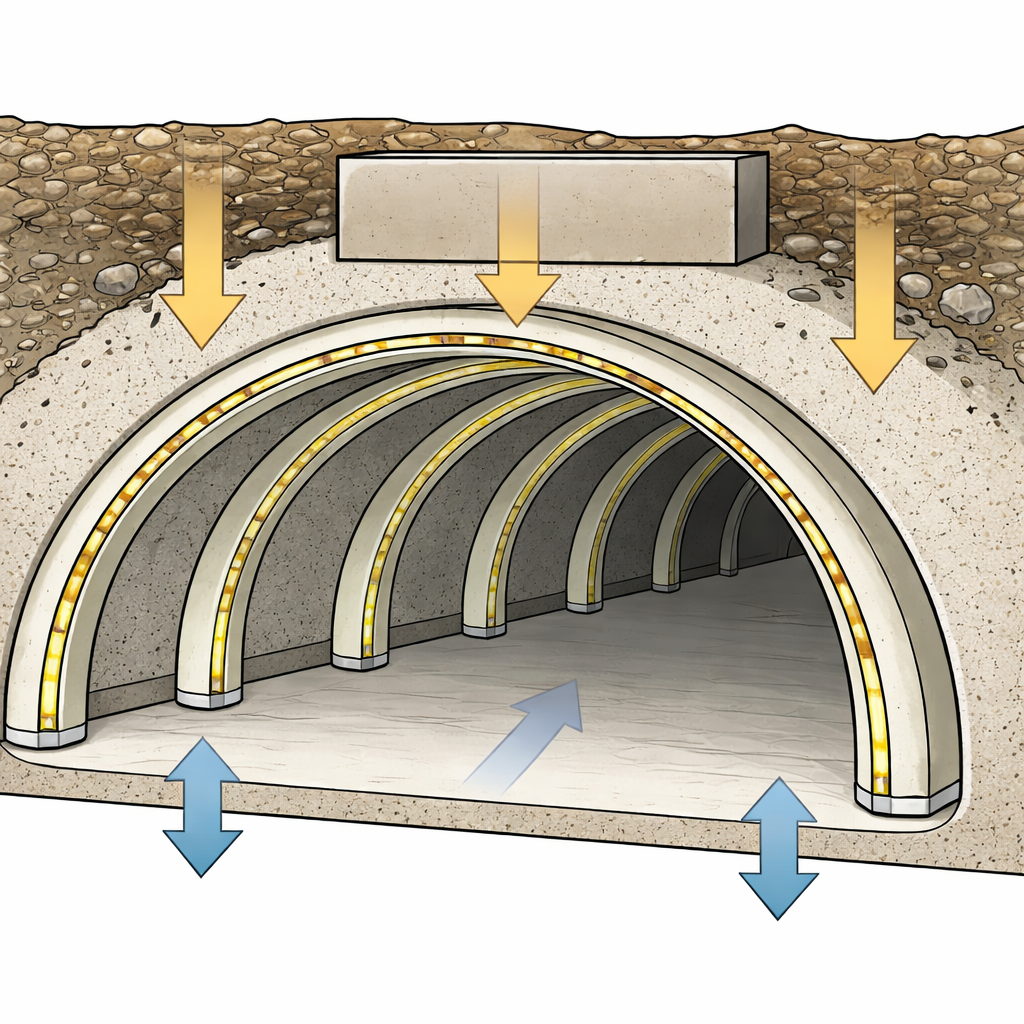
Modern cities and transport systems increasingly rely on tunnels and underground spaces, but the concrete and steel that hold them up can quietly weaken over time. Dark, wet, and often chemically aggressive underground environments corrode steel and damage concrete, raising maintenance costs and safety concerns. This study explores a new kind of tunnel support arch that replaces rust-prone steel with glass-fiber composites and specially reinforced concrete, aiming to provide long‑lasting strength where traditional materials struggle.
A New Kind of Protective Arch
The researchers focused on arch-shaped supports made from glass fiber–reinforced polymer (GFRP) tubes that are pre‑curved during automated manufacturing. These tubes are then filled with high-strength grout (a fine concrete) and further strengthened with thin internal GFRP bars running along the arch. Because GFRP does not rust, this combination is particularly attractive for damp, acidic, or salty underground settings such as tunnels, culverts, and protective structures. The team developed an industrial filament‑winding process that can produce these curved tubes with consistent quality, addressing a major barrier to using composite arches on a large scale.
Putting the Arches to the Test
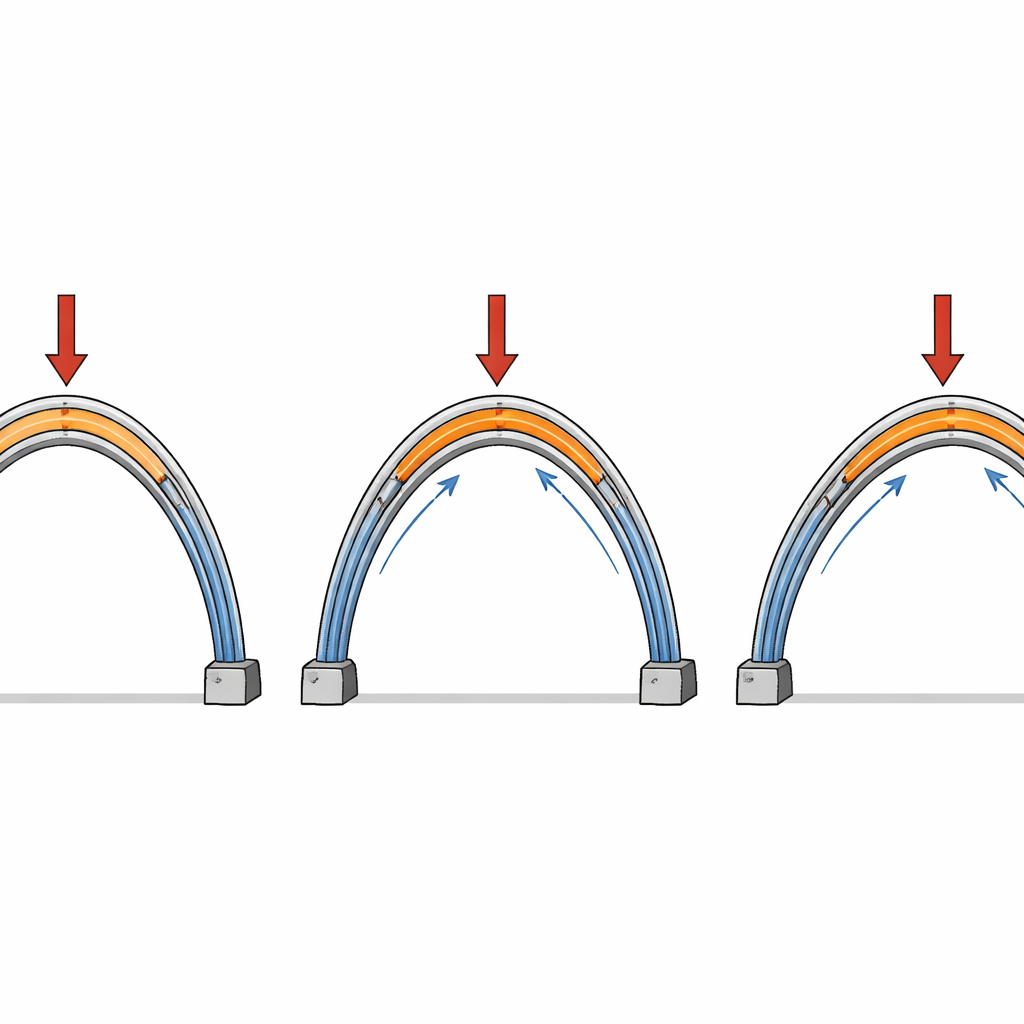
To understand how well these composite arches perform, the authors built and tested 18 arch specimens with a fixed size and shape but different internal layouts. Some arches were hollow GFRP tubes, some were filled only with grout, and others were filled with grout plus four internal GFRP bars. They also varied the tube wall thickness (3, 5, or 7 millimeters). Each arch was clamped at both ends and pressed downward at its crown in a universal testing machine, a setup chosen to create a clear, severe bending condition at mid‑span. During loading, the team recorded how much the arches deflected, how they cracked, and how strains developed around the curve, allowing them to track how the internal forces shifted as damage accumulated.
How Thickness and Inner Bars Change Behavior
The experiments showed that simply thickening the GFRP tube significantly increased how much load the arches could carry before failing. For both hollow and concrete‑filled arches, moving from the thinnest to the thickest tube roughly doubled the ultimate capacity, and thicker tubes also made the arches stiffer in the early, elastic stage. Filling the tubes with concrete provided another large boost in strength and energy absorption. The biggest leap, however, came from adding the internal GFRP bars: compared with hollow tubes, arches with both concrete and bars carried about two and a half to almost four times more load and could undergo more than double the deformation before losing capacity. Calculations suggest that the bars, though occupying only a small fraction of the cross‑section, provide roughly half of the total load‑carrying capacity, while the concrete contributes a steady share and the tube both resists tension and confines the concrete in compression.
From Test Data to Predictive Design
Beyond testing, the authors built a simplified calculation model to estimate how much load such an arch can support under a concentrated force at its crown. They treated the arch as a fixed‑ended structure that eventually forms four “plastic” hinge regions where bending is most severe. By converting the curved tubular section into an equivalent rectangle and using established formulas for confined concrete and GFRP in tension, they derived the bending strength at these hinges and, from that, the overall ultimate load. When they compared these predictions with their test results for arches containing internal bars, the differences were within about 10%, suggesting that the model captures the essential behavior for this specific arch shape and loading condition.
What This Means for Future Underground Structures
In plain terms, the study demonstrates that concrete‑filled GFRP arches with internal fiber bars can be both stronger and more forgiving than conventional concrete arches while resisting the corrosion that plagues steel. The combination of an industrially produced composite tube, a confined concrete core, and high‑strength internal bars yields supports that can sustain large loads and deform without sudden collapse. Although the current design rules are validated only for arches similar to those tested, the findings point toward a new family of durable, lightweight tunnel liners and protective arches that could make underground infrastructure safer and longer‑lasting with less maintenance.
Citation: Li, B., Yang, Z., Qi, Y. et al. Bending behavior of concrete-filled FRP wound tubular arches with internal FRP bars. Sci Rep 16, 7876 (2026). https://doi.org/10.1038/s41598-026-38886-w
Keywords: tunnel support, fiber reinforced polymer, concrete arches, corrosion resistance, underground structures