Clear Sky Science · en
A novel approach to design broadband tunable microwave absorber using expanded graphite on a flexible substrate
Why blocking stray signals matters
Wireless gadgets, radar, and high-speed electronics all share the same invisible highway of radio and microwave signals. When these signals bounce around uncontrollably, they create electromagnetic interference that can garble communication, expose radar targets, and even affect medical devices. Engineers therefore rely on special coatings called absorbers that soak up unwanted microwaves instead of letting them reflect. This paper introduces a thin, bendable absorber that can be “dialed” across a wide range of microwave frequencies simply by adding or removing tiny amounts of liquid water inside it.
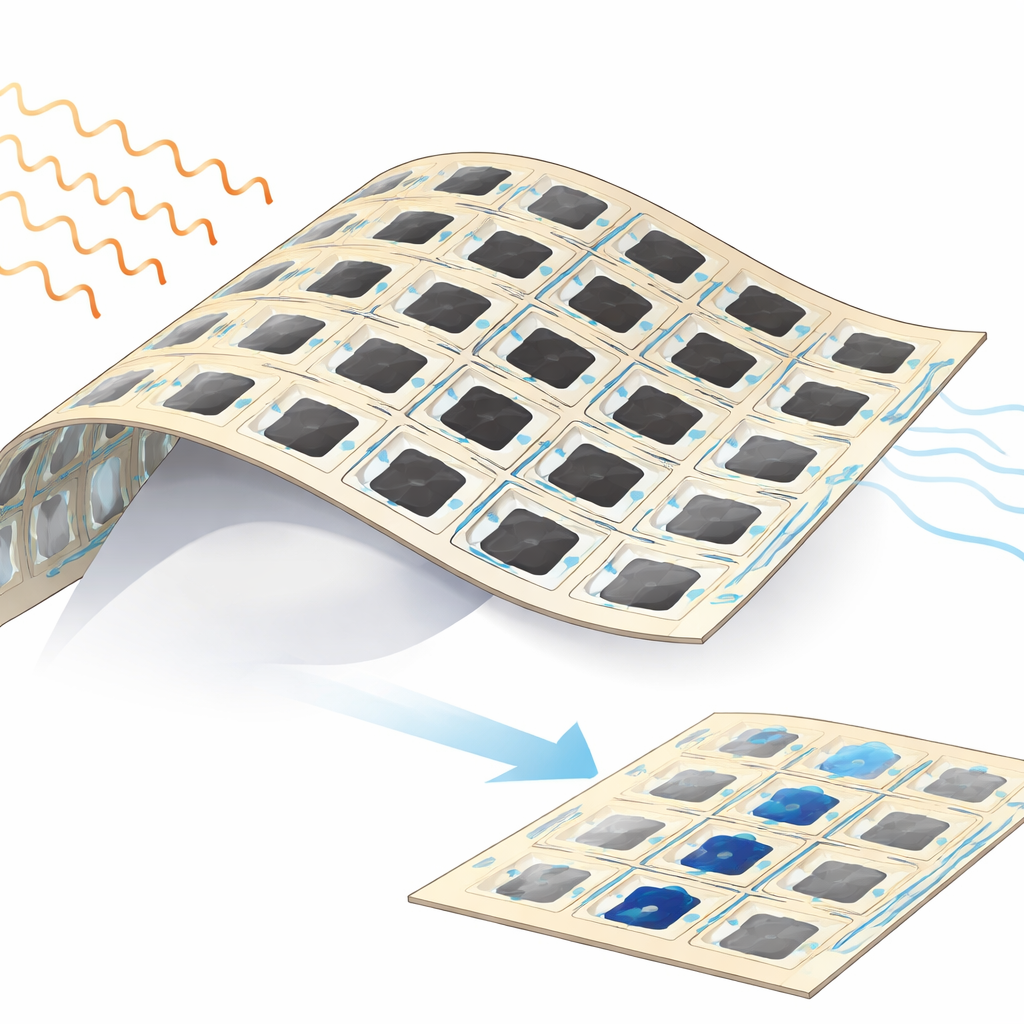
A thin sheet that drinks in microwaves
The researchers set out to build an absorber that is not only highly efficient, but also inexpensive, flexible, and easy to retune. Traditional designs often use rigid circuit boards and metal patterns, work over a narrow band of frequencies, and require electronic components and wiring to change their behavior. In contrast, this device is based on a soft plastic sheet made from linear low-density polyethylene (LLDPE) and patterned with shapes cut from expanded graphite, a cheap, non-corrosive form of carbon. These patterns act as so‑called metamaterial “unit cells” that interact strongly with microwaves even though each cell is much smaller than the wavelength.
How tiny squares and channels do the job
The basic building block is a square ring of expanded graphite with a smaller graphite square in the center, separated by a narrow gap. When a microwave hits this pattern, electric and magnetic fields build up in and around the gap, and at certain frequencies most of the incoming energy is trapped and turned into heat rather than being reflected. By carefully choosing the dimensions of the ring, the inner patch, and small openings in the ring, the authors first designed a version that, on its own, absorbs more than 90 percent of incoming energy around 10 gigahertz, within the so‑called X‑band used in radar and satellite links. They then refined the layout to broaden this absorption so that a large swath of neighboring frequencies is also strongly damped.
Turning water into a tuning knob
To make the absorber tunable, the team carved narrow channels into the plastic substrate directly underneath the gap where the electric field is strongest. These channels can be left filled with air or injected with distilled water. Because water has a much higher ability to polarize in a microwave field than air, introducing it changes the effective electrical environment of the unit cell, shifting the frequency at which it resonates. Computer simulations showed that with air in the channels the structure already offers around 2.1 gigahertz of useful bandwidth with more than 90 percent absorption. Filling one or both channels with water smoothly drags this absorption band toward lower frequencies, with shifts of about a gigahertz when both channels are filled, all while keeping the band broad.
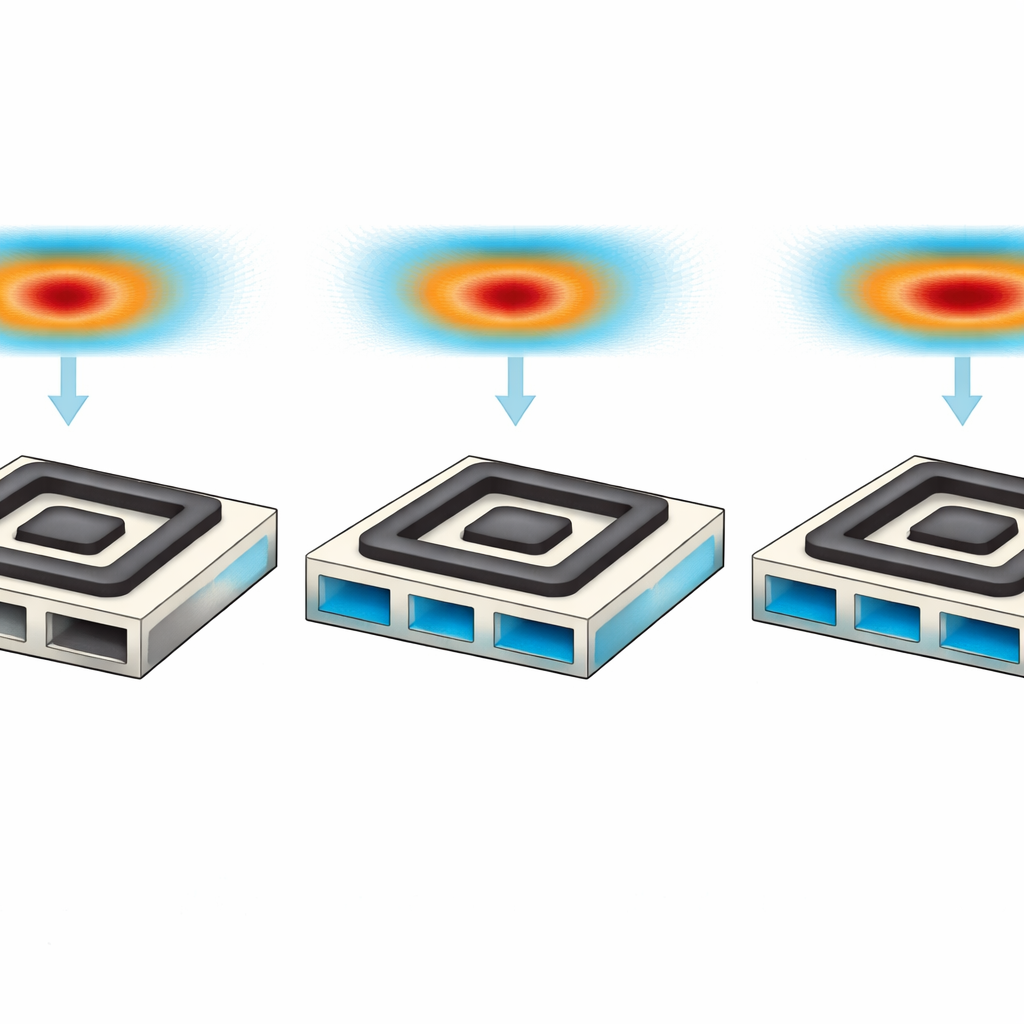
Putting the flexible sheet to the test
The authors did not stop at simulations. They molded flexible LLDPE sheets, formed the channels mechanically, and synthesized expanded graphite powder, which they pressed into thin conducting layers. Using a 3D‑printed mask, they cut out the square ring patterns and laminated them onto the plastic. The finished samples were tested in a standard microwave waveguide connected to a vector network analyzer, which measures how much signal is reflected. Experiments confirmed strong, broadband absorption in the X‑band and showed that introducing water into first one, then both channels, reliably shifted the absorption band by nearly the same amount predicted numerically. The absorber retained its performance when bent and for a range of incoming angles and polarizations, and even after water was removed and the channels refilled, demonstrating reusability.
What this could mean for real devices
In everyday terms, the team has created a kind of adjustable microwave “black cloth” that is thin, bendable, and made from inexpensive, non-metallic materials. Instead of relying on complex electronics, the cloth’s working band can be slid across a wide section of the radar-relevant X‑band simply by controlling how much water flows through hidden channels in the material. Because it combines broadband performance, flexibility, and simple fluid-based tuning, this absorber could be wrapped around curved surfaces to help hide objects from radar, reduce stray reflections in compact communication systems, or line wearable devices that need to shield the body from unwanted microwave exposure.
Citation: Borah, D., Boruah, M.J., Das, B.C. et al. A novel approach to design broadband tunable microwave absorber using expanded graphite on a flexible substrate. Sci Rep 16, 8796 (2026). https://doi.org/10.1038/s41598-026-38885-x
Keywords: microwave absorber, metamaterials, electromagnetic shielding, tunable materials, flexible electronics