Clear Sky Science · en
Entropy and thermal dynamics motivated by ternary nanocomposites and geometric influence of oblique channel
Why cooling and heating systems need smarter liquids
Keeping engines, electronics, and medical devices at the right temperature is a constant engineering challenge. Traditional coolants like water or oil can only carry away so much heat. This study explores a new kind of “smart liquid” that mixes ordinary water with three types of metal-oxide nanoparticles and sends it through a tank whose walls are slanted and flexible. By carefully shaping the tank and tuning the properties of this advanced fluid, the authors show how to boost heat removal while keeping energy waste, in the form of entropy, under control.
Building a three-ingredient super coolant
The work centers on a ternary nanofluid, which means a base liquid seeded with three distinct nanoparticle ingredients: aluminum oxide, titanium dioxide, and copper oxide mixed into water. Each type of particle has its own density and ability to conduct heat, so together they act like a tailored “cocktail” designed to move heat more efficiently than either the base liquid or simpler nanofluids with only one or two additives. The researchers first calculated how adding small amounts of these particles changes the fluid’s density, viscosity, heat capacity, and thermal conductivity. Their estimates, over a practical concentration range, show that the ternary mixture consistently outperforms both ordinary and hybrid (two-particle) nanofluids in key heat-handling properties. 
Shaping the tank to steer flow and temperature
Instead of studying this fluid in a straight pipe, the team considered a tank whose walls meet at an angle, forming an oblique channel that can either narrow (convergent) or widen (divergent) along the flow direction. The walls are elastic, able to stretch or shrink slightly, and the fluid is allowed to slip rather than stick perfectly to the surfaces. These details mirror realistic conditions in compact heat exchangers, microfluidic devices, and some biomedical channels. Using mathematical models written in polar coordinates, the authors describe how the ternary nanofluid moves and warms as it travels through the tank, including the extra heating that arises from internal friction when the fluid is forced through tight regions.
Simulating motion, heat, and disorder
Because the governing equations are strongly nonlinear, the authors relied on a numerical Runge–Kutta scheme to solve them with high accuracy. They examined how velocity, temperature, and entropy—a measure of irreversibility or wasted energy—respond to changes in channel angle, wall stretching or shrinking, flow speed, and viscous heating strength. The results show that flow speeds up in converging sections, where pressure rises and the moving walls pull the fluid along, but slows and can partially reverse in diverging sections where pressure is released. Temperature behaves differently: higher flow speeds and stronger internal friction can significantly warm the fluid, especially in converging regions, while wall shrinking tends to cool by thinning the fluid layer in contact with the walls. 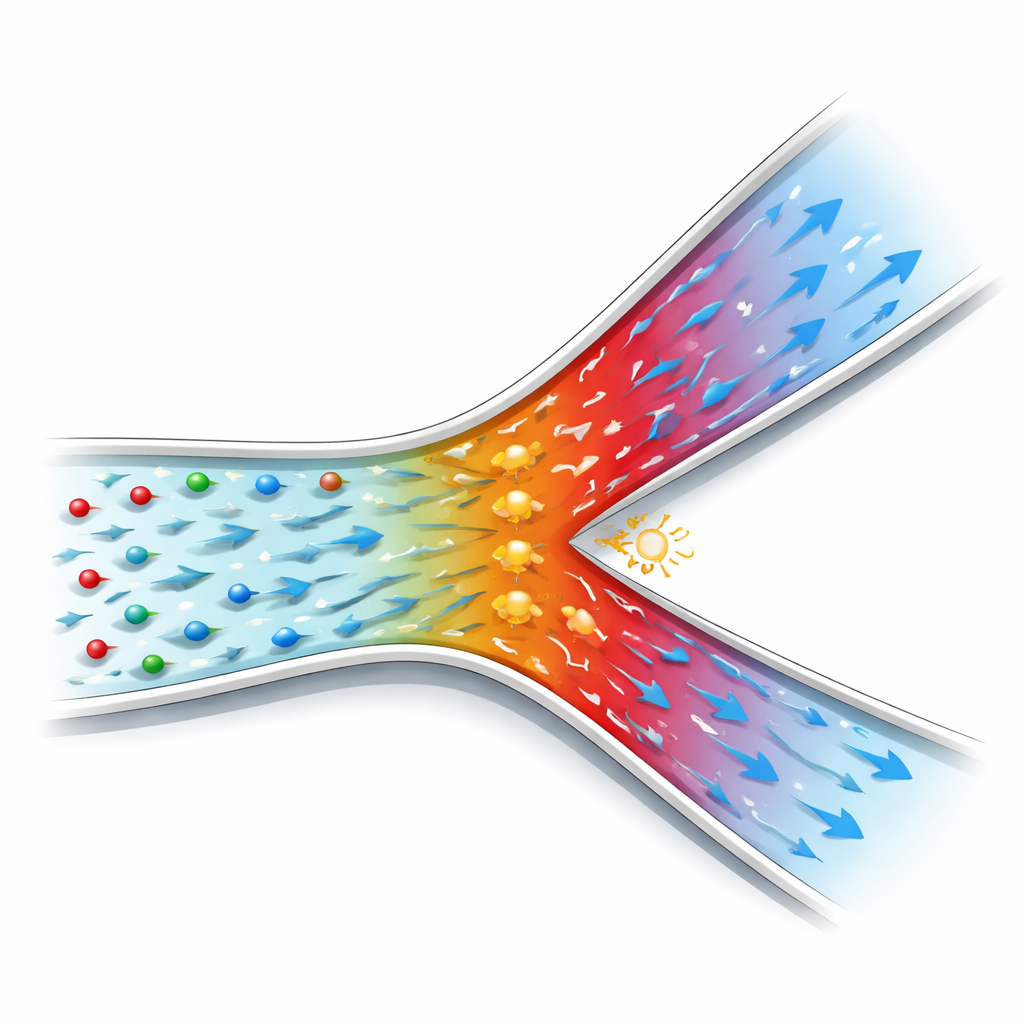
Managing entropy and wall forces
A key aim is to control entropy generation, which signals how much of the input energy is irrevocably lost rather than converted into useful heat transfer. The study finds that entropy can be minimized more effectively in widening channels with shrinking walls and modest levels of viscous heating, while converging sections with strong dissipation tend to produce more disorder. The authors also compute skin friction—the shear drag exerted by the fluid on the walls—and the heat transfer rate at the walls. Adding more nanoparticles increases drag on the elastic walls but, interestingly, reduces the heat carried through the walls, indicating that this particular oxide blend behaves as a strong coolant that keeps wall temperatures down while raising resistance to flow.
Design lessons for compact cooling technologies
For non-specialists, the main message is that both the recipe of a coolant and the shape and flexibility of the channel that carries it can be tuned together to manage heat and energy losses. Ternary nanofluids offer better thermal properties than simpler mixtures, and when combined with converging–diverging geometries and controllable wall motion, they allow engineers to speed up or slow down the flow, intensify or soften heating, and push entropy in a desired direction. These insights point toward more efficient cooling strategies for devices where space is tight and temperature control is critical, from miniature heat exchangers to biomedical fluid systems.
Citation: Jebali, M., Adnan, Mukalazi, H. et al. Entropy and thermal dynamics motivated by ternary nanocomposites and geometric influence of oblique channel. Sci Rep 16, 9444 (2026). https://doi.org/10.1038/s41598-026-38880-2
Keywords: ternary nanofluid, heat transfer, entropy generation, converging-diverging channel, cooling technology