Clear Sky Science · en
Probabilistic calculation formula for the compressive strength of ultra-high-performance concrete with coarse aggregate based on feature engineering and genetic programming
Stronger, Smarter Concrete for the Real World
Modern cities rely on concrete for everything from bridges to high-rise towers. A special class called ultra-high-performance concrete is remarkably strong and durable but also expensive and tricky to design. This study looks at a more affordable version that includes coarse gravel and stone, and proposes a new way to predict how strong it will be before it is poured. By combining laboratory tests with a kind of evolutionary computer search and probability thinking, the authors aim to give engineers a simple yet reliable formula that captures both strength and uncertainty.
Why Tough Concrete Still Needs Better Recipes
Ultra-high-performance concrete owes its reputation to very high strength, toughness, and resistance to harsh environments, but these benefits come at a cost. Much of the price and performance depend on steel fibers and fine mineral ingredients. To make this material more practical for large projects, researchers have developed versions that also use coarser stone, known as coarse aggregate. These mixes are cheaper and still far stronger than ordinary concrete, yet engineers lack a clear recipe book: there is no widely accepted formula that tells them how changes in stone content, stone type, and fiber content will affect compressive strength. Existing studies typically examine just one variable at a time and give only point estimates, without showing how uncertain those predictions might be.
Building a Data-Driven but Transparent Formula
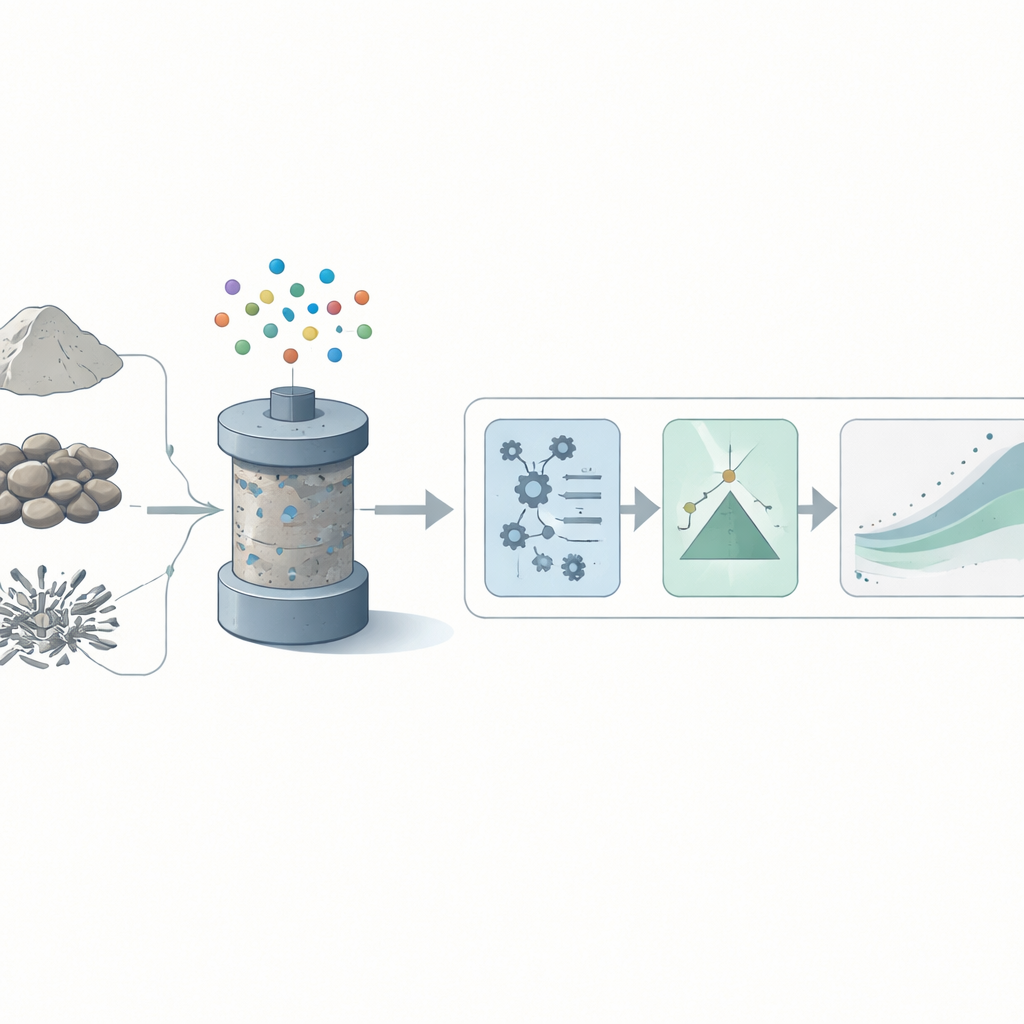
The authors cast and tested 35 sets of cubic specimens made from ultra-high-performance concrete with different amounts and types of coarse stone and varying volumes of steel fibers. All other ingredients were kept fixed to isolate the effects of these three key features. First, they used a neural network as a screening tool to measure how much each ingredient affected strength, finding that steel fiber content mattered most, followed by the total amount of coarse stone, with stone strength and size playing smaller roles. Next, they turned to an approach called genetic programming, in which a computer “evolves” simple mathematical expressions, keeping and refining those that best match the test data. This process produced a compact equation linking compressive strength to three inputs: stone content, stone strength, and fiber volume.
From a Single Number to a Range of Possibilities
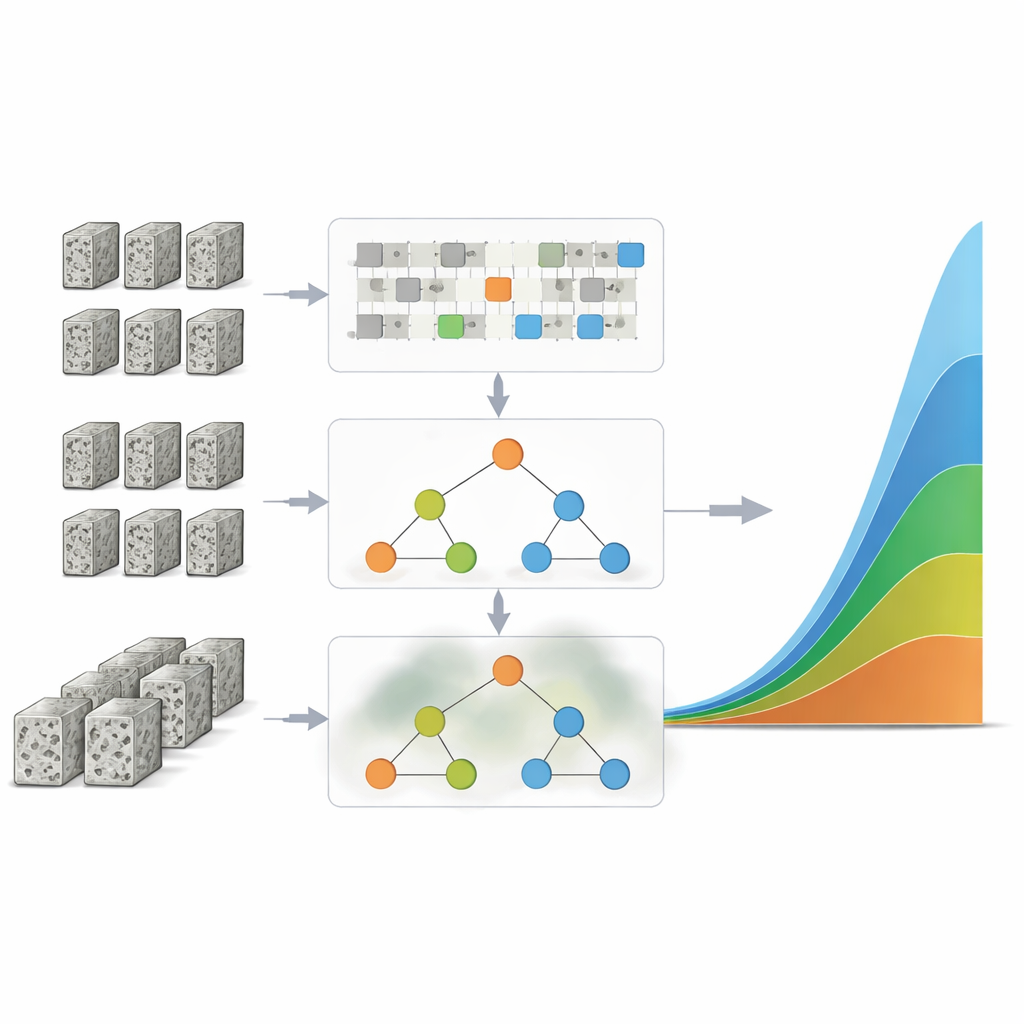
Concrete in practice is never perfectly uniform: raw materials vary, curing conditions differ, and any data-driven model is inevitably trained on a limited set of tests. To capture this real-world fuzziness, the team upgraded their formula into a probabilistic model. Instead of treating the constants in the equation as fixed, they allowed them to vary according to probability distributions and used Bayesian updating and Monte Carlo sampling to infer these distributions from the test results. The outcome is that, for any chosen combination of stone and fiber contents, the model does not just output a single strength value. It delivers a full distribution and confidence interval—narrow for more certain predictions and wider where the data or behavior are less settled.
What Controls Strength and How Factors Interact
With this probabilistic formula in hand, the researchers explored how the ingredients work together. Within the tested range, more coarse stone generally increases strength, and this trend can be approximated as nearly linear, even though it is mathematically exponential. Replacing weaker limestone with stronger basalt stone raises strength, but by only a few megapascals compared to the much larger gains from adding steel fibers. Fiber content shows a rapid-payoff pattern: strength climbs quickly as fibers are first added, then continues to rise but at a slower pace. The analysis also reveals that increasing one favorable factor (such as fiber content) amplifies the positive effect of the others (such as stone content or stone quality), with fibers exerting the strongest amplifying influence.
Why Uncertainty Grows with Strength
An intriguing finding is that higher predicted strengths tend to come with greater uncertainty. As stone content, stone strength, or fiber volume increase, not only does the mean predicted compressive strength go up, but the spread of the confidence interval widens as well. In practice, this means that the most ambitious, highest-strength mixes require the greatest caution and safety margins. The authors argue that pairing a clear, compact equation with explicit uncertainty bands offers a practical framework for designing ultra-high-performance concretes with coarse aggregate. Engineers can read off not just a target strength but also a conservative “design value” taken from the lower bound of the predicted range, helping them balance performance, cost, and reliability in real projects.
Citation: Guo, R., Niu, J., Li, D. et al. Probabilistic calculation formula for the compressive strength of ultra-high-performance concrete with coarse aggregate based on feature engineering and genetic programming. Sci Rep 16, 8458 (2026). https://doi.org/10.1038/s41598-026-38878-w
Keywords: ultra-high-performance concrete, compressive strength, coarse aggregate, steel fibers, probabilistic modeling