Clear Sky Science · en
Development of a controlled ex vivo human skin platform for quantitative evaluation of age-related functional biomarkers following application of topical treatments
Why this matters for everyday skin care
Many people reach for creams and serums that promise to slow skin aging, but it is surprisingly hard for scientists to test whether these products really protect or repair human skin. Most lab models do not look or behave like real skin, and they often ignore differences in age or skin tone. This study introduces a new way to test anti-aging products using real donated human skin kept alive in the lab, and shows how one particular ingredient, a special form of zinc oxide, can help skin bounce back after strong ultraviolet (UV) light exposure.
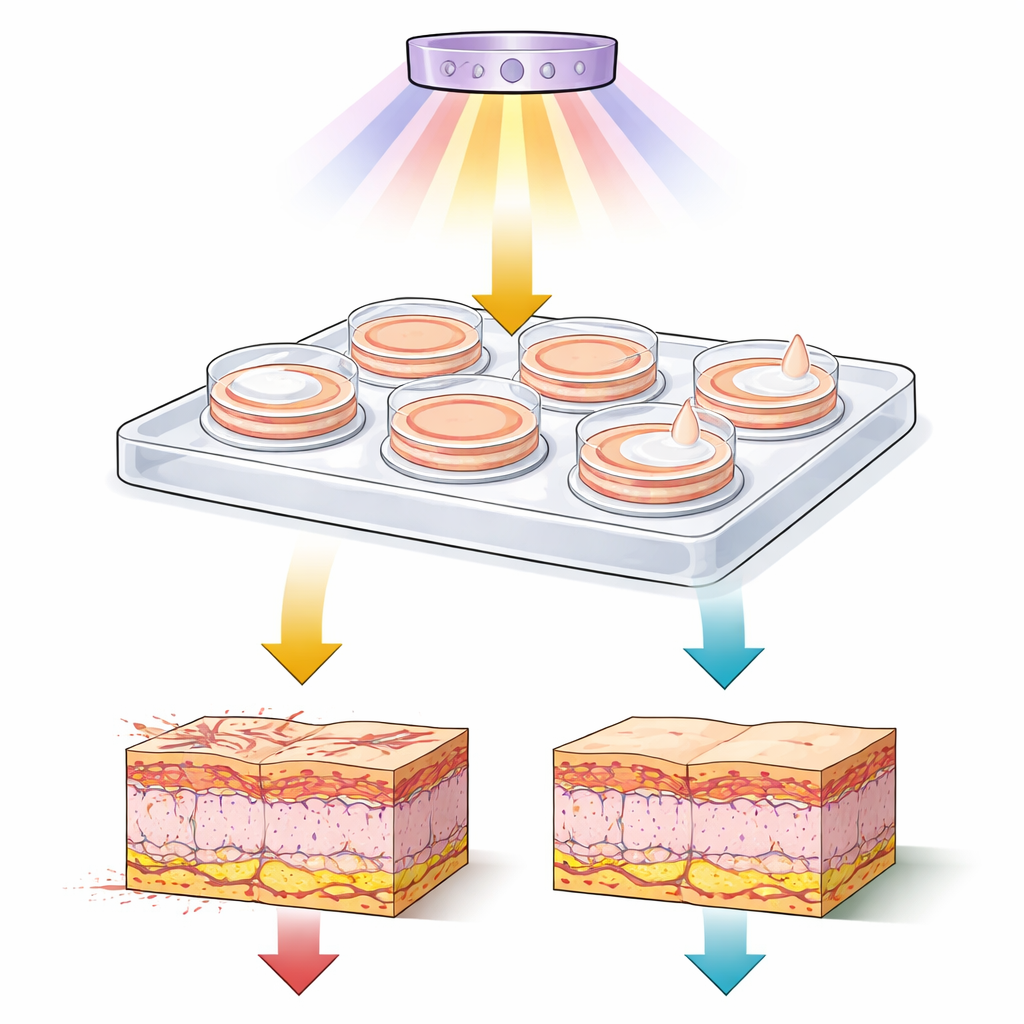
A closer look at how skin ages
Skin ages for two main reasons: built-in biological changes over time and daily wear and tear from the environment. UV light from the sun is one of the biggest external culprits. It gradually pushes skin cells into a stressed, “retired” state where they stop dividing, release irritant molecules, and weaken the structural support that keeps skin firm and smooth. Scientists can track this hidden damage by measuring certain proteins inside the tissue that rise when cells are stressed or inflamed. Among the most informative are p53 and p16, which respond to different kinds of cellular strain, and IL-1β, a signal tied to skin irritation and redness.
Building a realistic lab version of human skin
To study these changes in a realistic way, the researchers worked with full-thickness pieces of human skin removed during surgery and donated for research. These small disks of tissue kept their normal layers, cell types, and supporting fibers, and came from adults of different ages and Fitzpatrick skin types, from lighter to darker tones. In the lab, the team exposed these skin samples to carefully controlled doses of UVA and UVB light chosen to mimic strong sun exposure without killing the tissue. They then added topical treatments either just before the UV light, to test prevention, or right after, to test repair. Over the next several days, they measured stress and aging signals in the tissue and examined thin stained slices under the microscope to see how the structure changed.
Testing new and existing anti-aging ingredients
The study compared three kinds of topical agents: an engineered nanodiamond zinc oxide (ND-ZnO), the antioxidant N-acetylcysteine (NAC), and preparations containing tiny packets released by cells called exosomes. ND-ZnO and NAC lowered the levels of the aging-related proteins p53 and p16 after UV exposure, with ND-ZnO consistently outperforming NAC, especially when applied after damage had already occurred. ND-ZnO and the exosome preparation both reduced the inflammatory signal IL-1β in skin from donors with different ages and skin tones, but again ND-ZnO showed stronger effects. Under the microscope, skin treated with ND-ZnO kept a more normal appearance: the upper layer stayed better organized, the collagen fibers in the deeper layer remained more orderly, and signs of inflammation were reduced compared with untreated, UV-damaged samples.
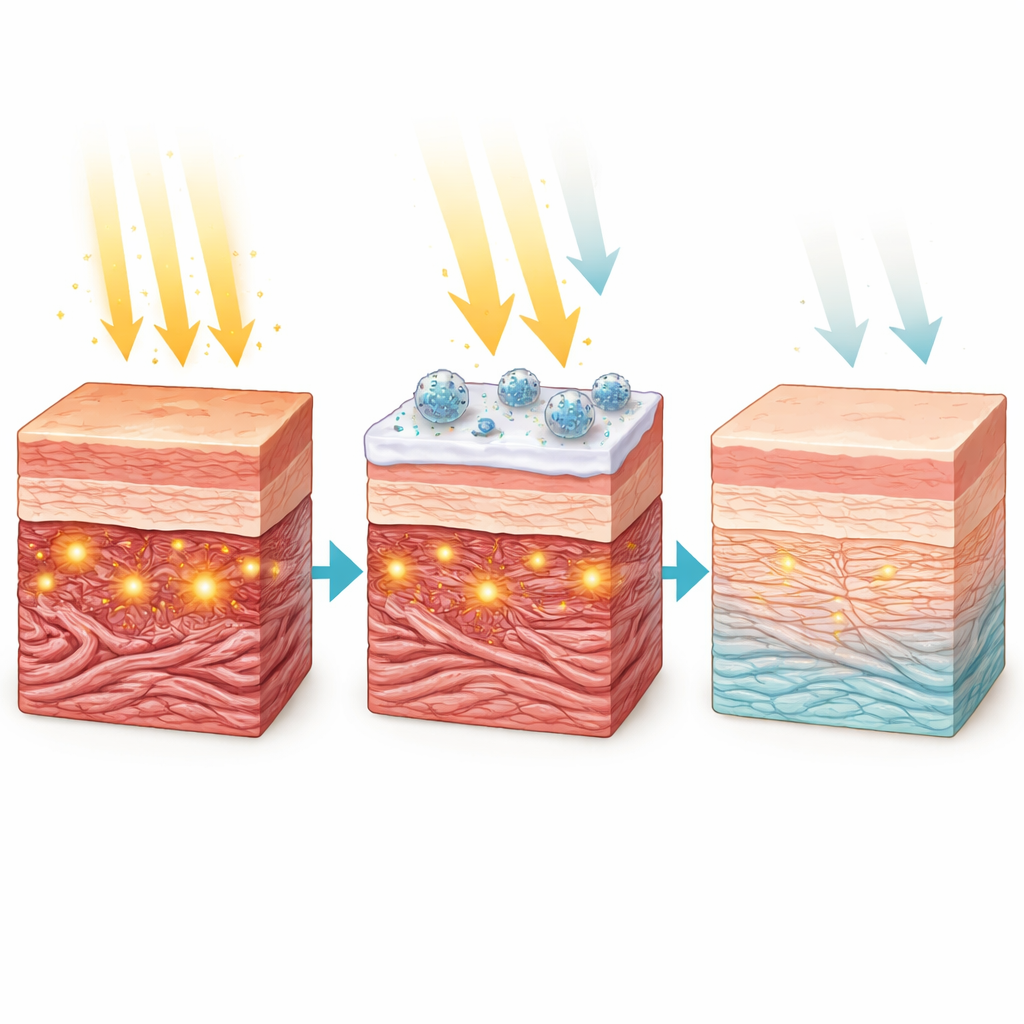
Connecting lab results to visible changes
To see whether these lab findings might translate to real-world results, the researchers ran a small, four-week case study in a single person who applied an ND-ZnO cream to the face once a day. Standardized photographs taken before and after the test period showed less surface redness and more even tone, especially on the cheeks and around the mouth. While one person is far from enough to prove broad effectiveness, the visible improvements matched the patterns seen in the lab model: less inflammation and better preservation of skin structure after UV-like stress.
What this means for future skin treatments
Overall, the work shows that carefully maintained pieces of real human skin can serve as a powerful test bed for anti-aging products, capturing both hidden molecular changes and visible structural damage across different ages and skin tones. Within this system, the nanodiamond zinc oxide ingredient stood out for its ability to dampen stress signals and preserve tissue architecture after intense UV exposure, likely by reducing harmful reactive molecules and helping maintain collagen. For lay readers, the takeaway is that more realistic lab models like this can help distinguish which topical products truly support skin health and resilience, and they can do so in a way that better reflects the diversity of human skin.
Citation: Zhang, X.D., Atalla, N., Rodriguez, E. et al. Development of a controlled ex vivo human skin platform for quantitative evaluation of age-related functional biomarkers following application of topical treatments. Sci Rep 16, 8124 (2026). https://doi.org/10.1038/s41598-026-38877-x
Keywords: skin aging, UV damage, topical treatments, zinc oxide, human skin models