Clear Sky Science · en
Rivers constrain female but not male dispersal and genetic structure in brown bears
Why rivers matter for roaming bears
As human activity carves up wild landscapes, many large animals struggle to move freely between the pockets of habitat that remain. This study asks a deceptively simple question with big implications for conservation: do rivers in northern Sweden stop brown bears from finding food, mates, and new territories—and do males and females respond to these watery barriers differently?
Connecting the bear family tree
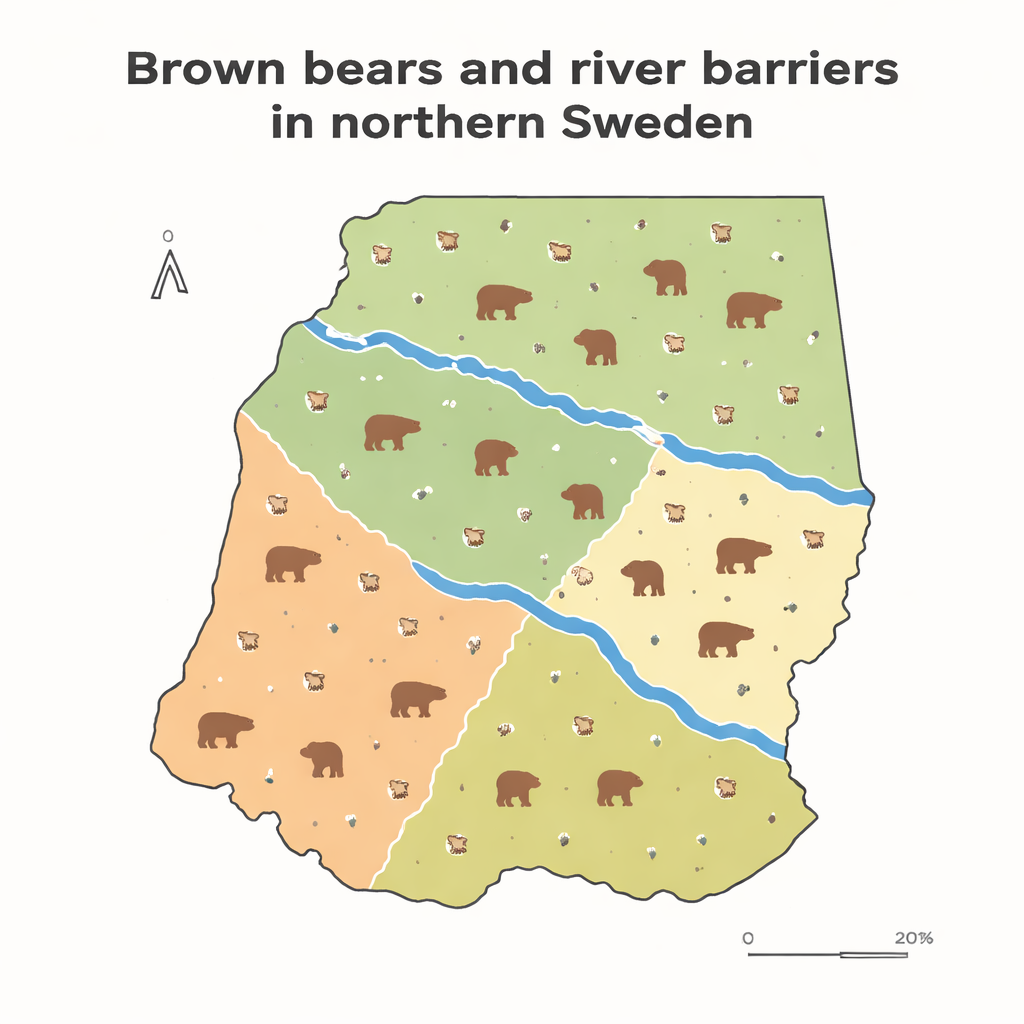
To tackle this, researchers turned to an unusual kind of detective work: DNA left behind in bear droppings. Hunters and other citizens collected fecal samples across Västerbotten County, a large region of northern Sweden naturally sliced into four areas by three major rivers. From these samples, scientists built genetic profiles for 519 individual bears and identified close relatives—pairs such as parents and offspring or full siblings. By measuring how far apart related bears were found, they could estimate how far individuals had moved from where they were born or once lived, without needing to follow them with radio collars.
How far and how often bears cross rivers
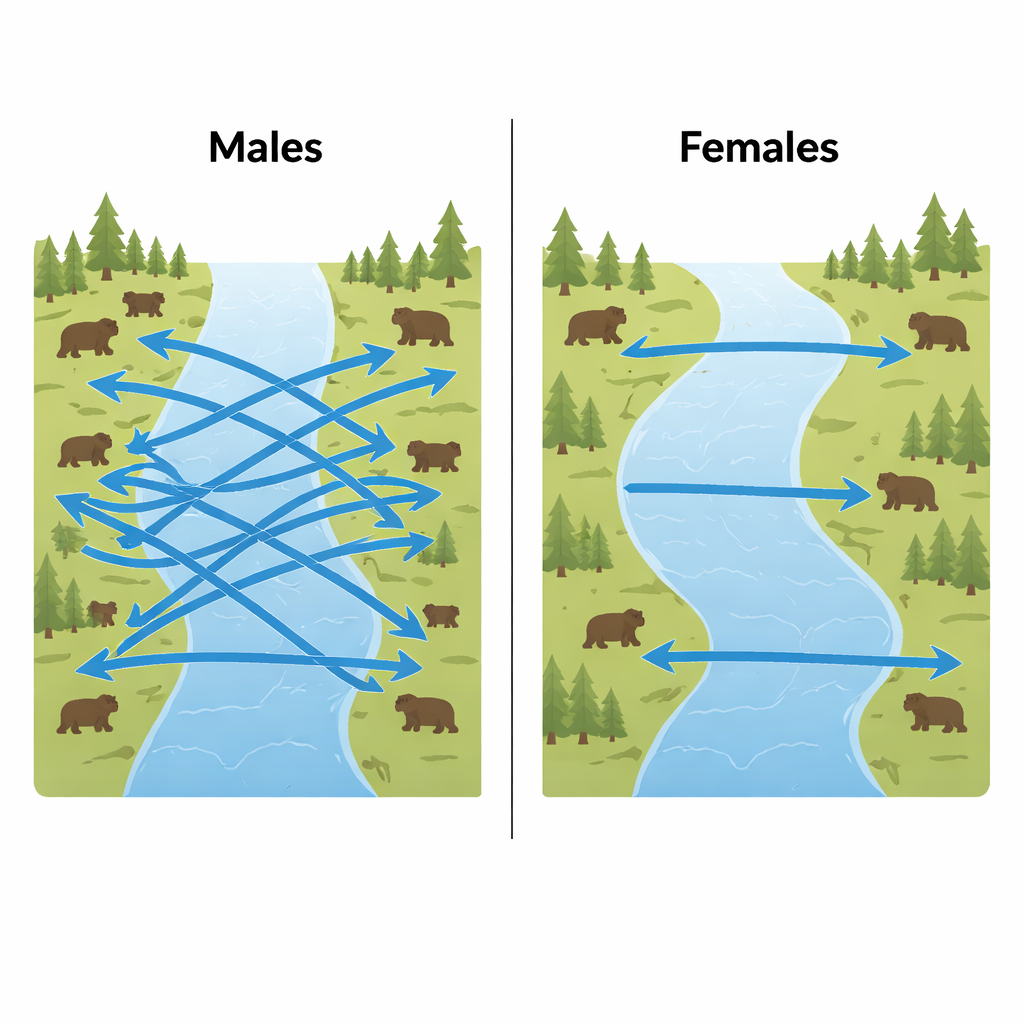
The genetic map revealed a clear divide between the sexes. Male bears had typically moved more than twice as far as females (about 56 kilometers for male pairs versus 23 kilometers for female pairs), and their movements much more often involved crossing at least one river. Around 42 percent of male–male dispersal events included a river crossing, compared with just 11 percent for female–female pairs. Some male-linked movements even spanned two or all three rivers, but none of the female-linked movements crossed more than one. A smaller set of bears that were sampled at multiple locations over time showed the same tendency: males were nearly three times as likely as females to have crossed a river, even though the sample was too small for this pattern alone to be statistically conclusive.
Not just shorter trips for females
One simple explanation might be that females rarely reach rivers because they travel less. To probe this, the team ran simulations where female movements kept their real-world distances but were assigned random directions. In these virtual scenarios, females should have crossed rivers more often than they actually did. The fact that real females crossed less than expected suggests that they are not just moving shorter distances; they are also actively avoiding directions where they would need to cross rivers. When the researchers examined movement angles, male movements were essentially random with respect to the rivers, while females were less likely to move perpendicular to river courses—the directions that would force a crossing.
Subtle imprints on the bear gene pool
If rivers slow or divert movement, they may gradually leave a fingerprint in the genetic makeup of the population. Using statistical tools that look for clusters of genetically similar individuals across space, the researchers found almost no river-related genetic pattern in males. Their genes were well mixed across the four regions, consistent with frequent male crossings. Females told a slightly different story. Their genetic variation changed gradually from southwest to northeast—roughly across the rivers—though not in sharp steps that lined up exactly with river channels. Females from the far north were somewhat more distinct from those farther south, hinting that rivers act as partial, not absolute, barriers for them.
What this means for bears and conservation
Put simply, the study shows that in northern Sweden, rivers do little to stop roaming male brown bears, but they noticeably slow or deflect females. Females tend to stay closer to where they were born and likely avoid risky crossings, especially when raising cubs that could struggle with strong currents. Over time, this behavior can reinforce mild genetic differences between areas, even as male movements keep the overall population well connected. For wildlife managers, the message is that specific river crossings—such as shallow sections or dams—may be especially important for maintaining female movements and genetic exchange. Understanding where and how females cross, and how rivers interact with other obstacles like roads, will be crucial for designing conservation strategies that keep bear populations healthy and resilient in a landscape increasingly shaped by people.
Citation: Spitzer, R., Norman, A.J., Schneider, M. et al. Rivers constrain female but not male dispersal and genetic structure in brown bears. Sci Rep 16, 5581 (2026). https://doi.org/10.1038/s41598-026-38870-4
Keywords: brown bears, wildlife connectivity, river barriers, animal movement, conservation genetics