Clear Sky Science · en
Nano-silicon enhances drought tolerance, yield stability, and bio-active compounds in Lallemantia iberica under water deficit conditions
Why Tiny Minerals Matter for Thirsty Plants
As climate change makes droughts more common, farmers and herbal producers face a tough question: how can they keep crops alive and productive with less water? This study looks at an emerging solution that uses ultra-tiny particles of silicon, a mineral found in sand, to help a medicinal plant called Lallemantia iberica stay healthier, yield more seeds, and maintain its valuable oils when water is scarce. The work offers a glimpse of how nanotechnology could support more resilient and sustainable agriculture in dry regions.
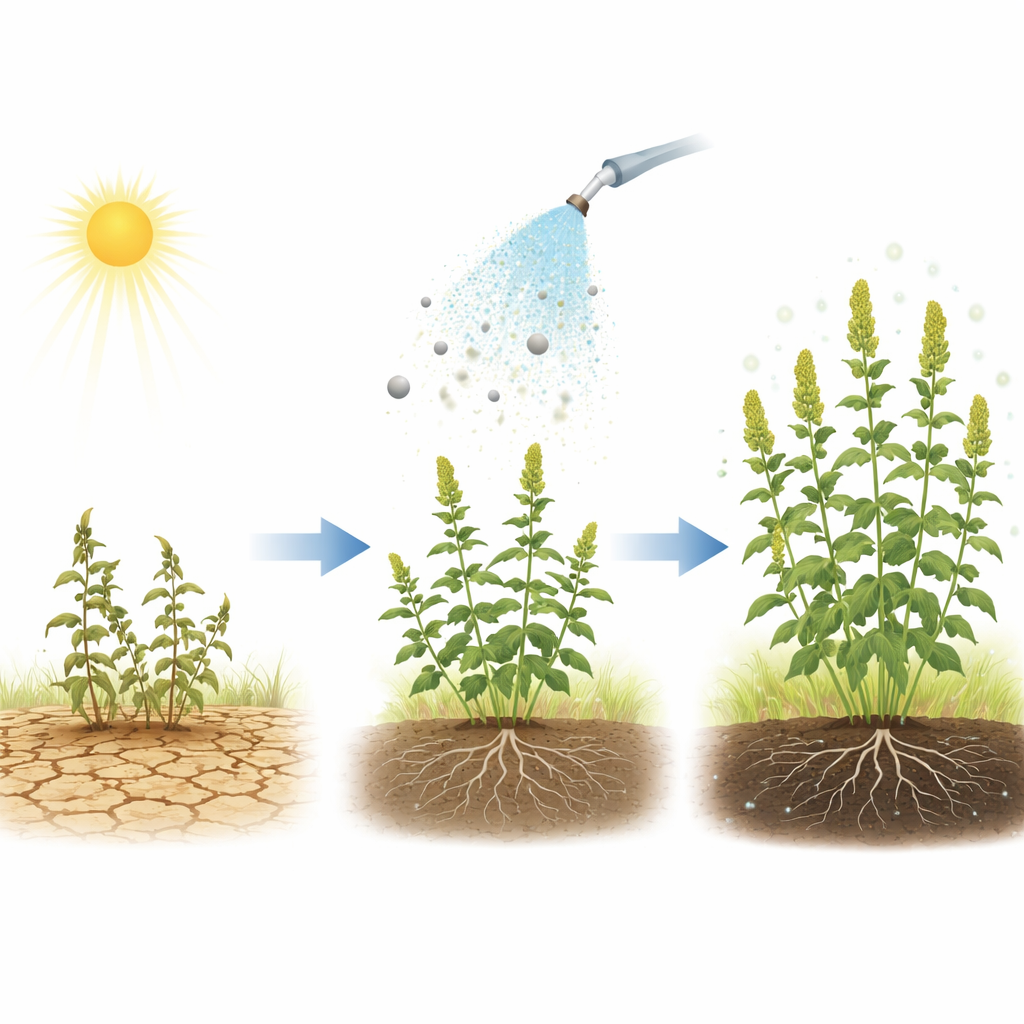
Dry Times for a Medicinal Seed Crop
Lallemantia iberica, sometimes grown for its mucilaginous seeds and aromatic oils, is particularly sensitive to drought. When water is limited, these plants grow less, photosynthesize less, and produce fewer bioactive compounds that give them their medicinal value. In this greenhouse experiment, researchers grew the plants under well-watered conditions or under a moderate but long-lasting water shortage, mimicking the kind of stress common in semi-arid farming areas. They then asked whether spraying the leaves with either conventional silicon powder or much smaller nano-silicon particles could soften the blow of drought.
How Nano-Silicon Was Put to the Test
The team set up four groups of plants: a well-watered control, drought-stressed plants with no spray, drought-stressed plants sprayed with nano-silicon, and drought-stressed plants sprayed with regular, larger-particle silicon. All plants were grown in identical pots and soil in a carefully controlled greenhouse. Drought was imposed by keeping soil moisture at about half of the level considered fully watered. Every three days during the stress period, the sprayed plants received a fine mist containing either nano-sized silicon or bulk silicon at the same concentration. After four weeks, when the plants showed stable signs of drought stress, the researchers measured growth, water status, leaf greenness, seed yield, oil yield, and several chemical markers linked to stress protection.
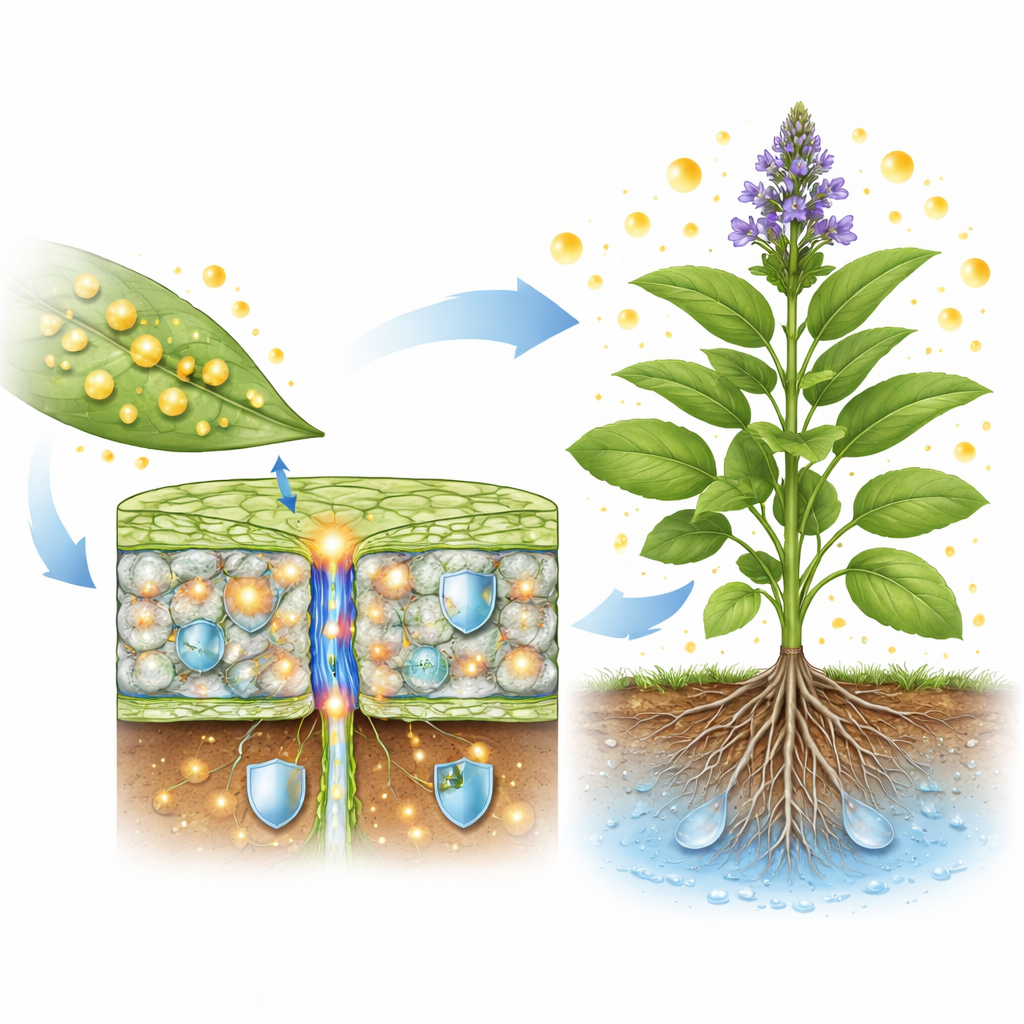
Stronger Growth, Greener Leaves, and Better Water Use
Drought alone sharply reduced plant height, root length, and overall dry weight, and it lowered the efficiency of photosynthesis. Leaves became less green, indicating loss of chlorophyll. Applying nano-silicon under these dry conditions reversed much of this damage: compared with unsprayed droughted plants, biomass roughly doubled, shoots and roots grew almost twice as long, and photosynthetic performance improved strongly. The plants also managed water better. Measures of relative water content and leaf water potential showed that nano-silicon helped plants hold onto moisture and avoid the severe internal water deficits typical of drought. As a result, water-use efficiency—how much plant material is produced per unit of water—rose dramatically and was closely tied to higher yields.
Boosting the Plant’s Internal Defense System
Drought does more than just dry plants out; it also triggers reactive oxygen molecules that can damage cells. Plants normally rely on antioxidant enzymes and protective compounds to keep this damage in check. In this study, drought reduced both the activity of key enzymes and the levels of phenolic and flavonoid compounds that contribute to antioxidant defense. Nano-silicon turned this pattern around. Treated plants showed markedly higher activity of several protective enzymes and much greater amounts of antioxidant compounds than droughted plants without nano-silicon. These internal defenses were closely linked with better growth, better water status, and sustained production of essential oils, suggesting that nano-silicon helps plants coordinate water management and chemical protection rather than changing a single trait in isolation.
What This Could Mean for Farmers and Herbal Producers
For growers of medicinal plants in dry climates, the findings are encouraging: foliar sprays of nano-silicon helped Lallemantia iberica stay greener, grow more, and produce more seeds and essential oils, even when water was limited. The nano form clearly outperformed regular silicon at the same dose, likely because its tiny size makes it easier for plants to absorb and use. However, the work was done in pots under greenhouse conditions, not in open fields with complex soils and changing weather. Before nano-silicon can be widely recommended, researchers will need to test how long it persists in soil, how it interacts with microbes and other organisms, and whether it remains safe and cost-effective at farm scale. Still, this study points to a promising tool: using very small particles of a common mineral to help crops endure big stresses.
Citation: Vafa, Z.N., Sohrabi, Y., Barasarathi, J. et al. Nano-silicon enhances drought tolerance, yield stability, and bio-active compounds in Lallemantia iberica under water deficit conditions. Sci Rep 16, 8127 (2026). https://doi.org/10.1038/s41598-026-38869-x
Keywords: drought tolerance, nano-silicon, medicinal plants, water-use efficiency, essential oils