Clear Sky Science · en
Emergence and spread of Aedes albopictus in northern Iran with risk assessment and habitat hotspot analysis in Mazandaran Province
Why a new mosquito matters to everyday life
Most of us think of mosquitoes as a summertime nuisance, but some species are capable of carrying serious viruses such as dengue, chikungunya and Zika. This study reports the first establishment of the Asian tiger mosquito, Aedes albopictus, in Mazandaran Province in northern Iran, a popular tourist and trade hub on the Caspian Sea. Because this mosquito thrives in small pockets of water around homes and in city trash, understanding where it is spreading and which neighborhoods are at greatest risk is essential for protecting public health.
A new arrival along the Caspian coast
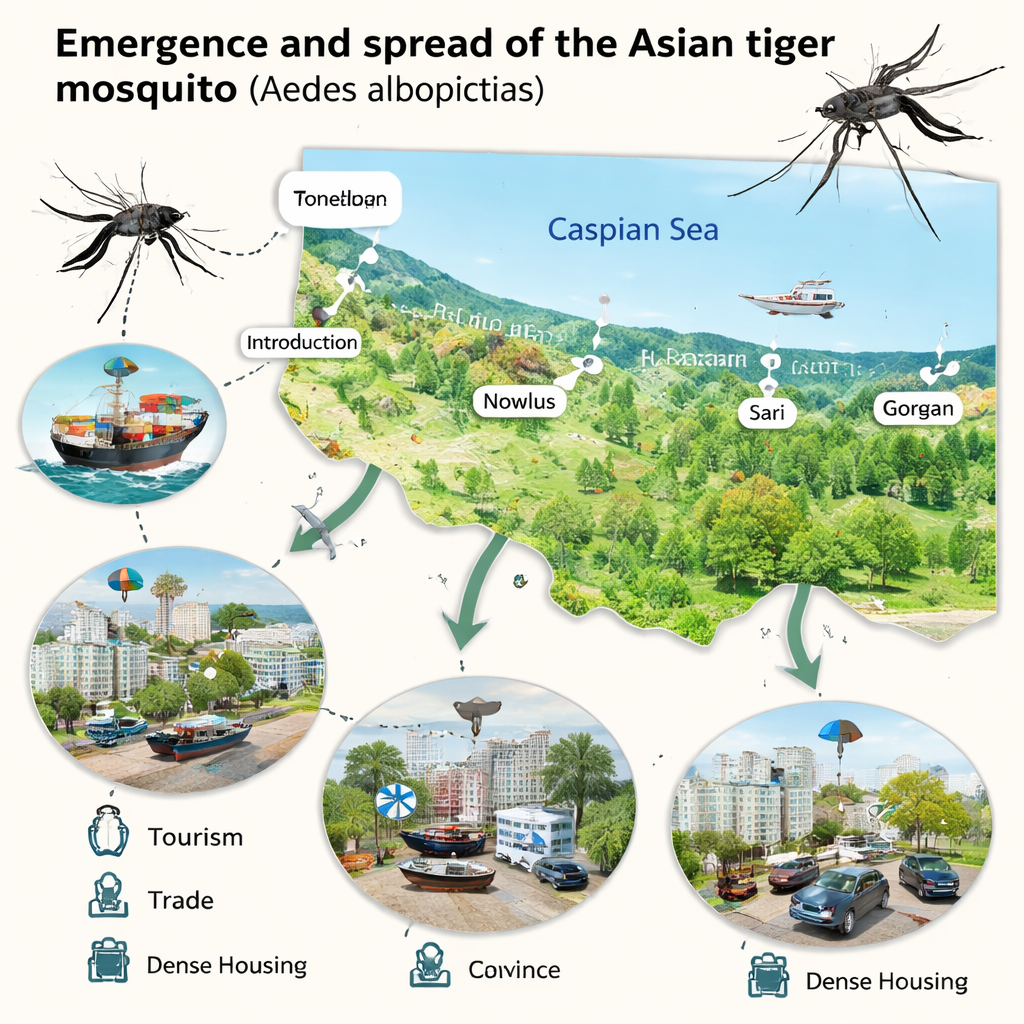
Mazandaran’s warm, humid climate, dense coastal towns, busy roads and ports make it an inviting gateway for invading insects. The researchers launched intensified mosquito surveillance across ten counties from early 2024 to mid‑2025. Using egg traps, netting of adult mosquitoes landing on human volunteers, and sampling of standing water, they searched places like hotels, transport hubs and residential areas. On June 27, 2024, they confirmed Aedes albopictus in the yard of a hotel in Ramsar County. Soon after, the species was detected at dozens of outdoor sites across Ramsar, Tonekabon, Abbasabad, Chalus, Nowshahr, Nur, Mahmudabad, and later Babolsar and Fereydunkenar, revealing that the mosquito was no longer a rare visitor but had begun to spread along the coastal belt.
Hunting for hidden water pockets
To find out how easily this mosquito could multiply, the team carried out an exploratory survey of potential larval habitats during the summer of 2024. They systematically walked selected city blocks chosen for busy travel, tourism, crowding and priority in control plans. In every yard, street edge and vacant lot they recorded objects that could hold rain or tap water long enough for mosquito larvae to develop. In total they cataloged 80 different habitat types across more than 8,000 observations—from tree holes and animal troughs to discarded tires, broken boats and construction debris. By far the most common sites were disposable plastic containers, plastic bottle caps and plastic bags, usually concentrated in cluttered urban areas.
Trash, towns and rain as risk drivers
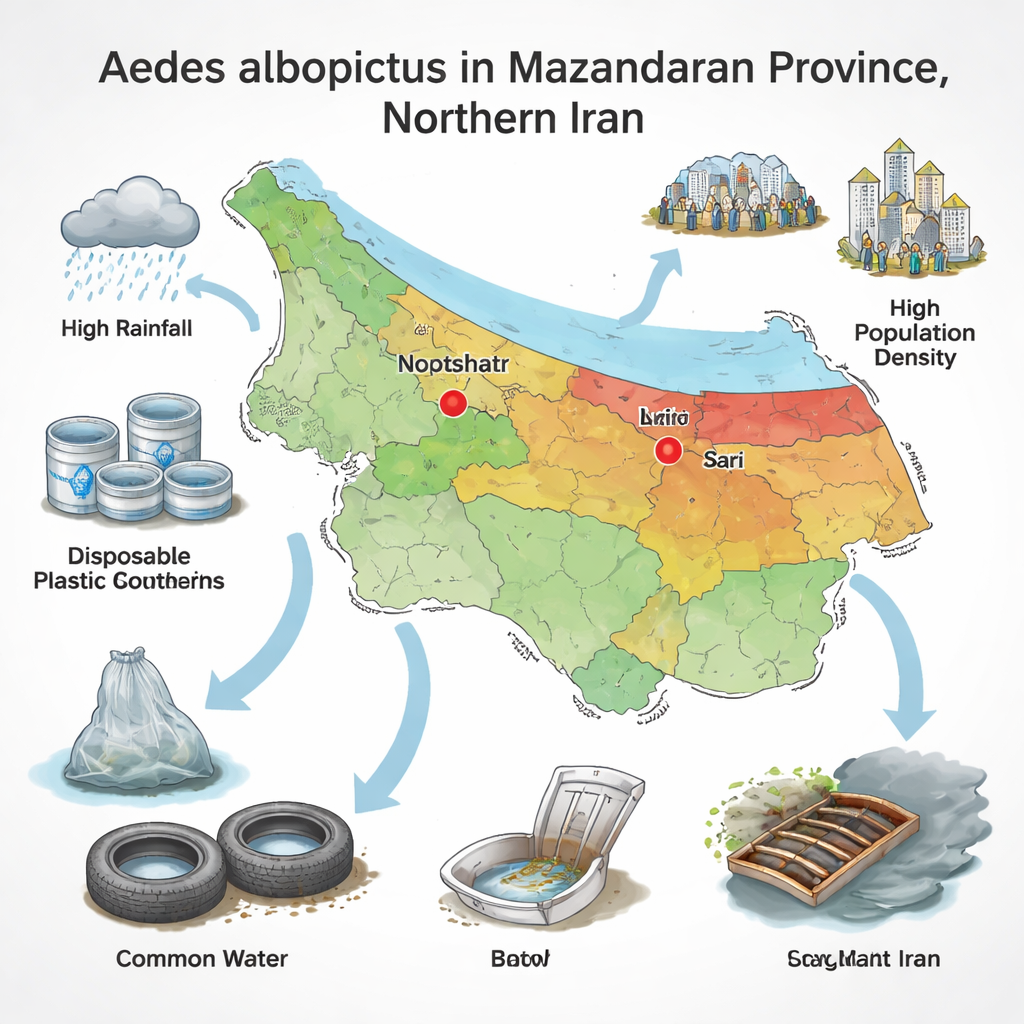
Using statistical tools and digital maps, the scientists then looked for patterns linking environment, people and mosquito habitats. They grouped counties into three risk clusters. Nur, with cooler temperatures, less rainfall and fewer breeding sites, fell into a low‑risk group. A second cluster of counties, including Amol and Babolsar, had warmer, wetter weather, high humidity and large, dense populations, putting them at moderate risk. A third cluster—Chalus, Ramsar, Tonekabon, Abbasabad and Nowshahr—combined heavy rainfall, very high humidity and many types of water‑holding containers, creating a clearly high‑risk profile. Further analysis showed that more people and more rain were strongly associated with a higher number of potential breeding sites, while strong winds and higher average temperatures tended to reduce them.
Mapping the mosquito’s favorite neighborhoods
To move from broad risk categories to street‑level priorities, the team applied a hotspot mapping technique that highlights areas where breeding sites cluster unusually tightly. This approach identified Chalus, Babolsar and Amol as statistically significant hotspots for Aedes albopictus habitats. In these places, littered plastic cups, bottle caps, bags and other small containers were frequently found holding water, often because of poor waste disposal, leaking pipes or careless watering. More than sixty percent of all potential habitats in the survey were linked to household and urban waste, underlining how everyday habits—like throwing a cup in a vacant lot or leaving a broken bucket in the yard—can quietly fuel mosquito populations.
What this means for communities
For residents and local officials, this study delivers a clear message: the arrival of the Asian tiger mosquito turns poorly managed trash and tiny puddles of water into stepping stones for possible future outbreaks of dengue‑like diseases. By pinpointing where the mosquito is already present and which counties and neighborhoods host the most breeding sites, the work gives health authorities a roadmap for targeted action. Simple measures—regular clean‑up campaigns, better waste collection, covering or removing water‑holding containers, and ongoing mosquito monitoring—can dramatically cut down breeding opportunities. In short, the study shows that managing household waste and standing water is not just about tidiness; in Mazandaran, it is now a frontline defense against emerging mosquito‑borne disease.
Citation: Nikookar, S.H., Cherati, J.Y., Charkame, A. et al. Emergence and spread of Aedes albopictus in northern Iran with risk assessment and habitat hotspot analysis in Mazandaran Province. Sci Rep 16, 7780 (2026). https://doi.org/10.1038/s41598-026-38865-1
Keywords: Aedes albopictus, mosquito-borne disease, dengue risk, urban waste and mosquitoes, Mazandaran Iran