Clear Sky Science · en
Integrating species distribution modeling and climate projections to predict ant species redistribution
Why ants on a mountainside matter
Ants may be small, but they quietly hold ecosystems together: they move seeds, recycle nutrients, and help control other insects. This study asks a big question with these tiny creatures as guides: as the climate warms and rainfall patterns shift, where will key ant species in central Iran be able to live in the coming decades, and what does that mean for the health of dryland forests, grasslands, and farmlands?
A living laboratory in the highlands
The research takes place in a vast transition zone between the central Zagros Mountains and the Gavkhouni Lake basin. In this region, low, dry plains give way to mid‑elevation shrublands and then to cooler, oak‑dotted highlands. The authors focused on five common but ecologically important ant species that span this gradient, from heat‑loving desert foragers to moisture‑seeking woodland dwellers. Because these habitats lie side by side along steep slopes, they offer a natural testbed for seeing how different ants respond to the same changing climate in different ways.
Using computers to follow future ants
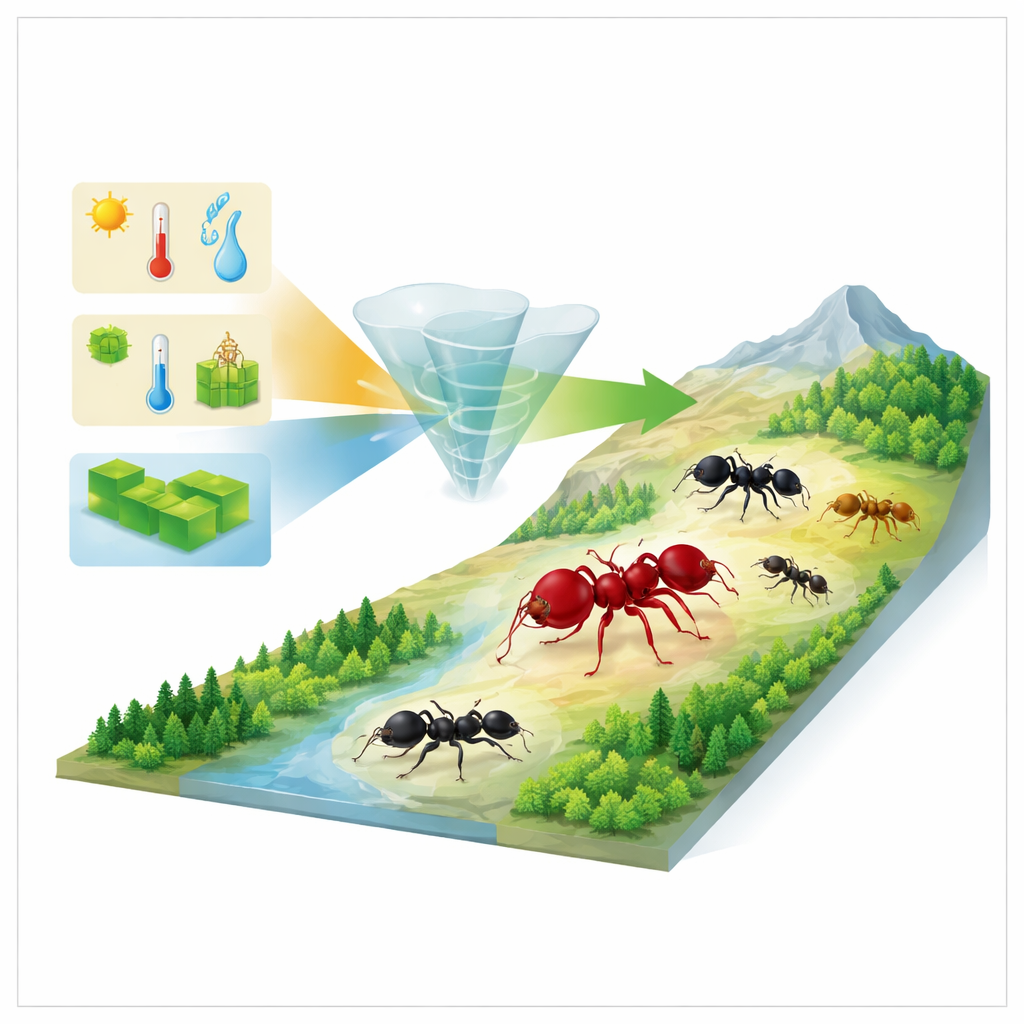
To peer into the future, the team combined detailed field surveys of ant nests (with true records of both presence and absence) with modern “species distribution models.” These computer models learn how current ant locations relate to factors such as temperature, rainfall, elevation, and satellite‑measured plant cover, then project where conditions will be suitable later in this century. The study used an ensemble of five machine‑learning approaches, with a boosted model giving the most accurate predictions. Importantly, the researchers did not treat vegetation as fixed: they first predicted how plant greenness (which shapes shade, soil moisture, and food) will change under four standard climate pathways, then fed those shifting vegetation maps into the ant models.
Winners climbing up, losers squeezed out
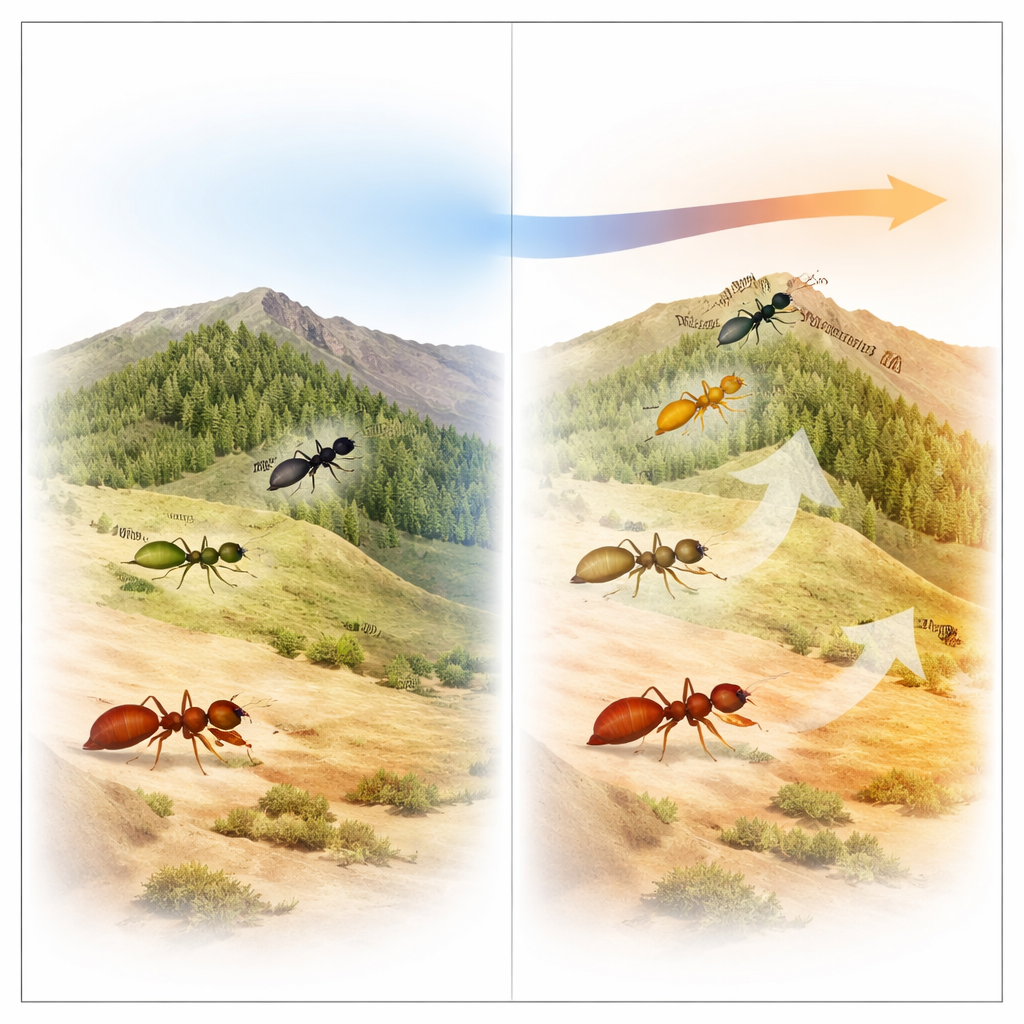
The projections reveal that climate change does not treat all ants equally. One desert‑adapted species, Cataglyphis nodus, and the seed‑harvester Messor platyceras tend to become “winners,” gradually broadening the range of conditions they can tolerate and potentially expanding into new areas, especially higher elevations that become warm enough for them. In contrast, Crematogaster subdentata remains a strict specialist tied to moist, vegetated sites and loses habitat across most scenarios, making it a clear “loser.” Lasius neglectus shows strong shrinkage of suitable area, while slightly relaxing its demands for rainfall, and Messor syriacus changes the least, hanging on as a cautious “persister.”
Mountains and plants as climate safety nets
Underlying these different fates are two powerful protective forces: elevation and vegetation. As lowlands grow hotter and drier, many suitable habitats shift upslope, turning high ridges and cool valleys into climate refuges. At the same time, patches of dense vegetation—captured by a satellite index of plant greenness—create local pockets of shade and moisture that buffer ants from harsh conditions. For moisture‑dependent species, these green patches matter as much as the overall amount of rain, helping explain why some ants can persist even as regional climates become more arid.
What this means for people and protection
Because ants are sensitive and easy to monitor, their shifting ranges offer early warning of deeper changes in dryland ecosystems that support local communities. The study concludes that conservation cannot focus only on today’s reserves or on single sites. Instead, it urges protecting continuous elevation corridors, maintaining and restoring vegetated microhabitats, and planning for different futures under low and high emission scenarios. In simple terms, keeping mountain slopes connected and leafy will give both “winner” and “loser” ants—and the many services they provide—a fighting chance as the climate of central Iran transforms over the coming decades.
Citation: Khalili-Moghadam, A., Tahmasebi, P. Integrating species distribution modeling and climate projections to predict ant species redistribution. Sci Rep 16, 8227 (2026). https://doi.org/10.1038/s41598-026-38860-6
Keywords: climate change, ant biodiversity, species distribution models, Iran Zagros mountains, conservation planning